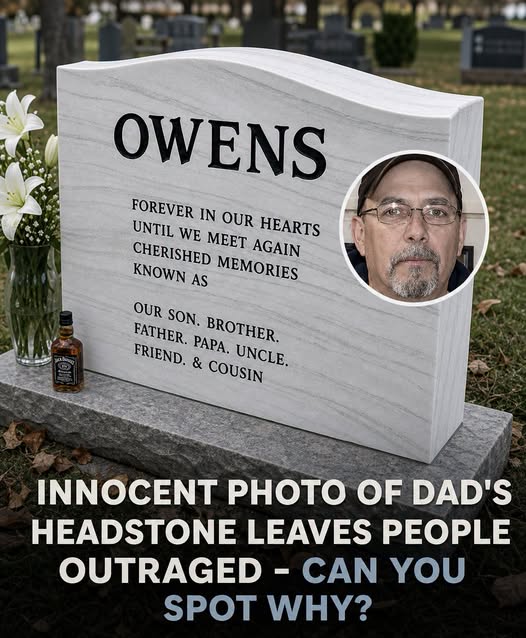
A quiet grave. A simple epitaph. Then someone noticed the secret.
At first glance, Steven Paul Owens’ headstone looked completely ordinary. Nothing about the carefully arranged lines seemed unusual. It was only after someone read the inscription differently that the hidden message emerged.
The first letters of each line spelled out a profanity.
It was not an accident. It was a final inside joke from a family deep in grief, a coded message designed to make the people who knew Steven best smile even in the middle of their loss.
They said it was exactly what he would have wanted.
For the Owens family, the hidden acrostic was never meant to shock strangers or offend an entire community. It was something much more personal: a final shared laugh with a man whose sense of humor had helped carry his family through difficult years.
The profanity was private in spirit, even though it had been carved into stone.
A tiny joke.
A permanent goodbye.
But once a photograph of the headstone began circulating online, the private family moment became public property. People who had never met Steven suddenly had opinions about how he should be remembered.
Some found the inscription hilarious.
Others called it disrespectful.
And cemetery officials were not laughing.
They reportedly raised concerns about decorum, the presence of children, and what they described as community standards. They wanted the family to alter the stone, arguing that a cemetery was a shared public space rather than a place where anything could be permanently displayed.
The Owens family refused to back down.
To them, changing the headstone would mean removing something essential about Steven simply because strangers found it uncomfortable.
Supporters rallied behind them, arguing that grief is deeply personal and that families should have considerable freedom when deciding how to remember someone they loved.
Why should a final memorial have to sound formal and respectable if the person being remembered never lived that way?
Why should a private joke disappear simply because someone outside the family does not understand it?
The controversy quickly became larger than one headstone.
It became an argument about memory itself.
A cemetery represents permanence. Once words are carved into stone, they are meant to outlast the people who chose them. But that permanence also creates a strange conflict: the family knows the person behind the inscription, while everyone else sees only the words.
The Owens family saw Steven.
The cemetery saw a rule.
The internet saw a controversy.
And somewhere between those three perspectives was the man himself — remembered by the people closest to him not as a perfect figure, but as someone who apparently loved a good joke enough to make his final one impossible to miss.
In the end, the hidden message became more than profanity.
It became a reminder that mourning does not always look solemn.
Sometimes people cry.
Sometimes they pray.
And sometimes, even while saying goodbye, they find one last way to laugh.
For Steven’s family, that was the entire point.
They weren’t trying to rewrite his legacy.
They were trying to preserve it.
And perhaps the strangest part of the controversy was that the secret only mattered because someone bothered to look closely enough to find it.
A few letters.
A few lines of stone.
And one final joke that refused to stay buried.