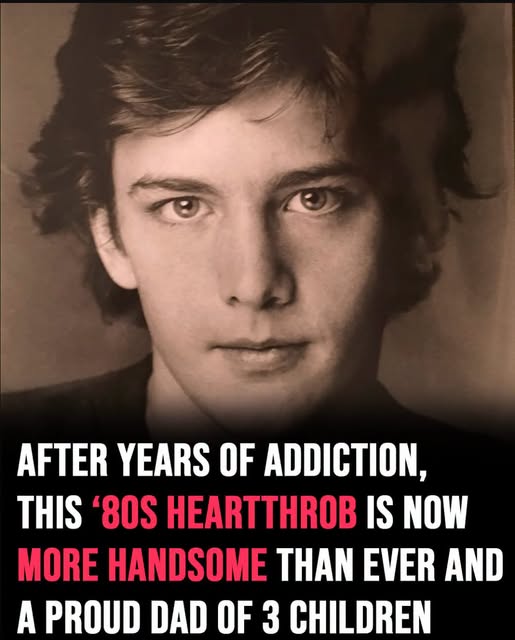
He was the soft-spoken dream every teenage girl once pinned to her bedroom wall. With his boyish looks, quiet charm, and unmistakable presence, Andrew McCarthy became one of the defining faces of a generation of young Hollywood stars. But behind the posters, magazine covers, and glamorous premieres, something far darker was developing. At the height of his fame, the smile began to feel forced, the parties became harder to control, and the mornings became increasingly difficult to face. The hangovers grew worse, the loneliness deeper, and the pressure of being constantly watched became something he struggled to escape. Almost no one realized how quietly he was destroying himself.
McCarthy’s story is one of the less glamorous versions of Hollywood success. There was no single explosive scandal that suddenly exposed everything. Instead, his problems developed behind closed doors, hidden beneath successful movies and the image of the charming young actor audiences thought they knew. While viewers saw the star of *Pretty in Pink*, *St. Elmo’s Fire*, *Mannequin*, and *Weekend at Bernie’s*, he was privately struggling with alcohol and the emotional weight that came with fame.
He had become famous while still young, at an age when many people are only beginning to understand who they are. Suddenly, his face was everywhere. Strangers recognized him. Fans wanted pieces of his time. Studios wanted him to remain successful. Every appearance carried expectations, and every performance contributed to an image that seemed almost impossible to escape.
The world saw the golden boy.
He knew what it felt like to be exhausted behind the smile.
The contradiction became increasingly difficult to maintain.
McCarthy has spoken openly over the years about his struggles with alcohol and the way drinking became intertwined with his life during his younger years. What might have begun as something associated with parties and the social world of entertainment gradually became something much more destructive.
The drinking wasn’t simply about having fun anymore.
It became a way to escape.
A way to quiet anxiety.
A way to make uncomfortable situations easier.
A way to temporarily disappear from the version of himself that everyone else seemed to want.
And the more he relied on it, the harder it became to imagine life without it.
That is one of the cruelest aspects of addiction. From the outside, a person can appear successful while privately losing control. Career achievements can continue even while personal life is becoming increasingly unstable. A person can walk onto a film set, deliver lines, smile for photographs, and then return to a private room where the reality is completely different.
For McCarthy, the consequences eventually became impossible to ignore.
The image of the carefree young actor no longer matched how he actually felt.
The parties were no longer exciting.
The attention was no longer flattering.
The alcohol was no longer something he could simply turn off.
And somewhere beneath all of it was a growing realization that he had to make a decision.
Continue down the same road.
Or stop.
At 29, he chose to enter rehab.
That decision became one of the most important turning points of his life.
It was not a glamorous Hollywood comeback.
There was no dramatic red-carpet moment.
There was simply a young man recognizing that the life everyone else admired was becoming a life he could no longer survive.
Stepping away from the spotlight gave him something he had struggled to find while surrounded by it: space.
Space to think.
Space to recover.
Space to understand what had happened.
And, perhaps most importantly, space to discover who he was when he wasn’t performing for anyone.
Recovery did not mean that every problem instantly disappeared.
Rebuilding a life after addiction requires patience. It requires confronting habits, emotions, and patterns that may have been developing for years. It also requires learning how to experience ordinary life without constantly searching for an escape.
McCarthy began creating a different kind of career.
Instead of remaining trapped inside the image of the teenage heartthrob, he moved behind the camera and developed a successful career as a television director. His work directing episodes of television allowed him to remain connected to the entertainment industry while approaching storytelling from an entirely different perspective.
The shift was significant.
As an actor, he had spent years being watched.
As a director, he became the person making decisions behind the camera.
He could shape performances rather than constantly being evaluated himself.
He also discovered another form of storytelling through writing.
His travel writing became an important part of his creative life, giving him an opportunity to explore places and experiences far removed from the controlled world of Hollywood studios.
Travel offered something fame rarely could.
Perspective.
Instead of being defined by what strangers thought they knew about him, he could become an observer again. He could experience unfamiliar places, listen to other people’s stories, and write about the world without needing to be the center of it.
His personal life changed as well.
He built a family and found a different kind of fulfillment—one based less on public attention and more on relationships, responsibility, and ordinary moments.
That transformation may be one of the most important parts of his story.
The young actor once associated with bedroom posters eventually became a man far more interested in building a life than maintaining an image.
The face changed.
The priorities changed.
The definition of success changed.
The boyish idol audiences remembered was still part of his history, but he was no longer trapped inside that identity.
There is something powerful about that distinction.
Hollywood often celebrates reinvention when it involves a new role, a new hairstyle, or a dramatic career comeback.
But the most meaningful reinvention can happen privately.
It can mean waking up one morning and realizing you no longer want to live the way you have been living.
It can mean asking for help.
It can mean admitting that something has become bigger than your ability to control it.
It can mean walking away from an identity that everyone else loves because that identity is destroying the person underneath it.
McCarthy’s story illustrates that success does not automatically protect someone from pain.
Fame can provide money, opportunities, recognition, and access, but it cannot guarantee emotional stability.
Sometimes, in fact, constant attention can make private struggles harder to reveal.
When everyone believes you are living the dream, admitting that you are miserable can feel almost impossible.
That may be why his story resonates so strongly.
He wasn’t the celebrity who collapsed in front of cameras.
He was the person who was struggling while the cameras kept showing the world a completely different picture.
His recovery therefore became more than a personal decision.
It became a rejection of the idea that appearances matter more than reality.
Today, McCarthy’s life is not defined only by the films that made him famous.
Those movies remain an important part of his legacy, and audiences continue to remember the young actor who became an icon of 1980s cinema.
But his life eventually became much larger than those roles.
He became a director.
A writer.
A father.
A storyteller.
And a person who learned to live without allowing alcohol to determine the shape of his days.
The lines on his face tell a different story now.
They are not the perfectly preserved image of a Hollywood heartthrob frozen in his twenties.
They are evidence of time.
Of experience.
Of mistakes.
Of recovery.
Of a life that continued.
And perhaps that is more valuable than remaining forever young in the public imagination.
The most important thing he gained was not another hit movie or another magazine cover.
It was ownership of his own life.
He no longer needed to be the person teenage audiences imagined him to be.
He could simply be Andrew.
A man who had struggled.
A man who had asked for help.
A man who had changed direction.
A man who discovered that the spotlight was not the only place where a life could have meaning.
The boyish idol may still exist in old photographs and classic films, but the person standing today is something more complicated—and, in many ways, more remarkable.
Because he didn’t simply survive fame.
He learned how to live beyond it.
And sometimes the greatest comeback isn’t returning to the spotlight.
It’s finally becoming comfortable living without needing it.