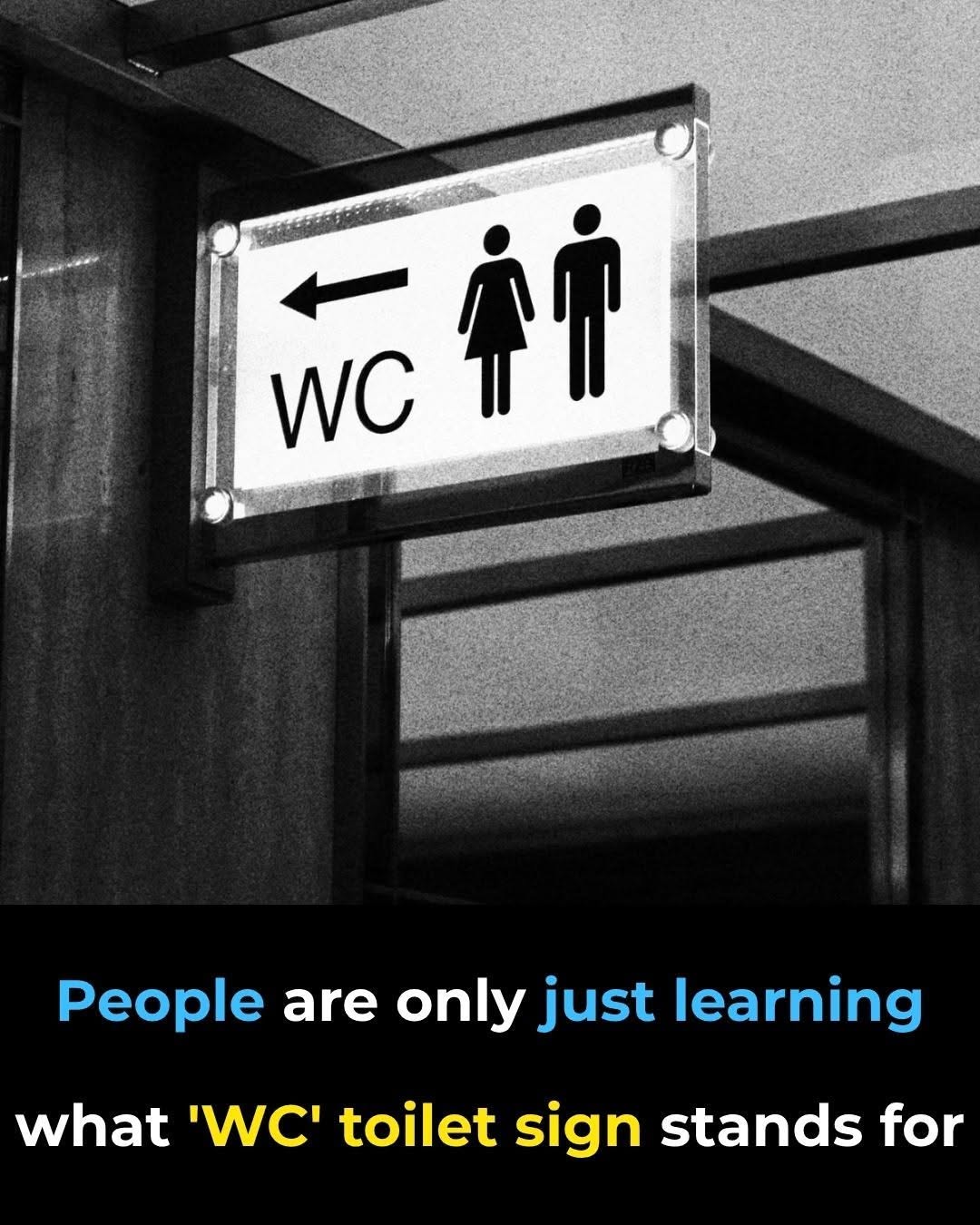
For generations, people around the world have walked past the letters “WC” without giving them a second thought. They appear on doors in airports, train stations, shopping centers, and cafés, quietly directing visitors to restroom facilities. Most people assume the abbreviation is simply an international symbol for a toilet, yet few realize it actually stands for something much older: “Water Closet.” While the term sounds unusual today, its origins reveal a fascinating chapter in the history of modern sanitation and public health.
The widespread use of “WC” demonstrates how certain words can survive long after their original meaning has faded from everyday language. Millions of travelers recognize the sign instantly, even though many have never questioned what the letters represent. Recently, discussions online have reignited curiosity about the abbreviation, leaving many people surprised to discover that a term created more than a century ago is still guiding them to restroom doors across the globe.
To understand where the phrase came from, it is necessary to look back to Victorian-era England during the late nineteenth century. At that time, indoor plumbing was still considered a luxury. Most homes lacked private toilets, and many people depended on outdoor facilities or shared sanitation systems. When flushing toilets began appearing inside wealthier homes, they were often installed in small enclosed spaces separated from the rest of the house. These compact rooms became known as “water closets,” combining the idea of a closet-like enclosure with the revolutionary introduction of running water and flushing technology.
Owning a water closet was once viewed as a symbol of wealth and modern living. Families who could afford indoor plumbing were considered progressive and fortunate, especially during a period when public health concerns and sanitation improvements were becoming major social priorities. As the technology spread and became more common, architects, builders, and planners began abbreviating the term to “WC” on blueprints, signs, and official documents. Over time, the shortened version became just as recognizable as the full phrase.
As British influence expanded through trade, travel, and international connections, the abbreviation spread far beyond the United Kingdom. By the early twentieth century, “WC” had become a practical, widely understood way of identifying facilities equipped with flushing toilets. Even as countries developed their own preferred terms—such as “bathroom,” “restroom,” or “lavatory”—the abbreviation remained visible throughout Europe and many other regions of the world. It offered a simple solution that could be understood regardless of language barriers.
The reason “WC” survived while many older terms disappeared is largely due to its universal simplicity. Travelers may not understand local words for restroom facilities, but the familiar letters provide immediate guidance. In this way, the abbreviation functions almost like an international symbol, bridging linguistic differences and helping people navigate unfamiliar places with ease.
In recent years, social media users have rediscovered the meaning behind the abbreviation, generating widespread amusement and curiosity. Many people admit they spent decades seeing the letters without ever asking what they stood for. The revelation has become a reminder of how easily historical language can blend into everyday life until its origins are almost forgotten.
Beyond its practical function, the story of the water closet highlights the relationship between technology and language. What was once a cutting-edge innovation became so commonplace that its name transformed into a simple symbol. The term serves as a small reminder of the enormous advances in sanitation, engineering, and public health that shaped modern society. Indoor plumbing, now taken for granted in many parts of the world, was once considered a remarkable achievement.
Today, whenever someone spots a “WC” sign in an airport, railway station, hotel, or café, they are encountering more than just directions to a restroom. They are seeing a linguistic relic from another era, a phrase that survived changing technologies, cultures, and generations. More than 150 years after its creation, the humble abbreviation continues to connect the modern world with a period when indoor sanitation represented one of humanity’s most significant improvements in everyday living.