The morning bell still echoes through school hallways, yet many classrooms feel strangely disconnected—not because students are absent, but because the very structure supporting education seems to be weakening. For years, criticism has focused on overcrowded schools, shrinking budgets, and exhausted teachers as people searched for explanations behind declining academic performance and growing discipline problems. Then one retired educator decided to challenge that narrative. In a powerful open letter, she redirected the conversation in a way that stunned readers across the country. Her message sparked fierce debate, forcing many to reconsider who truly bears responsibility for the struggles facing today’s students.
Questions about the state of education affect families in every community. Nearly everyone has an opinion about what schools should do to prepare children for the future, but few voices carry the perspective of someone who spent decades teaching inside the classroom. In 2017, retired educator Lisa Roberson published an open letter in the Augusta Chronicle that quickly spread nationwide. Although it was written years before the pandemic reshaped education, its central argument continues to resonate today. Rather than blaming curriculum changes or government policies, Roberson insisted that the real source of the crisis begins long before children walk through the school doors—inside their own homes.
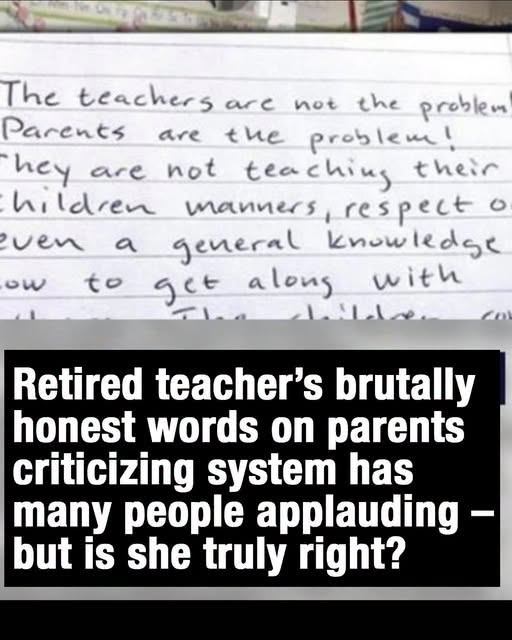
Opening her letter with unmistakable frustration, Roberson wrote that she was tired of hearing opinions from people who had little understanding of what actually happens inside public school classrooms. She argued that the widespread belief that teachers are responsible for the decline in education ignores a far deeper issue. According to her, the greatest obstacles students face are not created at school but at home, where many children fail to learn the basic values of respect, responsibility, courtesy, and self-discipline before ever meeting their first teacher.
To support her argument, Roberson pointed to what she viewed as a troubling contradiction. She described students arriving at school wearing expensive designer shoes and fashionable clothing while lacking simple classroom essentials such as pencils, notebooks, or paper. In many cases, teachers end up purchasing these supplies themselves using their own limited salaries. For Roberson, this reflected a growing cultural imbalance where appearances often receive greater attention than the educational tools children actually need to succeed, leaving educators feeling unsupported by the families they are expected to work alongside.
Her concerns extended far beyond missing school supplies. Roberson challenged readers to rethink how they evaluate struggling schools. Instead of immediately blaming teachers or administrators, she suggested asking different questions. Are parents attending conferences with teachers? Do they regularly communicate with the school? Are they making sure their children arrive prepared, rested, and ready to learn, or have they gradually shifted those responsibilities onto the education system itself?
She continued by describing what she believed were widespread shortcomings in parental involvement. Roberson questioned whether homework was consistently being completed, whether schools had accurate contact information for families, and whether children were being taught the importance of listening, following instructions, and taking responsibility for their own learning. According to her experience, many classrooms were overwhelmed not by difficult lessons but by constant behavioral disruptions caused by students who had never developed the basic habits expected before entering school. She argued that educators were increasingly expected to fill the roles of both teacher and parent, a burden she believed no school system could realistically sustain.
The response to Roberson’s letter was immediate and deeply divided. Many educators and supporters praised her honesty, saying she had finally expressed frustrations that teachers had quietly carried for years. Others strongly disagreed, arguing that her criticism overlooked the realities faced by countless families balancing multiple jobs, financial hardship, and other daily challenges that make active school involvement far more difficult. Her letter quickly evolved into a broader national conversation about where the responsibilities of schools end and those of parents begin.
As the years have passed, the discussion has only become more complicated. The pandemic dramatically changed the relationship between schools and families, bringing increased tension, growing concerns over student behavior and mental health, and new disagreements over education itself. Even so, the central question Roberson raised continues to provoke reflection. Have schools become an easy target for problems that actually originate outside the classroom, particularly in the home environment where children’s attitudes and values are first developed?
Roberson never intended her letter to be a gentle recommendation. Instead, it was a direct appeal for greater accountability from parents and communities alike. She argued that improving education requires more than increased funding, new technology, or additional standardized testing. In her view, meaningful progress begins with stronger parental involvement, consistent discipline, and renewed respect for the work educators perform every day. Schools, she maintained, can only reinforce the lessons children first learn at home. Until families fully embrace their role in that partnership, she believed the cycle of disappointment and blame would continue. Ultimately, the debate is no longer simply about whether education is failing—it is about whether society is willing to honestly confront its own role in that failure.