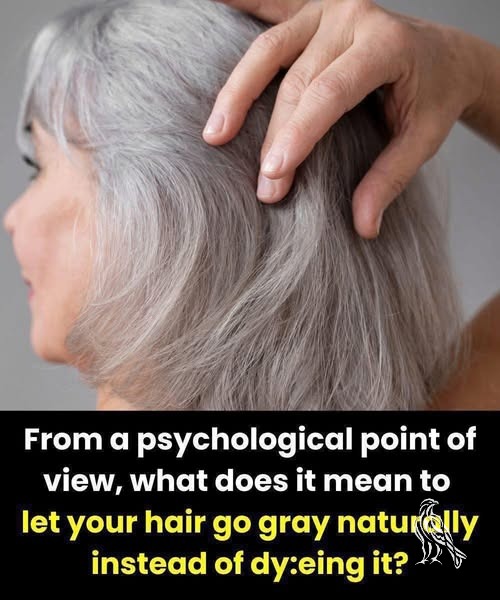
The room grows quiet when she walks in.
Not because she demands attention. Not because she is trying to make a statement. And certainly not because gray hair is unusual.
The silence comes from something deeper.
She is no longer hiding.
In a culture that spends billions convincing people to erase every visible sign of aging, her silver hair stands out precisely because it refuses to participate. It doesn’t ask for approval. It doesn’t apologize. It simply exists, and in doing so, it challenges expectations many people have never questioned.
What often begins as a practical decision can become something far more meaningful.
Maybe it starts with skipping a salon appointment.
Maybe it begins with curiosity.
Maybe she simply grows tired of maintaining a cycle that no longer feels necessary.
At first, the change seems small. A few silver strands appear near the roots. Weeks pass. Then months. Gradually, the gray becomes impossible to ignore.
So do the reactions.
Some people offer compliments.
Others offer concern disguised as advice.
Many cannot resist asking whether she plans to color it again.
The question itself reveals an assumption—that gray hair is something temporary, a problem waiting to be fixed.
But what if it isn’t?
As the transition continues, something unexpected often happens.
The mirror changes.
For years, it may have served as a place to search for flaws and corrections. A place to monitor every new line, every change, every reminder that time is moving forward.
Now it becomes something else.
A place of recognition.
The silver strands no longer feel like evidence of decline. Instead, they begin to resemble evidence of life itself.
Years survived.
Challenges endured.
Lessons learned.
Losses carried.
Victories earned.
Every mark tells a story.
Every change has a history.
The face looking back is not older despite life.
It is older because of life.
And that distinction matters.
Of course, the world doesn’t suddenly become more accepting.
Some people stare.
Some offer backhanded compliments disguised as praise.
Others assume she has stopped caring about herself simply because she no longer colors her hair.
Yet beneath those reactions, something within her shifts.
The urgency begins to fade.
The constant pressure to appear younger.
The fear of being judged.
The exhausting effort of meeting standards that move further away each year.
Little by little, those burdens become easier to set down.
In their place comes something quieter.
Confidence.
Not the confidence of perfection.
The confidence of acceptance.
There is freedom in no longer fighting every visible sign of time.
Freedom in realizing that worth was never attached to hair color in the first place.
Freedom in understanding that beauty can evolve rather than disappear.
The result is not surrender.
It is ownership.
Ownership of her appearance.
Ownership of her choices.
Ownership of her story.
Her gray hair is not a criticism of women who choose differently. It is not a rejection of beauty, self-care, or personal expression.
It is simply a decision.
A visible declaration that she no longer wishes to spend energy hiding something that was never shameful to begin with.
And perhaps that is what makes people pause when they see her.
Not the silver hair itself.
But the certainty.
The quiet confidence of someone who has stopped asking permission to age.
In a world obsessed with resisting time, that kind of peace can be surprisingly powerful.
Because the most striking thing about her isn’t the gray.
It’s the fact that she wears it without apology.
And in doing so, reminds everyone else that growing older is not something to conceal.
It is evidence that we were fortunate enough to keep living.