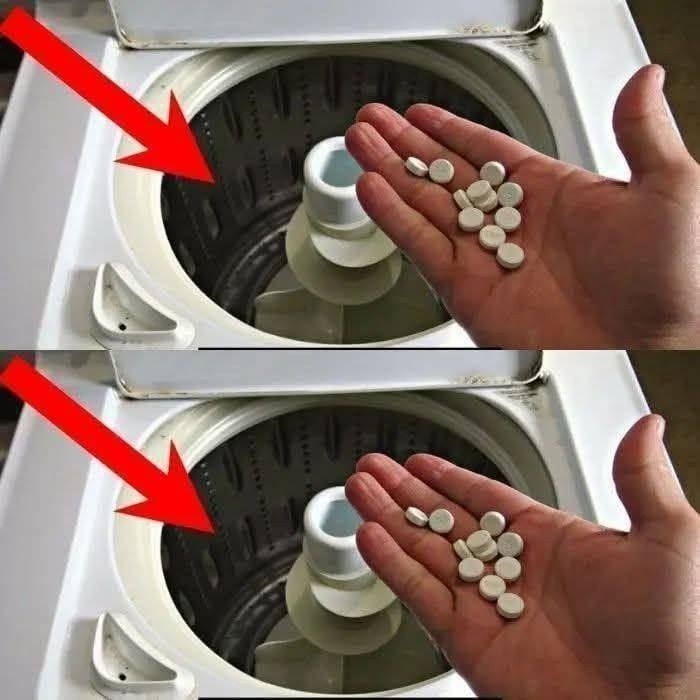
At first, I thought the rule came from grief.
Every time I carried a basket of laundry past the kitchen, my father-in-law would look up almost immediately and ask the same question in the same quiet voice:
“Did you remember the aspirin?”
Not detergent.
Not fabric softener.
Aspirin.
The way he said it unsettled me at first. Not angry, not demanding exactly — just deeply serious, as though forgetting that tiny white pill would somehow violate something sacred inside the house. After my mother-in-law died, he clung tightly to routines that seemed almost painfully precise. Towels had to be folded a certain way. Sheets tucked exactly as she used to tuck them. Her measuring spoons still sat untouched beside the stove like museum pieces nobody was allowed to move.
And always, the aspirin in the laundry.
At first, I assumed it was emotional rather than practical. Grief makes people attach meaning to ordinary rituals all the time. The house still carried traces of her everywhere: the faint scent of clean linen lingering in closets, neatly stacked washcloths folded with military-level precision, handwritten notes tucked into recipe books. It felt plausible that adding aspirin to the wash was simply another habit he refused to abandon because it connected him to her.
So I never questioned it openly.
I would crush a tablet into the machine mostly out of respect, even though part of me quietly believed it did absolutely nothing.
But eventually curiosity got the better of me.
One afternoon, after watching him inspect freshly washed white shirts with almost scientific concentration, I finally searched it online. I expected to find old wives’ tales or meaningless superstition.
Instead, I found chemistry.
Aspirin contains acetylsalicylic acid, and when dissolved in water, it releases salicylic acid — a compound capable of helping break down sweat residue, body oils, and the yellow-gray discoloration that slowly builds into white fabrics over time. Before modern stain removers became common, people sometimes used crushed aspirin tablets as a gentle method for brightening clothes without the harshness of bleach.
Suddenly his strange rule made perfect sense.
It had never been random.
My mother-in-law had known something practical and quietly brilliant all along.
Once I understood, I started experimenting myself. I crushed several tablets into warm water and soaked an old white shirt stained with years of dullness around the collar and sleeves. Honestly, I did not expect much. But by the next morning, the fabric looked noticeably different — not blindingly artificial the way bleach sometimes makes whites appear, but softly restored somehow. Cleaner. Brighter. Alive again.
The yellow haze had faded.
The fibers still felt gentle.
There was no sharp chemical smell lingering afterward.
I stood there holding the shirt feeling strangely emotional over laundry.
Because suddenly the aspirin ritual no longer felt eerie or obsessive. It felt intimate. Intelligent. Human. One small domestic trick passed quietly through generations without anyone calling it “science,” even though that is exactly what it was.
That realization changed the way I looked at my father-in-law too.
What I originally interpreted as grief-stricken rigidity was actually something more layered. Yes, he missed her terribly. That much was obvious in every room of the house. But the aspirin rule was not simply about refusing to let go. It was about preserving knowledge. Protecting the tiny invisible systems that once held a life together.
People leave pieces of themselves behind in ways outsiders rarely notice.
Not just through photographs or heirlooms, but through methods.
Habits.
Recipes.
Cleaning tricks.
The exact way they folded towels or removed stains or seasoned soup.
After someone dies, those ordinary details suddenly become sacred because they are proof a person once moved carefully through the world solving problems nobody else even noticed.
Now every time I add crushed aspirin to a load of whites, it feels different.
Part chemistry experiment.
Part inheritance.
I think about how many women — and men too — carried practical scientific knowledge through generations without formal education ever recognizing it as expertise. They learned through repetition, observation, necessity, and instinct. They knew which mixtures worked, which fabrics lasted, which remedies softened stains or revived old materials long before internet tutorials existed to explain why.
My mother-in-law may never have described salicylic acid scientifically.
But she understood exactly what it could do.
And perhaps that is what moves me most now.
The realization that love sometimes survives not through dramatic speeches or grand gestures, but through tiny repeated acts woven invisibly into ordinary life. A folded towel. A familiar scent. A white shirt restored carefully instead of thrown away.
Even now, years after her death, part of her still quietly participates in the laundry.
Not like a ghost haunting the house.
More like knowledge refusing to disappear.
And every time my father-in-law asks, “Did you remember the aspirin?” I no longer hear sadness alone.
I hear devotion.
Memory.
And the quiet persistence of someone still teaching us how to care for things properly, even after they are gone.