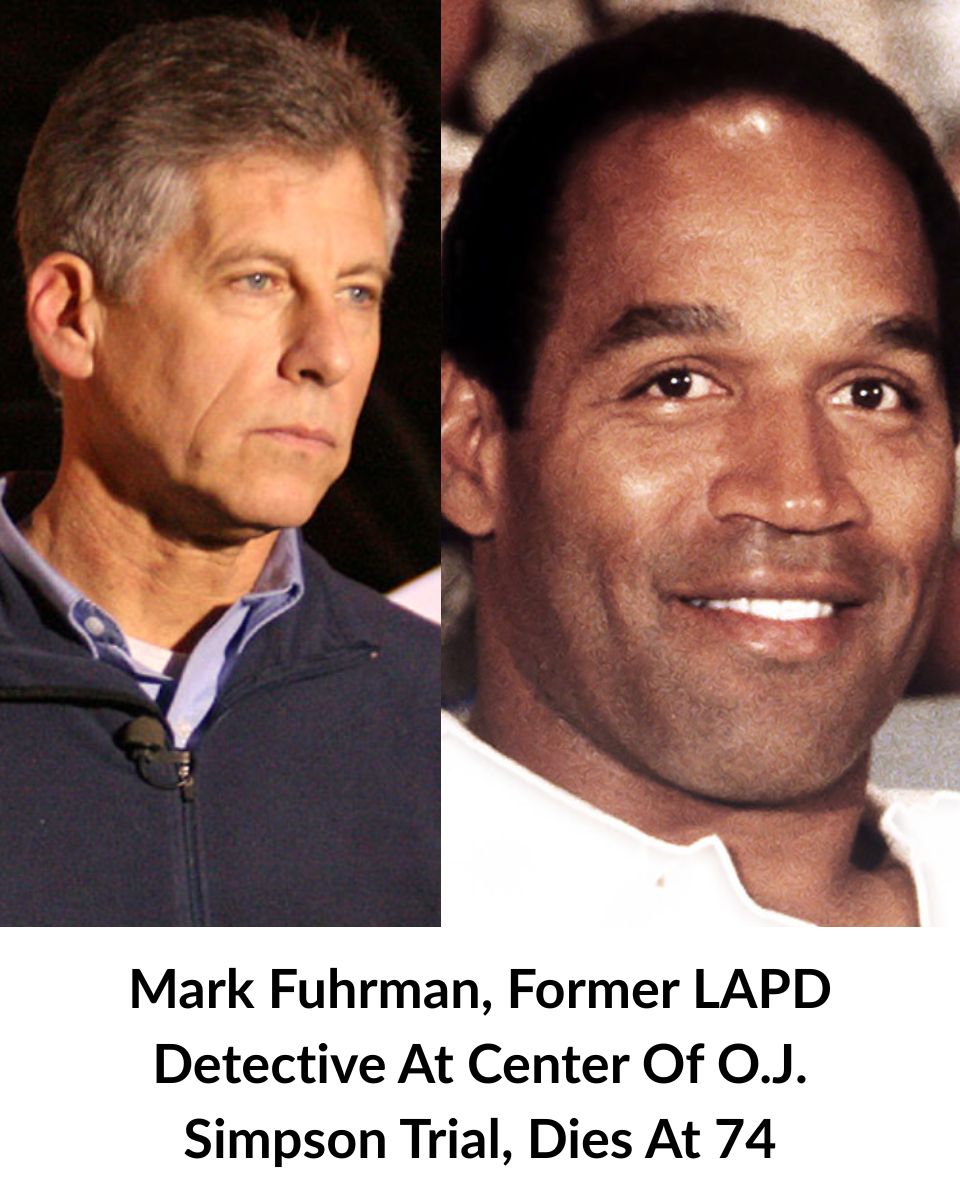
The death of Mark Fuhrman closes one of the most controversial and emotionally charged chapters in modern American criminal justice history — but it does not settle the arguments that followed him for decades. Even now, years after the murders of Nicole Brown Simpson and Ron Goldman, Fuhrman’s name still triggers fierce reactions about race, policing, truth, and whether the justice system itself can survive when public trust collapses inside a courtroom.
For millions of Americans, Fuhrman never became just another detective.
He became a symbol.
Depending on who was watching, he represented either the exposed rot inside policing or a deeply flawed investigator whose lies helped destroy a prosecution many believed otherwise had overwhelming evidence. That division never truly healed after the O.J. Simpson murder trial ended, and Fuhrman’s death at 74 has reopened many of those same unresolved questions.
The irony surrounding his legacy remains staggering even decades later.
In the most famous murder trial of the 1990s — one involving celebrity, race, domestic violence, media obsession, and public distrust of police — the only person criminally convicted in connection with the case was not O.J. Simpson, but the detective investigating him.
That fact alone still shocks people unfamiliar with the case’s full complexity.
Fuhrman rose to national prominence as one of the lead detectives investigating the brutal killings outside Nicole Brown Simpson’s Los Angeles home. His discovery of the bloody glove at Simpson’s estate became one of the prosecution’s most powerful pieces of evidence. At first, he appeared composed, authoritative, and convincing to much of the public.
Then everything unraveled.
Defense attorneys uncovered audiotapes recorded years earlier in which Fuhrman repeatedly used racist slurs while discussing police work and violent treatment of Black suspects. The tapes contradicted his sworn testimony in court, where he denied using such language in the preceding decade. That contradiction destroyed his credibility almost instantly and transformed the trial itself.
The moment became larger than one detective lying under oath.
It confirmed existing fears many Black Americans already carried about the Los Angeles Police Department, especially in the years following the beating of Rodney King and the subsequent Los Angeles riots. To many observers, Fuhrman’s tapes did not feel like isolated misconduct. They felt like proof of something systemic and deeply dangerous.
The defense seized on that collapse aggressively.
Attorneys argued Fuhrman’s racism made the investigation itself fundamentally suspect, suggesting evidence may have been mishandled or even planted. Whether people believed that claim often depended heavily on broader views about policing and race already existing long before the trial began. The courtroom transformed into something far bigger than a murder case. It became a referendum on institutional trust itself.
And the country split apart watching it.
Some Americans viewed Fuhrman as the prosecution’s fatal weakness — a detective whose dishonesty poisoned the integrity of the entire case. Others believed the defense successfully shifted focus away from physical evidence by turning Fuhrman into the central villain instead of Simpson.
Even today, opinions remain fiercely divided.
Was Fuhrman a racist officer whose prejudice irreparably contaminated the investigation?
Was he a dishonest but ultimately accurate detective whose personal failures overshadowed the evidence?
Or was he something more complicated — a product of a policing culture many Americans were only beginning to confront publicly at the time?
The discomfort surrounding his legacy comes partly from the fact that none of those questions ever received emotionally satisfying closure.
Fuhrman eventually pleaded no contest to perjury charges for lying about his racist language under oath. That conviction permanently altered public perception of the case and remains historically extraordinary given the trial’s scale. His credibility never fully recovered afterward, no matter how many books he wrote or television appearances he later made.
In the years following the trial, Fuhrman reinvented himself publicly as an author and conservative media commentator, particularly through appearances on Fox News. He continued discussing criminal justice and high-profile cases, though the shadow of the Simpson trial followed every appearance. For critics, his later media career felt like an unsettling rehabilitation of someone whose lies damaged public trust profoundly. For supporters, he became a symbol of how one catastrophic mistake consumed an entire career.
His final years unfolded far more quietly than the chaos that defined his public image.
Reports indicate Fuhrman privately battled throat cancer and eventually chose to stop treatment. There would be no massive public memorial, no nationally televised farewell, no final public reckoning with the case that made him infamous worldwide. Instead, his death arrived with striking silence compared to the media storm that once surrounded him relentlessly.
Yet silence may be impossible where his legacy is concerned.
Because Mark Fuhrman’s story remains deeply intertwined with unresolved American tensions surrounding race, policing, and credibility inside the justice system itself. The Simpson trial was never only about guilt or innocence. It exposed how differently Americans experienced law enforcement depending on race, history, and trust. Fuhrman became the human embodiment of that fracture.
That is why his death feels historically significant even decades later.
Not because he was universally admired.
Not because he was universally hated.
But because he stood at the center of one of the rare moments when an entire country openly confronted the possibility that truth inside a courtroom could become inseparable from bias, fear, history, and perception.
And even now, after his death, the argument remains unresolved.