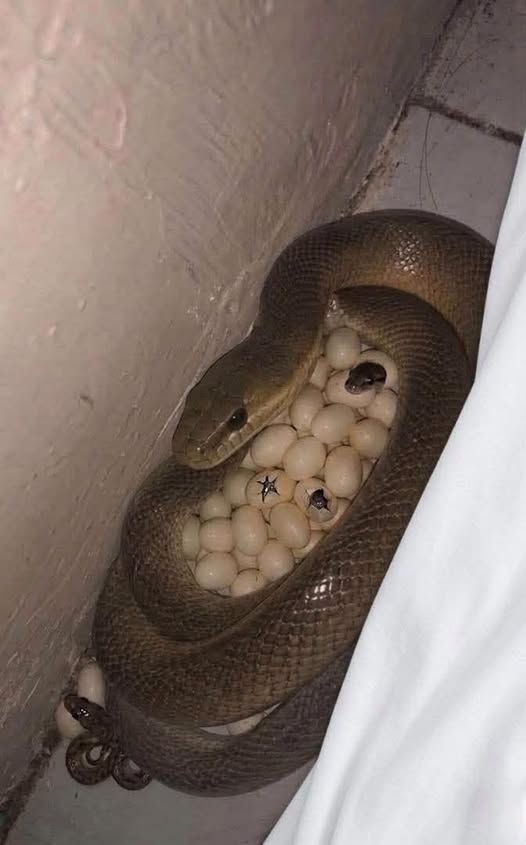
You wake in the middle of the night to an unsettling sight: a large python curled tightly beside your bed, wrapped protectively around a cluster of eggs. In an instant, your home no longer feels like your own. Panic takes over as your mind races through worst-case scenarios. While the scene may look like something from a thriller, wildlife experts say that understanding the snake’s behavior is the key to staying safe—for both you and the animal.
Female pythons are among the few snakes that actively care for their eggs after laying them. Instead of abandoning the nest, they coil tightly around the eggs, protecting them from predators and helping regulate their temperature until they hatch. During this time, the mother often remains almost constantly with the nest, leaving only when absolutely necessary. Her primary focus is not hunting people but ensuring the survival of her offspring.
To a nesting python, a quiet corner beneath a bed, inside a closet, or behind stored items may resemble a safe natural shelter such as a hollow log, rock crevice, or dense vegetation. These protected spaces provide darkness, stability, and a sense of security that make them attractive nesting sites, particularly if the snake has accidentally entered a home through an open door, damaged screen, or other small opening.
Many people assume a snake guarding eggs is preparing to attack, but defensive behavior is usually very different from predatory behavior. A brooding python is generally trying to protect its nest rather than seek conflict. However, if it feels threatened—especially by someone approaching too closely or attempting to remove the eggs—it may hiss, strike defensively, or attempt to drive away what it perceives as a danger.
The situation becomes more complicated once the eggs begin to hatch. Newly hatched pythons quickly disperse in search of shelter and food. Although the hatchlings are much smaller than their mother, they are still wild animals that should not be handled. Attempting to capture them without proper training can increase the risk of bites and make it more difficult for professionals to relocate them safely.
If you discover a nesting python inside your home, experts recommend remaining calm and avoiding any attempt to move the snake yourself. Do not strike the animal, spray it with chemicals, or try to separate it from the eggs. Sudden movements may cause the snake to become defensive and can place both people and the animal at unnecessary risk.
Instead, slowly back away from the area if it is safe to do so. Close the door to the room, keep children and pets away, and contact your local wildlife authority, animal control agency, or a licensed snake relocation specialist. Professionals have the equipment and experience needed to safely relocate both the mother and her eggs together, minimizing stress and reducing the chance of injury.
Preventing snakes from entering homes begins with reducing possible entry points. Sealing gaps beneath doors, repairing damaged screens, covering vents, and removing clutter near the home’s exterior can make a property less attractive to wildlife. Keeping yards tidy and limiting places where rodents gather may also reduce the likelihood of snakes visiting, since rodents are an important food source for many species.
It’s also important to remember that not all snakes are dangerous, and many play a valuable role in local ecosystems by helping control rodent populations. Pythons, in particular, are generally shy animals that prefer avoiding humans whenever possible. Encounters inside homes are uncommon and are usually the result of the snake accidentally finding what appears to be a safe nesting location.
Finding a python guarding eggs inside your home is undoubtedly alarming, but responding with patience rather than panic can lead to the safest outcome for everyone involved. By giving the animal space and allowing trained professionals to handle the situation, you help protect both your household and the wildlife that shares the environment around us. Sometimes the safest response is not confrontation but calm, careful distance until expert help arrives.