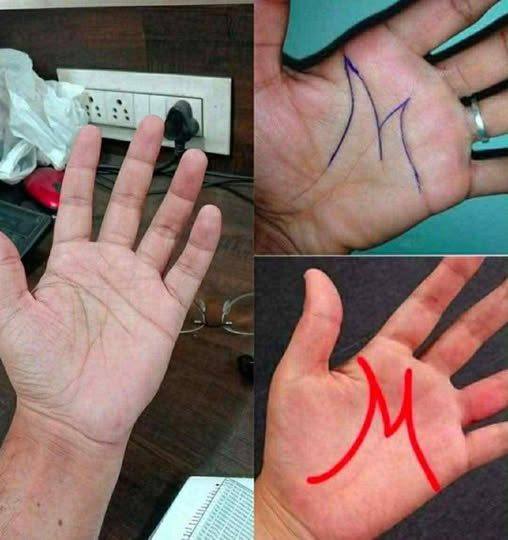
Some people go through their entire lives without ever paying attention to it. It’s always been there, quietly present, hidden in plain sight among the lines of their palm. Then one day—maybe out of curiosity, maybe by accident—they notice it. A shape that seems too precise to ignore, too deliberate to feel random. And suddenly, something that once felt ordinary begins to carry meaning. The mysterious “M,” traced across the hand, has intrigued people for generations, sparking a mix of curiosity, belief, and speculation. For some, it represents destiny. For others, it hints at something deeper—an inner strength or awareness that isn’t immediately visible but quietly influential.
The fascination with this symbol comes largely from the way it appears. On many palms, the natural lines—the head line, the heart line, and the fate line—intersect in a pattern that forms a shape resembling the letter “M.” It isn’t carved or placed there intentionally; it emerges from the natural structure of the hand. Yet despite its simplicity, this pattern has been interpreted in many ways, especially within the tradition of palmistry.
In that context, the “M” is often associated with qualities that go beyond surface-level traits. It is said to reflect a strong sense of intuition—an ability to perceive things that are not immediately obvious. People who have this marking are often described as having a natural awareness, a kind of instinct that allows them to understand situations or people without needing extensive explanation. This doesn’t necessarily mean they always have answers, but rather that they tend to notice patterns, shifts, and inconsistencies more quickly than others.
Alongside intuition, the symbol is frequently linked to honesty and integrity. The idea is that individuals with this marking have a strong internal compass—a sense of right and wrong that guides their decisions. They may not always express it outwardly, but it influences how they move through situations, how they respond to challenges, and how they interact with others. This quality is often described as quiet rather than forceful, something that exists steadily rather than dramatically.
There is also a connection made to leadership, though not always in the traditional sense. The kind of leadership associated with the “M” is often described as natural and understated. It’s not necessarily about seeking authority or recognition, but about having the ability to guide, influence, or inspire when the situation calls for it. People with this marking are sometimes seen as those who step forward when needed, who provide direction without imposing it, and who carry a sense of purpose that shapes their actions over time.
Another aspect often mentioned is the idea of clarity—of being able to recognize truth in situations where others might be uncertain. This is sometimes interpreted as the ability to see through deception or to sense when something doesn’t align. Whether understood as intuition or simply heightened awareness, it contributes to the broader perception of the “M” as a symbol of insight.
Traditionally, interpretations have also varied depending on context. Some views suggest that when the marking appears on a man’s palm, it is associated with ambition, planning, and the drive to create something meaningful or lasting. In contrast, when it appears on a woman’s palm, it is often linked to emotional intelligence, protective instincts, and a strong awareness of relationships and choices. These interpretations reflect broader cultural ideas about roles and qualities, though they are not fixed or universal.
Beyond those distinctions, however, the symbol has taken on a more general meaning over time. It has become less about specific predictions and more about reflection. Rather than defining a person, it serves as a reminder of qualities that many people value—awareness, honesty, resilience, and the ability to navigate life with intention.
It’s important to recognize that these interpretations are not based on scientific evidence, but on tradition, belief, and the human tendency to find meaning in patterns. The lines on the hand are part of the body’s natural structure, shaped by development and movement rather than predetermined outcomes. Yet the stories attached to them continue to hold interest, not because they provide certainty, but because they invite reflection.
In the end, the “M” on the palm is less about fate and more about perspective. It doesn’t determine who someone is or what they will become. Instead, it can be seen as a symbolic prompt—a way of thinking about the qualities that shape a person’s path.
Because regardless of what lines appear on the hand, it is the choices, actions, and values a person carries that truly influence their direction.
And that is something no marking alone can decide.