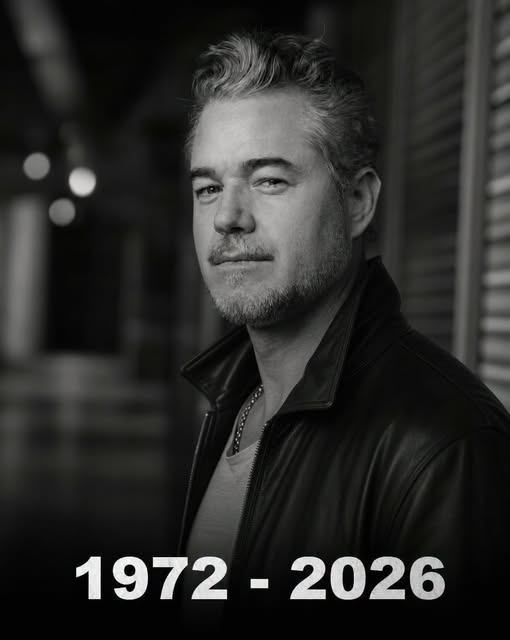
The news hit like a punch to the chest. Eric Dane is gone, and television suddenly feels colder, emptier, wrong. On February 19, 2026, the actor best known as Dr. Mark “McSteamy” Sloan on *Grey’s Anatomy* died at 53 after a battle with ALS.
For millions of viewers, Dane will forever be connected to that crooked smile, effortless confidence, and swaggering presence that made Mark Sloan such an unforgettable character. But the man behind McSteamy was far more complicated than the heartthrob image that first made him famous.
He had spent years building a career that eventually moved far beyond the role that introduced him to a massive audience. After *Grey’s Anatomy*, he became the commanding officer Tom Chandler in *The Last Ship*, then took on the much darker role of Cal Jacobs in *Euphoria*. Those performances revealed an actor willing to leave the comfort of the image audiences had created for him and explore characters that were damaged, complicated, and often deeply uncomfortable.
Then came the diagnosis.
In April 2025, Dane publicly revealed that he had been diagnosed with amyotrophic lateral sclerosis, or ALS. The disease gradually attacks the nerve cells responsible for controlling voluntary muscles, eventually affecting movement, speech, swallowing, and breathing.
For someone whose career depended on physical presence, expression, movement, and the ability to perform in front of a camera, the diagnosis was devastating.
Yet Dane didn’t immediately disappear.
That may be one of the most powerful parts of his final chapter.
Even after revealing his illness, he continued working. He returned to *Euphoria* for its third season, determined to keep doing what he loved for as long as his body allowed. He also used his public platform to advocate for ALS awareness and research, transforming a deeply personal battle into an opportunity to help people facing the same disease. ([ABC News][4])
There was something remarkably defiant about that choice.
He could have stepped away.
He could have disappeared from public view.
Instead, he kept moving forward.
Not because he wasn’t frightened.
Not because the disease wasn’t taking things from him.
But because he refused to let the diagnosis become the only story people remembered.
His final months were marked by an increasingly visible physical decline, but the people around him continued to describe the qualities that had always existed beneath the celebrity image: humor, warmth, generosity, and a stubborn determination to keep living on his own terms. His final days were spent surrounded by friends, his wife Rebecca Gayheart, and his two daughters, Billie and Georgia.
And that detail changes the way his final chapter feels.
Because behind the actor was a father.
A husband.
A friend.
A man whose greatest concern wasn’t necessarily how audiences would remember him, but the people who would continue living after he was gone.
His death leaves an especially strange silence because Dane was still part of the television world when he died. His work wasn’t simply something from a distant past. He had continued appearing on screen and had continued developing new chapters of his career even while fighting a disease that was steadily taking away his physical abilities.
His final televised interview, recorded for Netflix’s *Famous Last Words*, was released after his death, creating an especially poignant final connection between the actor and the audience that had followed him for decades.
It means viewers can still hear his voice.
Still see his face.
Still watch him work.
Still encounter the person he was at the very end.
And perhaps that’s why his death feels so difficult to process.
Eric Dane wasn’t simply an actor people remembered from the past.
He was still here.
Still working.
Still creating.
Still fighting.
Then suddenly, he wasn’t.
The world had already begun watching his physical decline, but nothing prepares an audience for the moment when a living person becomes a memory.
The man who once played the seemingly invincible McSteamy was ultimately confronted with something no amount of fame could defeat.
His body was failing.
His career was changing.
His future was narrowing.
And still, he continued showing up.
That is where his legacy becomes larger than the characters he played.
Mark Sloan gave audiences confidence and charisma.
Tom Chandler showed determination under impossible circumstances.
Cal Jacobs revealed a darker and more vulnerable side of his acting.
But Eric Dane himself gave audiences something different in his final years: an example of what it can look like to continue creating meaning while facing something you cannot control.
He didn’t defeat ALS.
No inspirational story can honestly claim that.
The disease ultimately took his life.
But it didn’t take away everything he still had to give.
He used the time he had to work.
To advocate.
To spend time with the people he loved.
To leave something behind.
And to remind people that dignity doesn’t necessarily mean pretending you’re fearless.
Sometimes dignity means admitting you’re afraid and continuing anyway.
Eric Dane’s final chapter therefore shouldn’t be remembered only as a tragedy.
It was tragic.
But it was also deeply human.
A famous actor became seriously ill.
A father fought for more time with his daughters.
A performer kept returning to set.
A man who had spent his career portraying strength discovered another kind of strength in simply refusing to surrender his passion.
His television characters will remain frozen in their best moments.
McSteamy will always have that smile.
Tom Chandler will always be standing on the deck of the *Nathan James*.
Cal Jacobs will remain trapped inside the complicated world of *Euphoria*.
But behind all of them was Eric Dane—a real person who became increasingly vulnerable in front of an audience that had once known him primarily as a symbol of confidence.
And perhaps that is why his passing feels so profound.
The world didn’t simply lose a familiar face.
It lost someone who, even as his body betrayed him, kept reminding people that a life can still have purpose inside its most painful chapter.
His legacy isn’t only the characters.
It’s the decision to keep creating.
To keep loving.
To keep showing up.
To keep fighting for something larger than yourself.
And when the final scene eventually comes, perhaps that is what matters most—not how invincible someone looked at the beginning, but how much courage they found when they finally discovered that they weren’t.