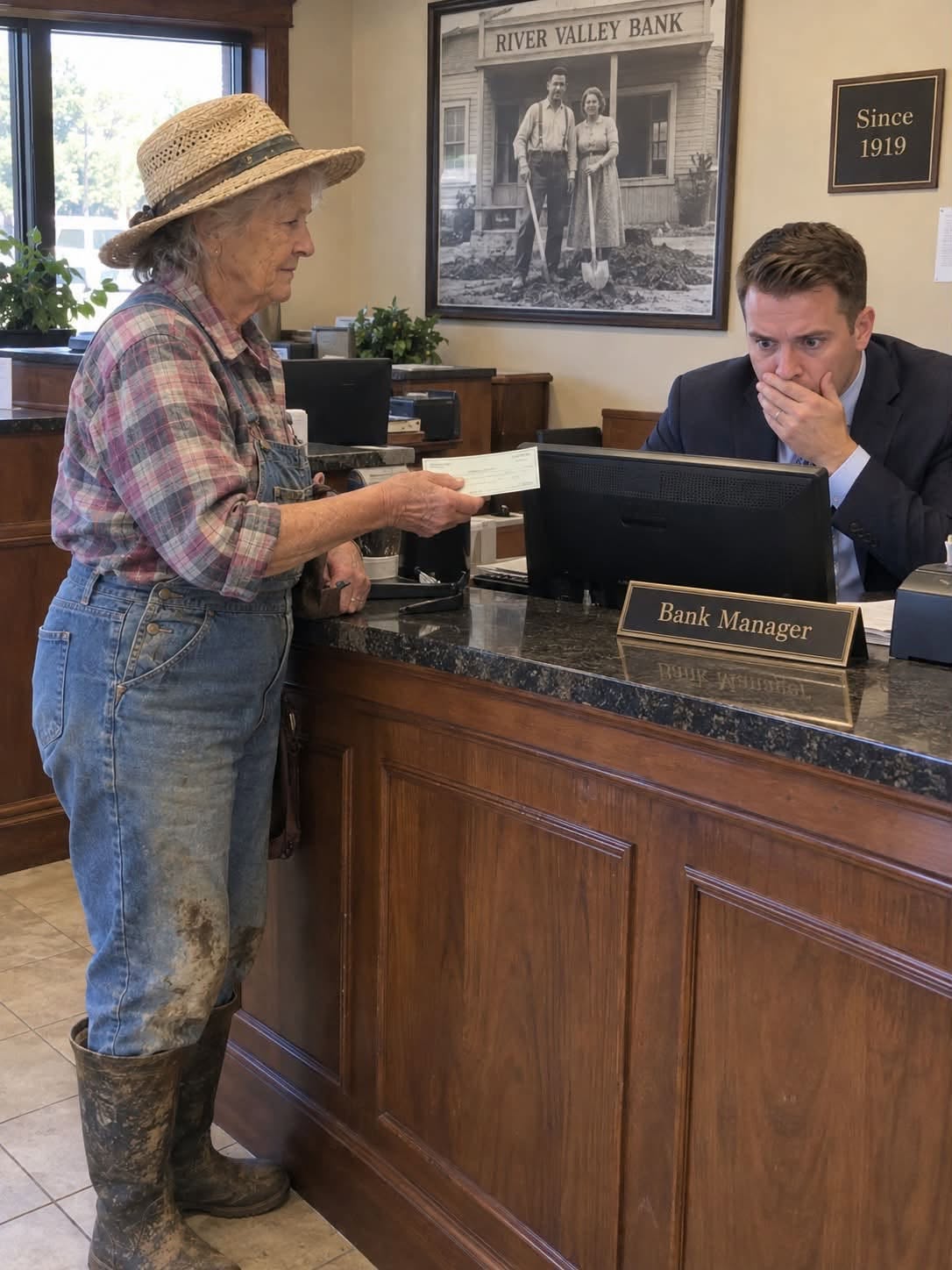
The Bank Manager Refused to Cash My $40 Check Because of How I Looked — Then I Asked Him to Pull Up Account 0001
The bank went silent when I asked the manager to pull up Account 0001.
Just moments earlier, he had looked me up and down, glanced at the $40 check in my hand, and told me he couldn’t help me.
I was standing in the middle of a marble-floored banking hall, wearing an old brown coat, worn-out shoes, and a faded cap that had seen better days. My hands were rough from years of work, and my clothes carried the dust of a long morning.
I knew I didn’t look like the bank’s usual wealthy customers.
But I had never imagined that my appearance would determine whether I deserved to cash a forty-dollar check.
“My good man,” the manager said, adjusting his expensive tie, “perhaps you should try a different branch.”
I stared at him.
“Why?”
He gave a small, uncomfortable laugh.
“We have certain procedures here.”
“What procedures?”
He glanced toward the line behind me, as though my questions were wasting everyone’s time.
“Sir, I’m simply saying that we cannot process every transaction without proper consideration.”
I looked down at the check.
Forty dollars.
That was all I was asking for.
I wasn’t trying to withdraw thousands of dollars. I wasn’t demanding a loan. I wasn’t asking him to make an exception to any banking rule.
I simply wanted to cash a check.
Yet the way he spoke to me made it feel as though I had walked into the bank asking for something I had no right to possess.
“My identification is right here,” I told him, placing it on the counter. “The check is valid. If there’s a problem, tell me what it is.”
He barely glanced at my identification before pushing it back toward me.
“I don’t think you understand how things work here.”
Those words hurt more than I expected.
Not because I needed his approval, but because I recognized the tone. It was the same tone I had heard in expensive restaurants, exclusive offices, and places where people decided what someone was worth before learning their name.
I had spent most of my life learning not to react to that kind of treatment.
But that morning, something inside me decided I had been patient long enough.
I leaned slightly toward the counter.
“What’s your name?”
He straightened his jacket.
“Mr. Peterson. I’m the branch manager.”
I nodded.
“Good. My name is Daniel Brooks. And before you send me away, I’d like you to do one thing.”
He sighed.
“What is that?”
“Pull up Account 0001.”
For the first time since I had entered the building, the manager stopped talking.
He looked at me as if he had misheard.
“Which account?”
“Account zero-zero-zero-one.”
A teller sitting nearby slowly turned toward us.
The manager’s expression changed, but only slightly.
“Sir, we don’t discuss confidential account information at the counter.”
“I agree,” I replied. “That’s why I’m asking you to verify it privately.”
He studied my face.
Then he looked at my coat again, as though the number I had given him couldn’t possibly belong to someone who dressed like me.
“Do you have an account card?”
“No.”
“An account statement?”
“Not with me.”
He folded his arms.
“Then I’m afraid there’s nothing I can do.”
I took a slow breath.
“Mr. Peterson, you’ve spent the last five minutes explaining why you won’t cash a forty-dollar check. I’m asking you to verify an account. You have my identification. Follow your normal security procedures and check the records.”
He hesitated.
The customers behind me were beginning to pay attention.
Finally, he gestured toward a small office behind the counter.
“Come with me.”
I followed him inside.
He closed the door, sat behind his desk, and opened the bank’s computer system.
“All right,” he said impatiently. “Let’s see what you’re talking about.”
He typed the account number.
Then he stopped.
He leaned closer to the screen.
His fingers hovered over the keyboard.
He clicked something, entered his password, and waited for the information to load.
A moment later, the color drained from his face.
“What?” I asked.
He didn’t answer.
He checked the number again, then looked at me.
“How did you get this account number?”
“I’ve known it for a very long time.”
“That isn’t possible.”
I pulled out the chair opposite his desk and sat down.
“What’s impossible, Mr. Peterson?”
He swallowed.
“This account is different from ordinary customer accounts.”
“I know.”
“It has special restrictions.”
“I know that, too.”
He stared at me.
Then he looked back at the screen, where a series of internal records and authorization notices appeared.
His voice had changed completely.
“Mr. Brooks, I’m going to need you to wait while I contact our regional office.”
“Of course.”
He picked up the telephone.
Before dialing, he glanced at my worn coat one more time.
Only now, there was no contempt in his eyes.
There was fear.
Not fear of me personally, but fear that he had made a terrible mistake.
And he was beginning to realize that the man he had dismissed over forty dollars might know far more about the bank than he had ever imagined.
The Account Nobody Talked About
While Mr. Peterson waited for someone to answer, I sat quietly.
I wasn’t enjoying his discomfort.
I had not come to the bank to humiliate anyone. I had come to cash a check and continue with my day.
But the situation reminded me of a lesson I had learned many years earlier: people often reveal their character when they believe the person in front of them has nothing to offer.
The manager had seen an old coat and worn-out shoes.
He hadn’t seen a customer.
He hadn’t even tried to understand the situation before deciding that I didn’t belong.
Now, the number on his computer screen had forced him to reconsider everything.
A woman from the regional office answered the telephone.
Mr. Peterson explained that he needed to verify a legacy account and confirm the appropriate procedure for speaking with the person sitting in his office.
He gave her the account number.
Then he listened.
His expression grew increasingly serious.
“Yes, ma’am,” he said. “I understand.”
Another pause.
“Yes. He’s here with me now.”
He glanced at me.
“Understood.”
He slowly put down the telephone.
For several seconds, he said nothing.
Then he stood up.
“Mr. Brooks, I owe you an apology.”
I looked at him.
“For what?”
He seemed surprised by the question.
“For the way I treated you when you arrived.”
I waited.
“I made assumptions about you based on your appearance. I should have examined your documents and followed the proper procedure instead of making you feel unwelcome.”
It was the first honest thing he had said to me that morning.
I nodded.
“Thank you for acknowledging that.”
He returned to his chair.
“But I need to ask you something. Are you the original account holder?”
I looked at the computer screen.
“Yes.”
He shook his head slightly.
“I’ve worked in banking for more than twenty years. I’ve never personally handled an account like this.”
“Most people haven’t.”
“Why?”
I folded my hands on the desk.
“Because Account 0001 was opened before this branch existed.”
He looked at me, waiting for an explanation.
I gave him one.
Decades earlier, I had been a young man with almost nothing. I worked long hours, saved every dollar I could, and learned the banking business from the ground up.
I wasn’t born into wealth. I didn’t inherit a fortune from a famous family. I had no powerful connections waiting to open doors for me.
Everything I built began with a decision I made when I was young: I would never allow my circumstances to determine the limits of my future.
I started a small business repairing equipment for local shops. At first, I worked out of a rented garage. My customers paid in cash, and I kept meticulous records because losing even a small amount of money could have ended the business.
Eventually, I expanded.
I hired employees, opened additional locations, and invested in properties that others had overlooked. I made mistakes along the way, but I learned from them.
Years later, I became involved in a financial institution that eventually merged with the bank where I was now sitting.
Account 0001 was an old legacy account associated with those early institutional records.
It wasn’t a magical account that gave me permission to ignore banking rules. It was a historical account whose records required special verification because of its age and status.
The manager listened without interrupting.
“And you still use it?” he asked.
“I maintain the relationship and its records. I don’t need to visit a branch very often.”
“Then why come here today to cash a forty-dollar check?”
I reached into my coat pocket and removed a folded piece of paper.
“Because I was on my way to see someone, and I stopped to take care of a simple errand. I didn’t think it would become an ordeal.”
He looked down at the check again.
Forty dollars.
The amount had not changed.
Only his understanding of the man holding it had changed.
The Name on the Screen
Mr. Peterson turned his attention back to the computer.
He studied the internal notes and verified the information through the proper channels. He asked me several security questions, confirmed my identification, and followed the procedures required for an account of that type.
I answered everything.
After a few minutes, he received confirmation from the regional office.
He leaned back in his chair.
“Everything appears to be in order.”
“Good.”
He looked uncomfortable.
“I still can’t believe I didn’t recognize the account.”
“Why would you recognize it?” I asked. “You had no reason to know me personally.”
“But I should have treated you differently.”
I considered his words.
“Yes,” I said. “But not because of the account.”
He looked at me.
“You should have treated me with respect before you knew anything about my money, my history, or my identity.”
He lowered his eyes.
I continued.
“If that account had belonged to an ordinary person with a few hundred dollars, would you have thought it was acceptable to dismiss me the way you did?”
He didn’t answer immediately.
“No,” he finally admitted.
“Then that’s the real problem.”
He nodded slowly.
I could tell that he was thinking about the conversation differently now.
The account had established my identity, but it had not created my right to be treated fairly. That right should never have depended on a number displayed on a computer screen.
After completing the necessary checks, Mr. Peterson escorted me back to the counter.
The teller processed the forty-dollar check according to the bank’s procedures.
She handed me the money.
“Is there anything else I can help you with today, Mr. Brooks?” she asked politely.
“No, thank you.”
I placed the bills in my wallet.
The entire transaction had taken only a few minutes once the manager stopped making assumptions and began doing his job.
Before I left, Mr. Peterson approached me again.
“Mr. Brooks, I hope you’ll accept my sincere apology. I understand that my behavior was unacceptable.”
I looked at him.
“I accept your apology. But I hope you’ll remember this the next time someone walks through those doors looking different from the customers you’re used to seeing.”
“I will.”
I wanted to believe him.
Whether he would actually change was something only time could reveal.
What Happened After I Left
I stepped outside into the cool morning air.
People hurried along the sidewalk, carrying coffee cups, checking their phones, and thinking about the ordinary responsibilities waiting for them.
Nobody passing me would have known what had happened inside the bank.
They would have seen an older man in a worn coat carrying a small wallet.
And that was fine with me.
I had never believed that a person’s value could be measured by the clothes they wore or the balance in their bank account.
I had seen wealthy people behave cruelly and people with almost nothing show extraordinary generosity.
I had learned that money could buy comfort, opportunities, and influence, but it could not automatically purchase kindness or good judgment.
That morning, I had walked into the bank asking for forty dollars.
I left with the same forty dollars, along with a reminder of something I had understood for most of my life.
A person’s appearance tells you very little about their character, their history, or what they have experienced.
The man wearing an expensive suit might be struggling privately. The woman carrying an old handbag might be supporting an entire family. The customer standing quietly at the back of the line might have spent decades building something extraordinary.
You cannot know someone’s story simply by looking at them.
And you should never need to know their story before treating them with dignity.
Later that afternoon, the regional office contacted me to confirm that the incident had been documented and that the branch would review its customer-service procedures.
I thanked them.
I didn’t demand that Mr. Peterson lose his job. I didn’t ask the bank to make a public announcement. I wanted the institution to take the incident seriously and make sure that other customers would not experience the same treatment.
Because the point was never to prove that I was richer, more powerful, or more important than the manager had assumed.
The point was to show how wrong it was to judge anyone that way in the first place.
The Lesson Behind Account 0001
People sometimes assume that respect must be earned through wealth, status, education, or influence.
But basic human dignity is not a reward reserved for people who impress us.
It is something every person deserves.
Mr. Peterson had looked at me and decided that I wasn’t worth his time. He had allowed my clothing to shape his judgment before he had established the facts.
When Account 0001 appeared on his screen, his attitude changed.
But the most important lesson was not that I had access to an account he had never expected me to possess.
It was that his behavior should have been different from the very beginning.
I could have been a millionaire, a retired worker, a struggling father, or someone who had lost everything. None of those possibilities would have justified the way I was treated.
The next time you see someone wearing worn-out shoes or carrying an old bag, remember that you are seeing only a small part of their life.
You don’t know what they have survived.
You don’t know what they have built.
And you certainly don’t know what their future holds.
That morning, I asked the bank manager to pull up Account 0001 because I wanted him to verify who I was.
But when I walked out of the building, I realized something more important.
I had not needed the account to prove that I deserved respect.
I had deserved it when I first walked through the door.
Sometimes, the most powerful revelation isn’t discovering who someone really is. It’s discovering how differently people treat you when they think they finally know.
a