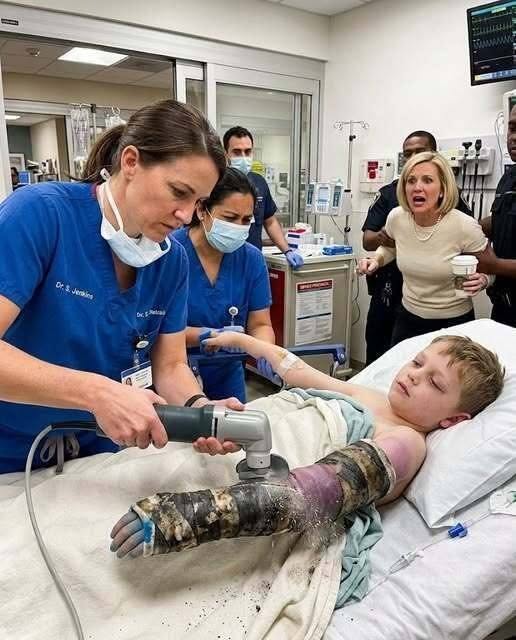
The smell reached me before the stretcher did.
Sweet.
Metallic.
Rotten.
It cut through the antiseptic, stale coffee, and disinfectant that usually defined the emergency department, settling in the back of my throat in a way that made every instinct sharpen.
I’m Dr. Sarah Jenkins.
After eight years in emergency medicine, I had learned that the most dangerous cases were not always the loudest.
Sometimes they arrived quietly.
Marcus, one of our nurses, hurried toward me with his mask pressed tightly over his face.
“Eight-year-old boy,” he said. “Mother says flu. Temperature 103.8. Heart rate 140. Blood pressure dropping. Barely responsive.”
Then he glanced toward Trauma Room 2.
“It’s his arm.”
The sliding doors opened.
The boy looked far younger than eight.
His lips were cracked. His cheeks were hollow. His skin had the pale, waxy color of someone whose body had been fighting far longer than anyone wanted to admit.
His right arm rested beside him inside a fiberglass cast stretching from his fingers to above his elbow.
The cast should have been the least concerning thing in the room.
It wasn’t.
The fiberglass was filthy, stained, and fraying at the edges. Near his hand, the material pressed against swollen purple skin.
His fingertips were blue.
I pressed gently against one.
The color did not return.
“How long has he had this cast?” I asked.
His mother stood in the corner holding an expensive paper coffee cup.
Martha Harris looked almost untouched by the emergency around her.
Cream sweater.
Pearls.
Perfect blonde hair.
Immaculate nails.
“About a month,” she said. “He’s always getting dirty. Climbing trees, falling down. We only came because he felt warm this morning.”
A month did not explain what I was seeing.
And it definitely did not explain the smell.
“Mrs. Harris, your son is in septic shock. We need to remove this cast immediately.”
Her expression tightened.
Not with fear.
With irritation.
“No.”
I looked at her.
“No?”
“His orthopedic doctor said two more weeks. Give him antibiotics and we’ll go home.”
Clara, one of our most experienced nurses, was already pulling on another mask. Marcus opened the pediatric IV kit. The sepsis protocol sheet was clipped to the bed.
Every person in the room understood the danger.
Except, apparently, his mother.
Or so I thought.
“Clara,” I said, “call security. Then bring me the cast saw.”
Martha moved instantly.
“You are not cutting that off!”
Clara stepped between her and the bed.
“Ma’am, back up.”
Two security officers entered.
Then Martha saw the saw.
Something changed in her face.
Her anger vanished.
“Don’t open it,” she whispered.
That stopped me.
“Why?”
She stared at the cast.
“Please.”
And in that moment, I understood.
She knew.
Maybe not exactly how bad it had become.
But she knew there was something beneath that fiberglass she did not want us to see.
I switched on the saw.
The boy flinched.
I leaned close.
“My name is Sarah. I’m taking this off because your arm needs help. You don’t have to do anything.”
His lips moved.
No sound came out.
I began cutting.
The outer layer resisted.
Then finally separated.
The smell intensified so sharply that Marcus turned away and gagged.
Beneath the fiberglass, the padding was soaked, dark, and compressed.
Clara lifted one section carefully.
Several pale larvae dropped onto the floor.
For half a second, the room froze.
Then training took over.
We stopped reacting and started working.
The tissue beneath the cast was badly damaged and severely infected. His hand was swollen, circulation compromised, and his entire body was showing signs that the infection had spread.
This had not happened that morning.
This was not a mild flu.
“Get surgery,” I ordered.
Martha started talking rapidly.
“He plays outside.”
Nobody answered.
“Maybe dirt got under it.”
Still nothing.
“He never said it hurt that badly.”
That made me turn.
“When did he tell you it hurt?”
Her mouth opened.
Closed.
“I mean… obviously a broken arm hurts.”
“That isn’t what I asked.”
Before she could answer, the monitor alarmed.
His blood pressure dropped again.
The conversation ended.
For the next several minutes, the room became controlled chaos.
Fluids.
Antibiotics.
Blood cultures.
Calls to surgery.
Constant monitoring.
Every second mattered.
As the transfer team prepared to take him upstairs, the boy’s eyes found mine.
His fingers barely moved.
“Am I bad?” he whispered.
I leaned closer.
“What?”
“Because I got it dirty.”
Something inside my chest tightened.
“No.”
I said it immediately.
“You are not bad.”
He looked at me like he was waiting for the rest.
For the condition.
The punishment.
So I made it simple.
“You’re sick. We’re taking care of you.”
His eyes closed.
Behind me, Martha said,
“See? He admitted it.”
Clara turned toward her.
I knew that look.
But she did not argue.
Instead, she sealed the discarded cast inside an evidence bag.
“We’re preserving everything,” she said.
Martha went quiet.
After the boy was transferred, I opened his medical chart.
I wanted the timeline.
The original instructions were clear.
Return immediately for worsening pain.
Swelling.
Changes in color.
Fever.
Odor.
Wet or damaged cast material.
There were also records documenting attempts to arrange follow-up care.
Nothing supported Martha’s claim that she had been told to leave the cast untouched for two more weeks regardless of symptoms.
When I returned to the trauma room, she was sitting alone.
Her coffee lay spilled on the floor.
“You checked his chart,” she said.
“Yes.”
“I want an attorney.”
“You can call one.”
“You’re making me sound like a monster.”
“I haven’t called you anything.”
“You think I did this.”
I kept my voice level.
“Your son arrived in septic shock with impaired circulation, a high fever, and a severely neglected cast. You tried to stop us from removing it. Those are facts.”
Her face crumpled.
“He kept complaining.”
I went still.
“When?”
“At first he said it itched.”
She stared at the floor.
“Then he said it was too tight.”
“How long ago?”
“I don’t know.”
“Martha.”
“Days.”
The word landed harder than I expected.
She began crying.
Not because she did not understand what had happened.
Because she did.
She told me she had been embarrassed that the cast had gotten wet.
Then embarrassed that she had waited.
Then afraid doctors would question why she had ignored the pain.
So she delayed again.
And again.
Every day made returning harder to explain.
Every worsening symptom made her more afraid of being judged.
Eventually, avoidance became more important to her than getting help.
And her son paid the price.
Hospital child-safety procedures were initiated immediately.
My role was not to decide guilt.
My role was to keep him alive.
Hours later, surgery called.
They had treated the infected tissue and restored enough circulation that they were not immediately taking his hand.
He was still critically ill.
There were no guarantees.
But he had survived the first stage.
Near midnight, I went to see him.
The filthy cast was gone.
His arm was wrapped in a clean dressing that could be opened, checked, and treated.
His face still looked exhausted, but some of the grayness had faded.
His eyes opened.
“Dr. Sarah?”
“I’m here.”
He glanced toward his arm.
“Is that another cast?”
“No.”
I pulled a chair closer.
“This one can be checked. People can see how you’re healing.”
He thought for a moment.
Then asked,
“If it hurts, am I supposed to tell?”
“Yes.”
“Even if somebody gets mad?”
The question hurt more than anything we had uncovered beneath the fiberglass.
“Especially then.”
His eyes filled with tears.
Clara entered with a fresh blanket and tucked it gently around him.
Then she pointed to the call button beside his hand.
“If you hurt, if you’re thirsty, if you’re scared, you press this.”
He touched it cautiously.
“People come?”
“People come,” I said.
He pressed it.
The light outside the room appeared.
Clara answered immediately, even though she was standing right beside him.
“What do you need, buddy?”
For the first time all night, the corner of his mouth lifted.
“Nothing.”
A pause.
“I was checking.”
Clara smiled.
“It works.”
A few minutes later, he fell asleep with the call button beside his hand.
The clean dressing remained visible above the blanket.
Accessible.
Inspectable.
Impossible to hide behind.
The old cast had become a wall.
Something everyone had been told not to disturb while danger grew beneath it.
The new dressing was the opposite.
It was designed to be opened.
Examined.
Cleaned.
Cared for.
The difference was small enough that most people would never notice it beneath a hospital blanket.
For one eight-year-old boy, it meant everything.
Because that night, he learned something no child should ever have to learn so late:
Pain is not misbehavior.
Asking for help is not disobedience.
And when something hurts, you are allowed to make enough noise for someone to come.