The letter arrived at a funeral and detonated the life I thought I understood.
My son.
The quiet neighbor.
A will that read like a confession.
For years, I had believed I knew the shape of my son’s world. I knew his school schedule, the friends he occasionally mentioned, the chores he tried to avoid, the books he left open on the kitchen table. I knew his favorite meals and the way he became quiet when something bothered him. I thought I knew the people who mattered to him.
Then an envelope arrived with his name on it.
Inside was a letter from Mr. Vance, the elderly man who had lived across the street for as long as I could remember.
The man I had assumed was simply a neighbor.
The man my son had apparently known in a way I never understood.
The will contained money, but money was only the surface. The real bequest was a map of regret—of streets never crossed, conversations never finished, apologies never offered, and love spoken too late. It was handed to a nineteen-year-old who suddenly found himself holding eighty-five thousand dollars and the unfinished emotional life of a man who had spent decades keeping his deepest feelings hidden.
I had always believed I was raising my son in the safety of small routines.
Lawns trimmed.
Curfews kept.
Homework finished.
Kindness taught in manageable doses.
I believed that if I gave Noah enough rules, enough guidance, and enough love, I could protect him from the worst parts of the world.
The envelope showed me how little control I truly had.
It also showed me something far more surprising: my son had been learning from someone I barely knew.
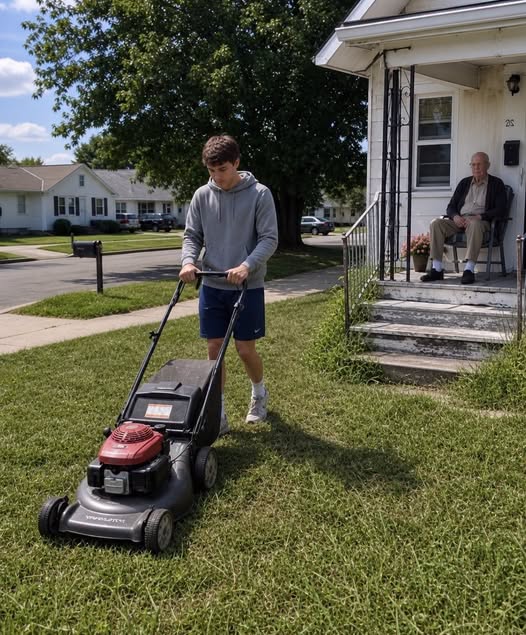
Mr. Vance had watched Noah’s ordinary loyalty—the way he carried groceries across the street, checked on him after storms, helped with small repairs, and sometimes simply sat outside with him when he seemed lonely.
To Noah, those moments had never seemed important.
They were just things you did for an older neighbor.
But to Mr. Vance, they had become something else entirely.
Evidence that someone had noticed him.
Evidence that someone still cared.
And apparently, that mattered more than either of us realized.
The letter explained that Mr. Vance had spent much of his life believing he had plenty of time to repair the things he had broken. He had postponed apologies. Avoided difficult conversations. Let friendships disappear rather than make the first call. He had loved people without always finding the courage to tell them.
By the time he understood what those choices had cost him, many of the people he wanted to reach were gone.
The will was his attempt to leave something behind that could not simply be measured in dollars.
He wanted Noah to understand that a life could be quietly ruined by waiting.
Not through one enormous mistake, but through thousands of tiny delays.
Call them tomorrow.
Visit next week.
Say it when the moment feels right.
Eventually, tomorrow becomes years.
And the people you meant to reach may no longer be there.
Reading those words, I felt something inside me shift.
I had spent so much time worrying about whether my son was becoming successful, responsible, and independent that I had forgotten to ask whether he was learning how to truly live.
Noah read the letter differently.
He did not become angry.
He did not reject the money.
He did not dismiss Mr. Vance’s regrets as the ramblings of an old man.
He sat quietly at the kitchen table, read every page twice, folded the letter carefully, and placed it beside him.
Then he asked me one question.
“Do you think he was lonely?”
I remember staring at my son because I suddenly realized he wasn’t really asking about Mr. Vance.
He was asking whether loneliness could happen to someone who appeared completely fine from the outside.
I told him yes.
And then we talked for hours.
About regret.
About forgiveness.
About the people we assume will always be there.
About how easily love can become something we feel but never say.
The eighty-five thousand dollars could have changed Noah’s life financially. It could have paid for school, helped him buy a home, or given him a head start that most nineteen-year-olds could only dream about.
But he treated the money almost like a responsibility rather than a reward.
He kept enough to secure his future and used part of it to help people in ways that reminded him of Mr. Vance.
He began visiting elderly neighbors.
He volunteered at community programs.
He started calling relatives he had barely spoken to.
He became the person who knocked on doors instead of assuming someone else would.
At first, I thought it was simply grief.
Then years passed.
And the behavior remained.
Noah kept finding other porches.
Other green chairs.
Other quiet people sitting alone at the edge of ordinary life.
Sometimes he would come home with a story about someone he had met. An elderly man whose children lived across the country. A widow who hadn’t spoken to anyone all week. A neighbor recovering from surgery. A stranger who simply needed someone to listen.
He never called it charity.
He called it showing up.
Eventually, I understood what Mr. Vance had really left my son.
It wasn’t eighty-five thousand dollars.
It wasn’t even the letter.
It was permission.
Permission to speak before it was too late.
Permission to cross the street.
Permission to make the uncomfortable phone call.
Permission to apologize without waiting for the perfect moment.
Permission to tell someone you love them while they are still there to hear it.
And perhaps most importantly, permission to live without accumulating a lifetime of unfinished sentences.
Mr. Vance had died believing he had failed at some of those things.
But his final act ensured that his failures did not have to become Noah’s.
The inheritance was not regret.
It was the chance to escape regret.
Years later, when I watched my son sitting on another porch beside another green chair, listening patiently to someone else’s story, I finally understood why that old man’s letter had changed everything.
Some inheritances arrive as money.
Others arrive as warnings.
And the rarest ones arrive as a second chance borrowed from someone else’s mistakes.
Mr. Vance could not go back and cross the streets he had avoided.
He could not repair every relationship.
He could not say every word he had swallowed.
But he could give a nineteen-year-old the courage to do those things while there was still time.
And Noah understood.
That was the true inheritance.
Not a fortune.
Not a house.
Not even a letter.
A life lived deliberately enough that, when the end finally comes, there are fewer things left unsaid.