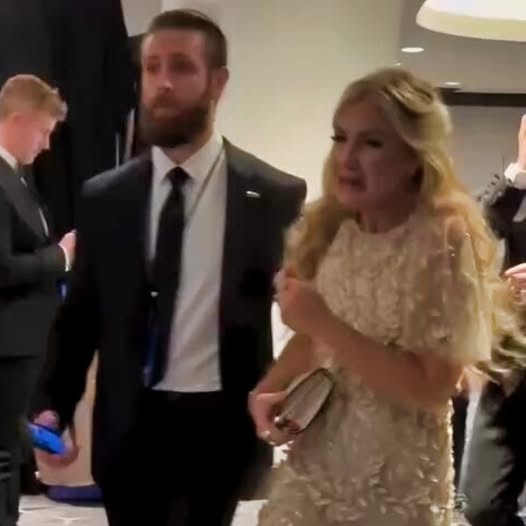
Traditionally, the White House Correspondents’ Dinner is an evening of high-fashion appearances, lighthearted roasts, and a rare moment of humor in the typically stuffy environment of the nation’s capital. But on the evening of April 26, 2026, the Washington Hilton became a theater of pure, unadulterated fear instead of a hall of pride. One person stood out as the emotional center of the crisis amid the pandemonium of a security breach that resulted in Secret Service agents drawing their service weapons and a high-stakes evacuation of the most influential leaders in the free world. A viral video of Erika Kirk, the 37-year-old widow of conservative firebrand Charlie Kirk, has shocked the American public. Her four-word, desperate appeal, “I want to go,” has become the eerie soundtrack to a night that almost became a national disaster.
Erika Kirk saw the unexpected outburst of panic as a visceral, bone-deep reminder of the trauma that has shaped her life over the past few months, rather than just a terrifying disturbance of a social calendar. Since her husband was tragically assassinated in September 2025, Erika has had to deal with grief while taking on a significant leadership role at Turning Point USA. She has transitioned from being a behind-the-scenes supportive spouse to a front-line leader for a movement, which has resulted in more scrutiny and, more alarmingly, an increase in credible threats. She was a mother attempting to project strength for her children and her community as she sat in the large ballroom, wearing a glittering evening gown that glistened beneath the chandeliers. However, that impression of strength vanished in an instant when the shouting started and the sound of federal officials’ heavy footsteps reverberated through the corridors.
The moment the mood changed from celebration to survival was reported by witnesses within the venue. The Secret Service responded with the decisive, aggressive pace necessary to safeguard President Donald Trump, the First Lady, and the Vice President as word spread that a suspected gunman had been apprehended close to the metal detectors at the entrance. Wine glasses were broken, tables toppled, and people wearing black ties were pushed toward emergency exits or had to dive under tables. Kirk was in the middle of this mad rush. Her face is a mask of unadulterated anguish and tiredness as she is led through the hallways in the video that was taken by a passerby. She was crying because she had reached her limit and not just because of the immediate fear.
It is impossible to overestimate the psychological cost of constantly being on high alert. Due to security concerns and specific threats against her team, Kirk had already had to postpone a number of high-profile engagements in the weeks preceding the dinner. For her, the threat of violence is a reality that stalked her and took her husband, not a theoretical idea discussed on TV news. Her impulse was not political when the ballroom plunged into chaos; rather, it was the plain survivalist drive of a mother realizing that the world was once again failing to provide her family the protection she so desperately wants.
The country started to struggle with the footage of Kirk’s departure while the Secret Service sought to seal the perimeter and verify that no attendees had been physically hurt during the breach. It is simple to see political politicians as players in a vast drama, devoid of humanity and reduced to their connections or talking points. However, Erika Kirk’s film serves as a reminder that beneath the titles and speeches lies a real being who lost the person she cared about the most due to the same brutality that was at the Washington Hilton. Her tear-streaked face was a somber representation of the time we live in, standing in sharp contrast to the extravagance of the occasion. The lines separating personal danger from civic service have become perilously thin in this fragmented era.
The political consequences will probably dominate the news for weeks as the investigation into how a potential shooter got so near to a high-security event continues. There will be discussions regarding the efficacy of the Secret Service’s response, the rhetoric of the current environment, and security procedures. However, the lesson is much more intimate for those who have viewed Erika Kirk’s film. It depicts a woman who has been forced to the verge and whose life has been filled with numerous unachievable burdens, finally pleading to be taken out of the spotlight. Her four words, “I want to go,” were a cry for a life free from the never-ending shadow of terror, not just a request to leave a building.
While Charlie Kirk’s murder in 2025 was a turning point for the conservative movement, Erika saw it as the end of her world. Since then, she has been a rock of resiliency, assuming leadership roles and making sure her husband’s legacy persisted. The Correspondents’ Dinner occurrences, however, indicate that the burden of that responsibility is becoming unmanageable. She was brought back to the time of her greatest loss by the sight of armed agents and the sound of terrified screaming. It was an affirmation of her worst fears: that there is never a truly safe place and that the violence that killed her spouse is always present.
The most lasting memory of the evening is the picture of Erika Kirk in her tear-stained gown as the dust settles in Washington, DC. It reminds us of the human cost of our political differences and the brittleness of the peace we frequently take for granted. Even if the immediate threat was eliminated and the President and Vice President were successfully evacuated, the psychological harm done to those present will not go away. Erika Kirk’s road to rehabilitation has just gotten much harder. She is now more than just a widow and a leader; she is a representation of a country in crisis and a woman who, in her most vulnerable moment, revealed to the world the heavy load she bears on a daily basis. The movie challenges us all to see past the political drama and see the actual, living person caught in the heart of the storm. It is a terrifying insight into a life spent under siege.