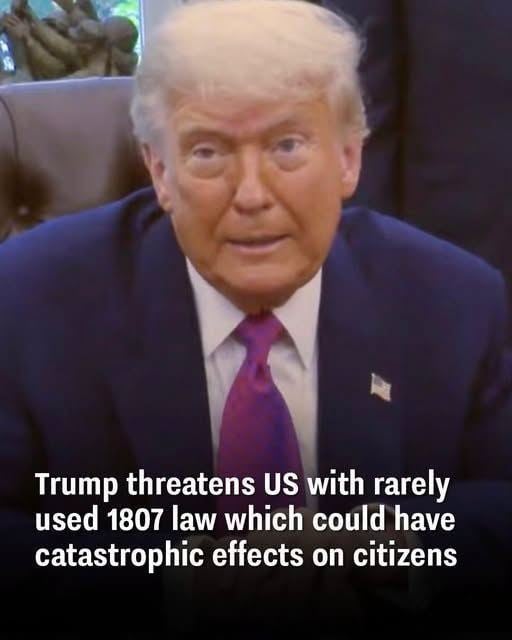
The streets look calm at first glance, almost deceptively so, as if nothing beneath the surface could possibly be wrong. But that sense of normalcy begins to erode the longer you pay attention. Something feels off in the spacing of movement, in the unusual presence of authority where it does not normally belong. Boots strike pavement in places where they historically never should, and what was once a distant legal concept—something buried in history books and constitutional footnotes—suddenly feels immediate, physical, and heavy. A 217-year-old law, written in a radically different era, now moves through the present like a loaded weapon resting in plain sight.
At the center of this tension stands the President, positioned at the edge of a decision that carries consequences far beyond the moment itself. It is not simply a question of policy or enforcement, but a potential turning point that could reshape the visible boundaries of American power in a single, decisive stroke. The choice carries the weight of precedent, interpretation, and history converging at once, where legal authority and democratic restraint meet their most fragile balance.
What happens if the Insurrection Act is invoked is not a question with a simple or contained answer. Its implications extend far beyond the immediate situation that might trigger it. The act itself was originally designed for a very different country—an era defined by horseback communication, scattered militias, and a far less complex understanding of civil and federal authority. Yet its language has remained largely intact, preserved through centuries of legal continuity, now applied to a modern state with vastly greater scale, technology, and political tension.
What makes it particularly powerful—and potentially dangerous—is not just its existence, but its ambiguity. It grants the executive branch the authority to deploy military forces domestically under conditions of perceived unrest, relying on broad and flexible terms like “necessity” and “order.” These terms, while legally recognized, are not tightly defined. Their interpretation depends heavily on the judgment of whoever occupies the office, and on how institutions choose to respond in real time.
If that legal “key” is turned in the present moment, the consequences may extend far beyond the immediate crisis that justified it. Even if the deployment were limited in scope or duration, the precedent itself would carry forward. Every future president would inherit not just the law, but the expanded expectation of how it can be used. What was once framed as an extraordinary measure reserved for exceptional circumstances could begin to feel like a viable response to political instability more broadly.
The deeper concern lies not in a single decision, but in what follows after it. Precedent has a way of reshaping norms gradually, often without formal acknowledgment. Once the presence of domestic military force in civilian spaces becomes visible, even in limited contexts, it becomes easier to imagine again—and easier to justify again. Over time, what was once shocking can begin to feel procedural.
That is where the true danger emerges: not in a dramatic rupture, but in a slow normalization. The possibility of troops stationed near protests begins to feel less exceptional. The sight of armored vehicles in urban centers begins to feel less alarming. Even the idea of military presence near polling places or political gatherings shifts from unthinkable to debatable. Fear, in this context, does not arrive all at once—it accumulates quietly, replacing earlier assumptions about consent, boundaries, and civilian space.
Ultimately, the question is no longer limited to what the law permits in theory. It becomes a question of what a democracy can endure in practice. Legal authority may define what is possible, but democratic stability depends on restraint, precedent, and trust in institutions to limit their own reach. Once those limits are tested in visible, irreversible ways, they are not easily restored.
In that sense, the moment is larger than any single administration or decision. It is about whether extraordinary powers remain truly extraordinary—or whether, through repetition and precedent, they begin to feel ordinary.