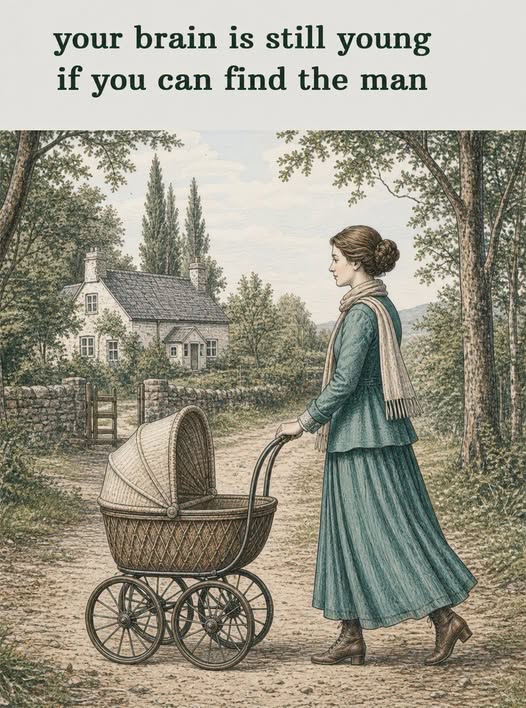
Optical illusions don’t simply fool your eyes—they reveal how easily your mind can reshape what you think you are seeing. At first glance, this peaceful park scene seems completely harmless. A woman stands with a stroller, trees stretch across the background, and shadows fall naturally through the quiet landscape. Nothing appears unusual. There is no obvious mystery, no strange figure standing on the path. Yet something is hiding in plain sight. Then, almost without warning, a face begins to emerge from the background. Once you finally see him, it becomes nearly impossible to look at the scene the same way again. The man was there all along.
The strange part is that the “mysterious man” is not actually standing somewhere in the park. He is the park itself. His face has been cleverly created from the natural shapes of the trees, branches, leaves, and shadows. The upper canopy forms the suggestion of his forehead, while the curved outline of a darker tree trunk creates the impression of his nose. Small openings between the leaves begin to look like eyes, while other patches of darkness and branches come together to suggest his mouth and chin.
At first, those shapes seem completely random. Your brain categorizes them as what they are expected to be: trees, shadows, branches, and empty spaces. Because the rest of the picture gives you a simple and believable story—a woman taking a stroller through a park—you have little reason to search for anything else. Your attention settles on the obvious subjects, and the hidden face remains buried in the background.
Then someone points it out.
Suddenly, the separate pieces begin connecting. The canopy no longer looks like a collection of leaves. The trunk no longer looks like just another tree. The gaps in the foliage seem to become carefully placed facial features. What appeared to be meaningless shapes suddenly locks into a single image, and your brain recognizes a face staring back at you.
That instant of recognition is what makes optical illusions so fascinating. Nothing in the picture has changed. The woman is still standing exactly where she was. The stroller remains in the same position. The trees have not moved, and the shadows are exactly where they were before. The only thing that changed was your interpretation of them.
Your brain initially chose the simplest explanation available: this is a peaceful park scene with a woman and a stroller. It did not need to analyze every branch or shadow because doing so would be inefficient. Human perception is constantly filtering enormous amounts of visual information, deciding what deserves attention and what can safely fade into the background.
But when you begin searching for the hidden figure, that mental shortcut no longer works. You start questioning the first impression, and suddenly details that seemed meaningless become important. Your brain essentially rewrites its interpretation of the same image, proving how quickly perception can shift when you change what you are looking for.
There is something almost unsettling about that realization. The face did not appear because it was added. It appeared because you finally learned how to see it. Before that moment, you could have stared at the illustration for minutes without noticing anything unusual. Afterward, you may wonder how you ever missed it.
That is the quiet power of a good optical illusion. It reminds us that seeing is not always the same thing as understanding. Our eyes collect shapes, lines, colors, and shadows, but our minds decide how those pieces fit together. Sometimes the mind gets it right immediately. Other times, it confidently creates a simple explanation while overlooking something hiding directly in front of us.
The mysterious man in this park is a perfect example. He was never walking down the path. He was never hiding behind a tree. He was woven into the landscape itself, waiting for your brain to make the connection.
And that may be the most fascinating part: the truth was visible from the beginning. You did not need to look harder. You simply needed to look differently.