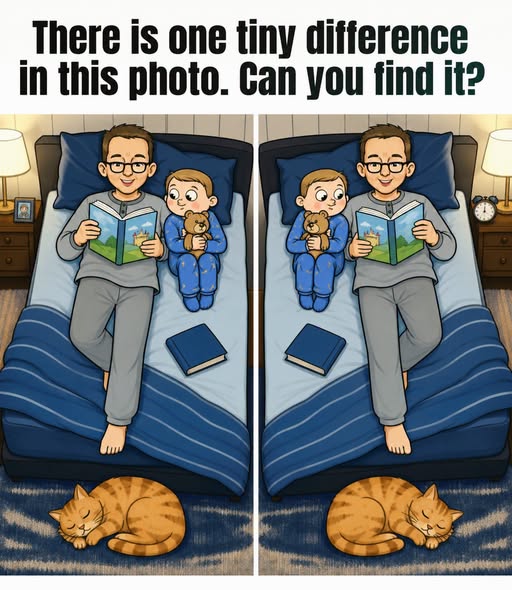
A single detail is wrong. Most people never notice it. You can stare at the father’s gentle smile, the boy curled up in his pajamas, and the sleeping cat stretched across the rug, yet somehow the mistake remains hidden in plain sight. Everything about the scene feels warm and familiar. The soft bedtime setting, the quiet expressions, the scattered books—it all looks almost too perfect. That is what makes the illusion so effective. Your eyes tell you that the two pictures are identical, while somewhere in your mind, a tiny warning keeps insisting that something is not quite right.
This is the kind of visual puzzle that seems easy until you actually try to solve it. At first, most people scan both images quickly, comparing the overall shapes and colors without realizing how much information their brains automatically ignore. Because the scene is so ordinary and comforting, your attention naturally focuses on the father, the child, and the cat instead of the tiny details hiding around them. The difference is deliberately subtle, forcing you to abandon the instinct to glance and move on.
The best way to find it is to slow down and examine the image systematically. Start with the father. Look closely at his face, his expression, and especially his glasses. Compare the smallest details rather than simply asking whether he looks the same. Then move down to the book in his hands. Check its position, shape, and the details surrounding it. Tiny changes can easily disappear when you look at the entire picture at once.
After that, shift your attention to the boy. Study his expression carefully, then examine the pajamas. Look at their patterns, folds, and small features. Instead of letting your eyes jump around the scene, give each section a few seconds of focused attention. The puzzle is designed so that a quick glance feels convincing, while careful observation begins to expose what your first impression missed.
Then move toward the background. Examine the bed, the pillows, and the blanket. Look at the folds and the spaces between objects. Check the open book resting nearby and compare its position and appearance. These are exactly the kinds of details that the brain tends to overlook because they seem unimportant to the overall story of the image.
Finally, turn your attention to the cat on the rug. It may seem like the least important part of the picture, but that is precisely why it deserves a closer look. Study its stripes, the curve of its tail, the position of its paws, and even the pattern underneath its body. When solving these puzzles, ordinary objects often become the hiding place for the one detail your brain is trying to skip over.
The difference is small, but it is intentional. Nothing about the scene is meant to immediately announce that something has changed. Instead, the puzzle relies on your expectations. Your brain sees a familiar bedtime moment and quickly fills in the details, allowing you to recognize the larger picture without carefully inspecting every individual element.
That is why finding the mistake can feel surprisingly satisfying. There is a moment when your eyes suddenly lock onto the difference, and everything changes. What looked completely identical a second earlier now seems obviously different. You may even wonder how you managed to overlook it in the first place.
But that is the real challenge. These puzzles are not necessarily testing how sharp your eyesight is. They are testing your patience and attention. In everyday life, we are constantly encouraged to move quickly, skim information, and make instant judgments. A picture like this asks you to do the opposite.
Slow down. Look again. Compare what you think you see with what is actually there.
When the hidden difference finally clicks, the reward is more than simply solving another spot-the-difference puzzle. It is that brief feeling of realizing your first impression was incomplete. You did not need better eyes. You simply needed to give yourself enough time to truly see.
And sometimes, that is the hardest part of all.