The plate shattered before the truth did.
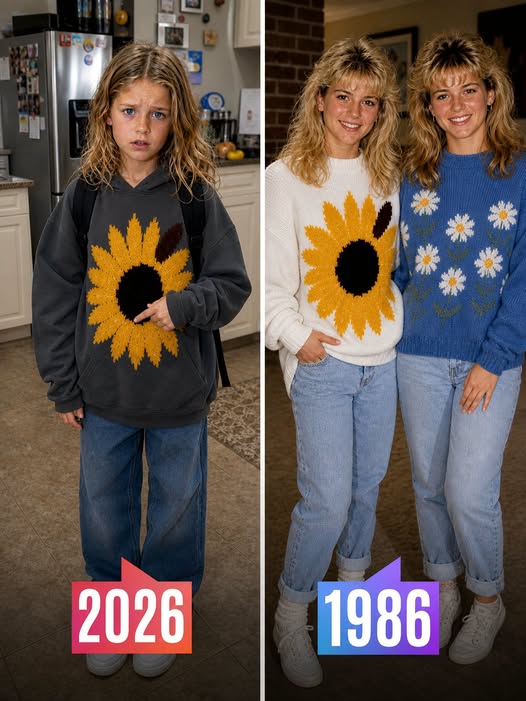
For a second, all I could hear was the sharp crack of ceramic against the kitchen floor. Then came the silence—the kind that feels heavier than any sound. Four decades of unanswered questions seemed to explode in that single moment when I looked up and saw my missing twin’s sweater on my granddaughter’s shoulders.
A sunflower was stitched into the fabric.
There was a hidden pocket I remembered from childhood.
And suddenly, objects that had meant nothing to me before began connecting themselves to a story I had spent most of my life trying not to imagine.
A carved wooden flower from a father who had lied.
A janitor who somehow knew my name.
A sister who had come back once—and been turned away.
For forty years, I had lived with an empty space where Laura should have been. I had learned how to talk about her without really talking about her. I learned how to answer questions from strangers, how to avoid certain memories, and how to smile when people asked whether I had ever found out what happened.
But seeing that sweater changed everything.
Suddenly, the past wasn’t a collection of fragments anymore.
It was a trail.
And every fragment led back to the same person.
Laura.
I had imagined kidnappings, accidents, even secret illnesses, because those stories felt easier than believing someone you love simply chose to leave. When someone disappears without an explanation, the mind creates possibilities because uncertainty is unbearable. I spent years imagining the worst because, in some strange way, believing she had died felt easier than wondering whether she had been alive somewhere without me.
There were moments when I convinced myself she had been taken.
Other times, I imagined she had been hurt and was unable to find her way home.
I even wondered whether she had been living with some terrible secret that prevented her from contacting us.
But I never seriously considered the possibility that she had walked away by choice.
And I certainly never imagined that she might have tried to come back.
Learning that Laura had left, then eventually tried to return and been refused, forced me to confront something far more ordinary—and far more devastating—than the stories I had invented in my head.
The damage we do when pride and fear speak louder than love.
That realization hurt in a way no imaginary tragedy ever had.
A kidnapping would have given me someone to blame.
An accident would have given me something to mourn.
An illness would have given me a reason.
But this gave me questions.
Why didn’t anyone tell me?
Why was she turned away?
What did she say when she came back?
How long had she waited?
Did she think I didn’t want her?
Did she believe I had forgotten her?
And how many times had she wondered whether I was still looking for her?
The cruelest part was realizing that the separation might not have been inevitable.
Maybe there had been a moment when everything could have changed.
Maybe one open door, one honest conversation, or one act of courage could have brought us back together decades earlier.
Instead, silence became habit.
Then habit became history.
And history became a life neither of us had chosen consciously, but both of us had been forced to live.
My father’s confession did not restore what we had lost.
It couldn’t give me back the birthdays Laura missed, the holidays we spent apart, the childhood memories we should have shared, or the countless ordinary moments that disappeared while I was wondering where she was.
It couldn’t erase the years.
But it finally gave shape to the ache that had followed me through every season of my life.
For the first time, the emptiness had an explanation.
And sometimes an explanation is painful precisely because it makes the past real.
I began looking at old memories differently.
Photographs I had stored away suddenly seemed incomplete.
Stories my family had told me sounded different.
Things I had once dismissed as strange or insignificant began carrying new meaning.
Even the carved wooden flower—the small object connected to my father’s lie—became more than something sitting on a shelf. It became part of a history that had been hidden from me for most of my life.
And then there was the janitor.
The fact that he knew my name.
The fact that someone outside the family appeared to know pieces of a story I had spent decades trying to understand.
It was almost too much to process.
Every answer seemed to create another question.
But eventually, I realized I couldn’t keep living as though solving the mystery would somehow return my lost life to me.
There are some doors that, once opened, don’t lead backward.
They lead to a different understanding of the present.
I still don’t know if Laura will ever knock on my door.
I don’t know whether she wants to see me.
I don’t know what she remembers.
I don’t know whether forty years of distance can be crossed by a single conversation.
And I don’t know whether the sister I remember from childhood still exists in the person she became.
Those uncertainties remain.
But my life no longer hangs on the possibility of reunion.
That may be the most unexpected thing I have learned.
For so long, I believed that finding Laura was the missing piece that would finally make everything whole. I imagined that one day she would appear, we would embrace, cry, and somehow the years between us would disappear.
Real life isn’t that simple.
Even if she comes back, the decades are still gone.
The children we were are still children only in our memories.
The people who made those decisions have changed, aged, or disappeared.
The pain remains part of the story.
But so does love.
I can hold grief and hope in the same hand now.
I can miss her without allowing the missing to consume everything else.
I can keep her sweater folded carefully in a drawer without treating it like a promise that she will return.
And I can sit beside my granddaughter while she draws a sunflower with one brown petal.
She doesn’t know everything the flower means.
To her, it is simply something beautiful she decided to draw differently.
But when I look at that imperfect sunflower, I see something else.
I see the past.
I see the missing years.
I see the sister I lost.
I see the family secrets that shaped lives without our permission.
And I see something I didn’t understand for most of my life:
Not everything broken can be restored to exactly what it was.
Sometimes healing means accepting that.
The past is real.
The loss is real.
The choices people made are real.
But they are not the only story left to live.
My life cannot be reduced to the day Laura disappeared.
It cannot be defined entirely by my father’s lies or by the years I spent searching for an answer.
There are still mornings.
There are still people who love me.
There are still stories waiting to be told.
There are still sunflowers my granddaughter can draw with whatever colors she wants.
And maybe that is enough.
Maybe the point isn’t to erase the missing years.
Maybe it’s to stop allowing them to steal the years that remain.
So I keep the sweater.
I keep the wooden flower.
I keep the memories.
But I no longer keep my life waiting at the door.
If Laura ever knocks, I will decide what comes next when that moment arrives.
Until then, I will live.
Not because I have stopped loving her.
But because I finally understand that loving someone who is missing does not require disappearing with them.
The past is part of me.
It always will be.
But it is not the only story I have left to tell.