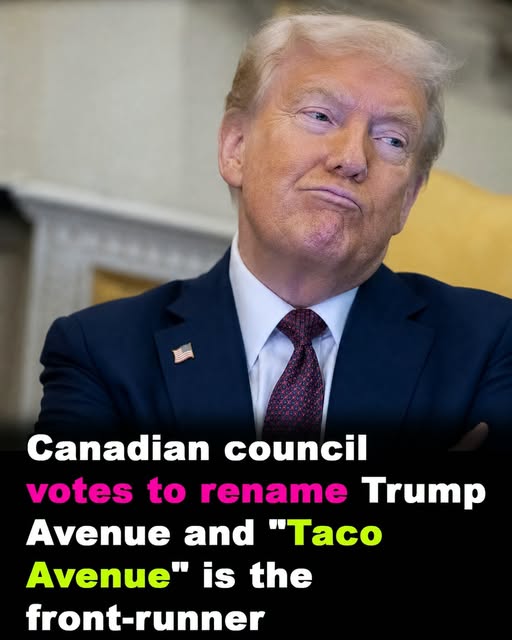
Ottawa just declared war on a street sign.
What was once nothing more than an ordinary suburban road has suddenly become a tiny geopolitical battleground. In a unanimous vote, city council moved to strip “Trump Avenue” from the map, turning a simple piece of local infrastructure into a symbol of a much larger political fight.
Neighbors are divided.
Some see the name as embarrassing and outdated. Others wonder why international politics should dictate what appears on their postal address. And beyond the neighborhood itself, people across Canada and the United States are watching what might seem like a bizarrely small dispute take on an outsized meaning.
And then came the wildest replacement idea.
It wasn’t “Obama Avenue.”
It wasn’t even another conventional political name.
It was “Taco Avenue.”
At first, the suggestion sounded like another internet joke. But the name quickly gained attention because of the acronym behind it: “Trump Always Chickens Out.” What began as a humorous jab became part of a larger conversation about whether a street name should be a serious civic decision, a political statement, or simply something residents can laugh about.
Twenty-five years ago, Trump Avenue was just another gimmicky name in a New York–themed subdivision. It wasn’t necessarily intended to become a major political symbol. It was simply a name attached to a residential street, surrounded by houses, driveways, lawns, and the ordinary routines of suburban life.
Nobody could have predicted that decades later, the same street sign would become part of an international political argument.
But the world changed.
And so did the meaning attached to the name.
With tariffs climbing and tensions between Canada and the United States becoming increasingly difficult to ignore, the old street name suddenly carried political baggage that it never had when it was chosen. Trump’s rhetoric and efforts to rebrand Lake Ontario as “Lake America” added another layer to the controversy, making what once seemed like a harmless novelty suddenly feel provocative to some Canadians.
Councillors called the name embarrassing.
The mayor made his position even clearer, saying he does not want Trump’s name anywhere in the capital.
What once produced little more than a shrug has hardened into a line in the sand.
For some residents, keeping the name now feels like an unnecessary reminder of a political figure whose policies and rhetoric have created significant tension between neighboring countries.
For others, the argument is much simpler.
It’s their street.
They have lived there for years.
Their mail arrives there.
Their driver’s licenses, utility bills, insurance records, business documents, and countless other pieces of paperwork may carry that address.
And changing it isn’t necessarily as simple as replacing a sign.
Residents caught between global politics and postal codes are being asked to weigh two very different kinds of cost.
There is the symbolic cost of keeping a name that some residents no longer feel represents them.
And there is the practical cost of changing everything associated with that name.
A street-name change can mean updating government records, identification documents, banking information, insurance policies, subscriptions, business records, maps, deliveries, and countless databases that quietly depend on an accurate address.
For someone living on the street, political symbolism can quickly become administrative work.
That’s where the debate becomes more complicated than the headlines suggest.
The replacement possibilities have added another layer of entertainment to the discussion.
Some suggestions are deliberately sober.
“Canada Avenue” would provide an uncomplicated alternative, replacing a controversial political reference with a name designed to emphasize national identity.
Other possibilities are openly partisan.
A name like “Pelosi Avenue” would simply replace one political figure with another, potentially turning the street into a permanent political punchline rather than removing politics from the address altogether.
And then there is “Taco Avenue.”
The joke is obvious once the acronym is explained, but its popularity reveals something interesting about the moment. People aren’t just debating what the street should be called.
They’re having fun with the fact that an ordinary road has suddenly become a stage for international politics.
Memes spread.
Jokes multiply.
People who had never heard of the neighborhood suddenly know exactly where Trump Avenue is.
The absurdity is part of what makes the story so compelling.
A street sign normally exists to help someone find an address.
It isn’t supposed to become a diplomatic statement.
It isn’t supposed to represent trade policy.
It isn’t supposed to symbolize tensions between two countries.
And yet, political symbols have a way of attaching themselves to ordinary objects.
A name on a map can become a statement.
A statue can become a controversy.
A building can become a political landmark.
And eventually, even a suburban street can become a battleground over identity.
For residents, however, the issue remains much more personal.
They aren’t debating foreign policy in an abstract sense.
They are deciding whether the name printed on their home address still feels like theirs.
Some may believe that keeping it is harmless and that changing it simply gives politics too much influence over everyday life.
Others may feel that a name is not neutral once the person it honors becomes deeply associated with policies and rhetoric they reject.
Both sides face a practical reality: eventually, someone has to live with the decision.
The council can vote.
Politicians can make statements.
Social media can produce memes.
But residents will be the ones receiving mail under the new name, explaining the change to businesses, updating documents, and answering questions from friends and delivery drivers.
That tension between symbolism and inconvenience may ultimately define the debate.
How much disruption is worth removing a name?
How much discomfort is worth keeping it?
And at what point does a street name stop being a harmless historical detail and become something residents feel they are being forced to carry?
Those questions don’t have easy answers.
The irony is that twenty-five years ago, almost nobody would have expected a street in a New York-themed Ottawa subdivision to become part of a political conversation reaching far beyond its neighborhood.
Back then, it was just a gimmicky name.
Today, it has become a tiny reflection of a much larger relationship between Canada and the United States.
And perhaps that’s why the debate has attracted so much attention.
It isn’t really about a road.
It’s about what names represent.
It’s about whether symbols can become outdated.
It’s about how international politics can suddenly enter the most ordinary corners of everyday life.
And it’s about whether residents should have to carry a political message every time they write down their address.
Maybe the final name will be serious.
Maybe it will be patriotic.
Maybe it will be deliberately partisan.
Or maybe, somehow, “Taco Avenue” will survive long enough to become the joke everyone remembers.
Whatever happens, one thing is already clear.
The sign that once meant nothing has become a symbol of something much bigger.
And in Ottawa, a few letters bolted to a metal pole have managed to turn an ordinary suburban street into one of the strangest political battlegrounds imaginable.