My wife, Brittany, kissed our son on the forehead, grabbed her rolling suitcase, and gave me that familiar smile—the one she used when she wanted to seem effortlessly generous.
“Three days in Napa,” she said from the doorway. “You boys will survive without me.”
Then she got into her white SUV, backed out of our driveway in central Ohio, and drove off.
I stood in the kitchen, coffee in hand, watching her taillights disappear. The house settled into its usual morning quiet—the TV murmuring in the living room, the neighbor’s sprinklers clicking on outside.
Normal. Ordinary.
Then I heard a chair scrape across the tile.
I turned.
Noah was standing beside the kitchen island.
For a moment, I couldn’t move. My brain struggled to reconcile what I was seeing with everything I believed to be true.
My son had been in a wheelchair for six years.
A highway accident had left him with a severe spinal cord injury. Doctors had stopped using words like “recovery” and started saying “management” and “realistic expectations.”
Six years of ramps. Appointments. Medications. Adjustments. Acceptance.
And now my sixteen-year-old son was standing on his own two feet.
The coffee mug slipped from my hand and shattered.
“Dad,” he said quietly, his voice steady but urgent, “don’t yell. Don’t call anyone. Just listen.”
I stepped toward him, afraid he might fall, but he caught my wrist.
“We need to leave. Right now.”
There was no panic in his voice. That made it worse.
“What are you talking about? How are you even—”
“There’s no time,” he said. “She’s gone. This is our chance. Please trust me.”
She.
Not Mom.
Something cold settled in my chest.
“Noah… did your mother do something to you?”
He glanced toward the hallway—toward the camera Brittany had installed last year—then leaned closer.
“She lied,” he whispered. “About me. For years.”
My stomach dropped.
“She told everyone I couldn’t walk,” he said. “Made sure I stayed scared enough not to try.”
“That doesn’t make sense.”
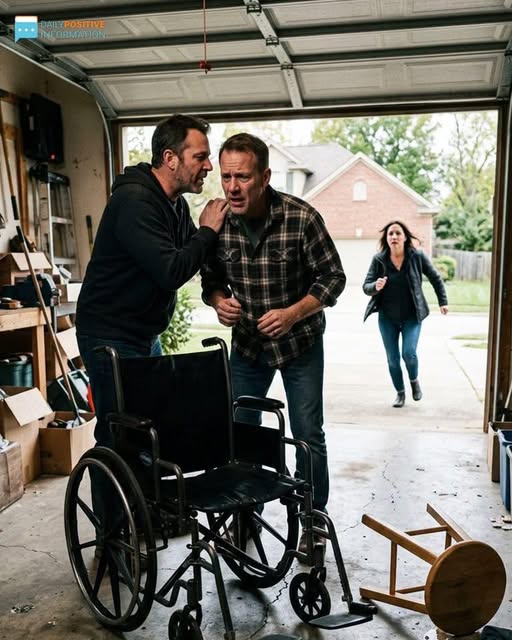
“It will,” he said. “When you see what’s in the garage.”
That was enough.
I grabbed my keys, wrapped an arm around him, and got him through the mudroom and into the garage. His legs were weak, but they worked.
I helped him into the car.
Then we heard the back door slam open.
“Ethan!”
Brittany’s voice.
I froze.
She wasn’t supposed to be back.
She came around the house barefoot, phone in hand, her expression sharp—controlled, urgent, not surprised.
“Stop the car!”
For a split second, instinct told me to listen.
Then I looked at Noah.
He was shaking—terrified.
I hit the gas.
We drove.
We didn’t speak until we reached the highway.
“Tell me everything,” I said.
Noah stared straight ahead.
“Don’t go home alone. Don’t answer her calls. And don’t call Grandpa.”
That last part hit hard.
“He knows something,” Noah said. “Maybe not everything. But something.”
Then he told me.
Three years ago, his doctor had said Noah still had potential—more movement than expected. He needed more aggressive therapy.
Brittany shut it down.
She told me insurance denied it.
She forged the letters.
She canceled appointments.
She controlled everything.
“Why?” I asked.
Noah’s voice dropped.
“Because being my mom got her attention. Donations. Sympathy.”
I thought about the fundraisers. The online posts. The praise.
“How long have you been able to stand?”
“A few months.”
“You hid it?”
“She made me afraid,” he said. “Said I’d make it worse. Said you’d leave if I cost too much.”
My chest tightened.
“I would never—”
“I know that now,” he said.
Then he told me the worst part.
She had been planning to move him—out of state—to a long-term care facility. Without me. With legal guardianship papers already in progress.
“Everything’s in the garage,” he said. “Locked cabinet. Cash. Records. Proof.”
My phone lit up.
A message:
Bring my son back or I call the police.
I didn’t answer.
“If we go back without proof,” Noah said, “she wins.”
I called someone I trusted—a sheriff’s deputy named Daniel.
When he arrived and saw Noah standing, he didn’t question anything.
We went back together.
In the garage, we found the cabinet.
Inside:
Cash.
Fake records.
Real medical reports showing Noah’s improvement—hidden from me.
And the guardianship documents.
Then we heard something crash inside the house.
Brittany walked into the kitchen with a duffel bag and a lockbox.
She saw me.
Then Daniel.
Then Noah—standing.
For a moment, she tried to recover.
“Whatever he told you—he’s confused,” she said calmly.
Then she saw Noah properly.
Really saw him.
And her face changed.
Not relief.
Not joy.
Fury.
“You ungrateful little liar.”
Everything stopped.
Daniel stepped forward.
“Put the bag down.”
She tried to run.
He stopped her.
The lockbox hit the floor and burst open—cash, documents, checks… including one to a care facility in Missouri.
It was over.
The investigation took weeks.
She had been stealing donations for years.
Forging documents.
Blocking Noah’s treatment.
Planning to take him away.
The charges followed. So did the divorce.
Two months later, Noah started real rehabilitation.
It wasn’t miraculous.
It was slow. Painful. Honest.
But it was real.
The first time he walked across the therapy room, I couldn’t hold it together.
Not because he was failing.
Because he finally had a chance.
I still think about that morning.
The coffee mug hitting the floor.
The look on his face—not joy, but urgency.
He had a five-minute window.
And he used it.
I had one choice.
And I chose to believe him.
That decision gave him his life back.
Noah is seventeen now.
Last month, he walked into the kitchen without his walker.
No announcement. No moment.
Just walked in, opened the fridge, looked around, and said:
“We’re out of orange juice.”
“I’ll get some,” I said.
“Okay.”
That was it.
The kitchen was quiet. Ordinary.
And for the first time in years—
everything was exactly as it should be.