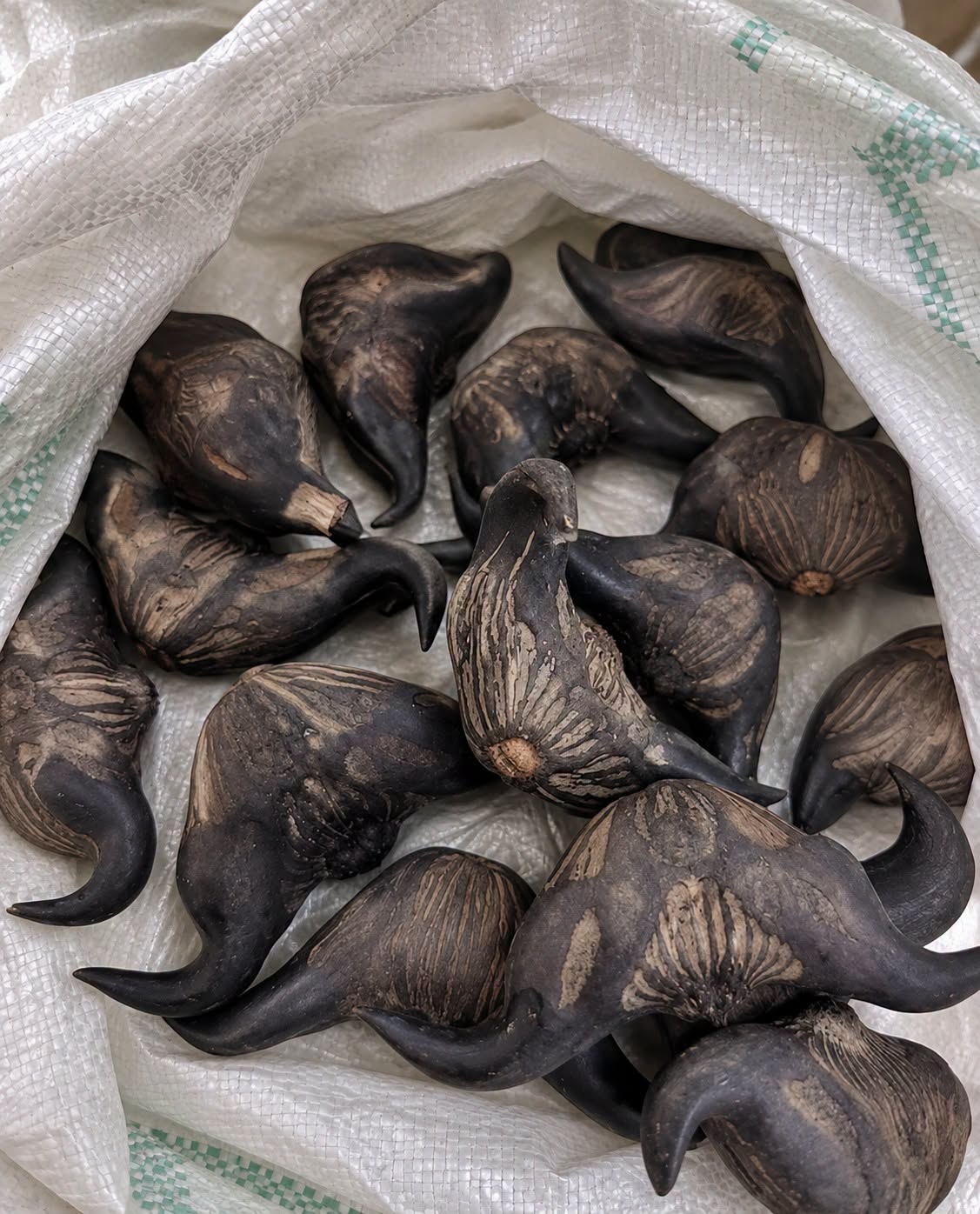
At first glance, they look less like something you would eat and more like something you might find hidden in an old box of cursed artifacts. Black, horned, angular, and surprisingly hard as stone, the strange fruits sitting inside a simple plastic bag can look almost weapon-like. Their sharp points seem designed to warn you away, and when you turn one over in your hands, the first question that naturally comes to mind is not how to cook it, but whether it is even safe to touch or eat.
One wrong assumption can have serious consequences. A careless bite of a raw freshwater plant fruit may expose you to organisms that live in the same ponds and lakes where the plant grows. What looks like an unusual snack can therefore become a health concern if it has been collected, identified, or prepared incorrectly. The mystery surrounding these fruits is part of what makes them so fascinating—but it is also exactly why caution matters.
They’re called **water caltrops**, although their unusual appearance has earned them a collection of dramatic nicknames, including **devil’s nuts, bat nuts, and buffalo nuts**. Different regions and cultures have given them different names, but nearly all of those names reflect the same first impression: these are fruits that look like they were designed by nature to defend themselves.
The dark, angular shells can have several pronounced horns extending outward in different directions. Their shape makes them difficult to handle casually, and the hard exterior protects what is hidden inside. Once properly prepared and opened, however, the intimidating exterior gives way to something completely different.
Inside is a pale, starchy kernel.
That kernel has quietly served as food for families across parts of Asia for generations. What initially appears threatening turns out to