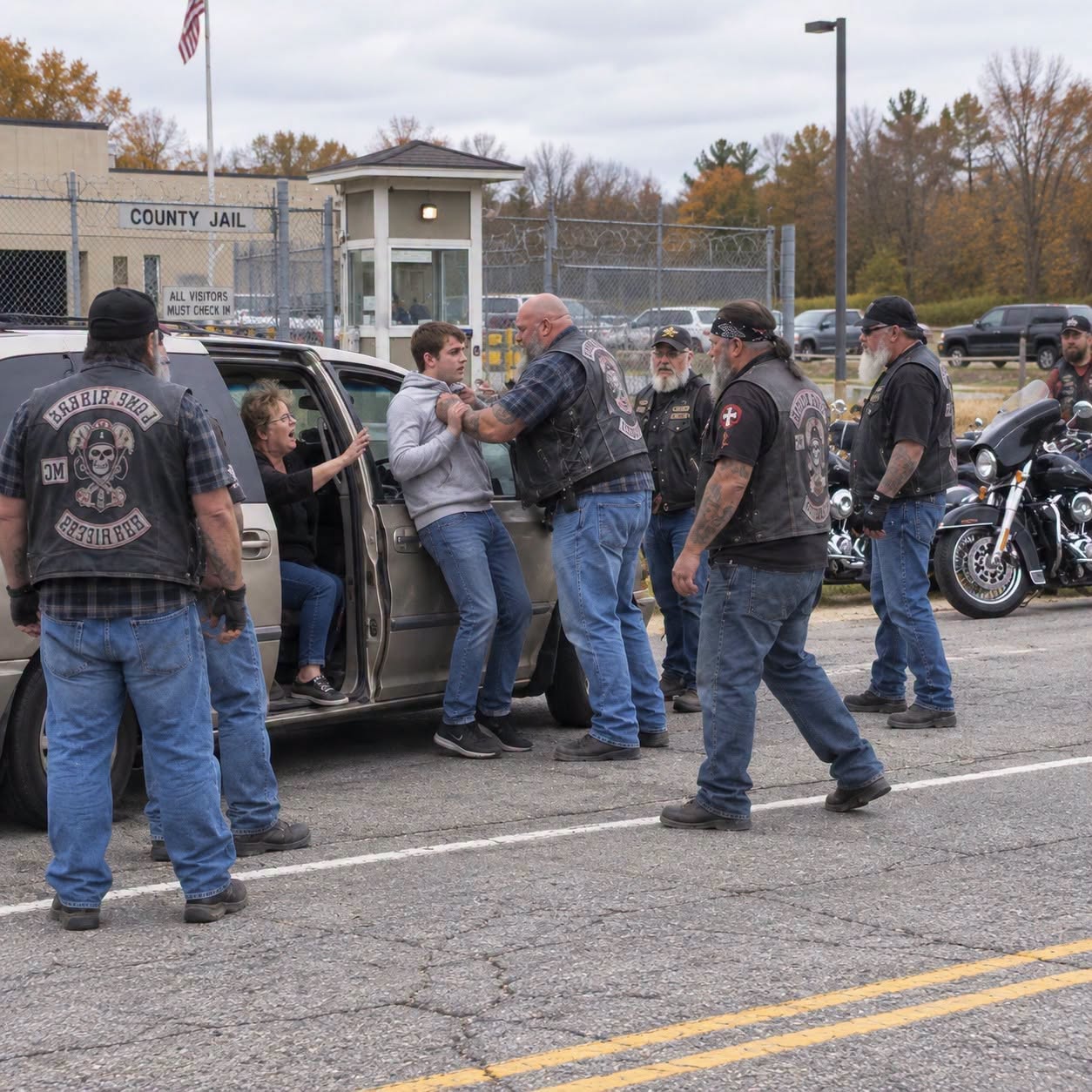
My Daughter’s Abuser Got Just 6 Months in Prison—So 80 Bikers Were Waiting at the Gate When He Got Out
When the judge announced the sentence, I felt as though the floor had disappeared beneath my feet.
Six months.
That was all the court had decided my daughter’s suffering deserved.
I sat frozen in the courtroom, my hands clenched so tightly that my fingernails dug into my palms. Beside me, my daughter stared at the floor. She was only fourteen when her life changed forever, and even now, months later, she still struggled to sleep through the night.
The man responsible stood beside his lawyer, looking relieved.
He had barely glanced in our direction.
Outside the courthouse, reporters asked me how I felt about the verdict. I couldn’t answer. What could I possibly say without breaking down in front of everyone?
That night, I sat at the kitchen table while my daughter slept upstairs. Her favorite mug sat untouched beside me, and the house was painfully quiet.
I kept thinking about the judge’s words.
Six months.
I wasn’t looking for revenge. I wanted my daughter to feel safe again. I wanted her to know that what had happened to her mattered.
But I couldn’t understand how the sentence could be so short.
Then my phone rang.
It was an old friend named Mike, a motorcycle enthusiast who had known our family for years.
“I heard about the sentence,” he said quietly.
I swallowed hard. “Everyone has.”
There was a pause.
“Listen, I can’t change what happened in that courtroom. None of us can. But I want you to know something. Your family isn’t standing alone.”
I thanked him and assumed that was the end of the conversation.
I had no idea what he was planning.
The Months That Followed
Those six months were some of the hardest of my life.
My daughter began seeing a counselor. Some days were better than others. Sometimes she laughed at a silly television show or asked me to make her favorite dinner, and I dared to believe that we were finding our way forward.
Then a sound, a memory, or an unexpected encounter would send her retreating into herself.
I learned to stop asking whether she was feeling better and instead ask what she needed that day.
We took small steps.
A walk around the neighborhood. A movie night. Breakfast together on Saturday mornings.
Slowly, she began to smile more often.
But the release date hung over us like a dark cloud.
She knew when it was coming. I knew when it was coming. And neither of us knew how to talk about it without bringing back the fear.
One evening, she appeared in the kitchen while I was washing dishes.
“Mom?”
I turned off the faucet.
“Yes, sweetheart?”
“Will he be allowed to come near me again?”
The question broke my heart.
I dried my hands and pulled her into my arms.
“We’re going to make sure you have support,” I told her. “We’ll speak to the people who can explain what protections are available. You don’t have to handle this alone.”
She nodded against my shoulder.
That night, after she went to bed, I called Mike.
I told him I was frightened about the release and asked whether he knew anyone who could help us understand our options.
He listened without interrupting.
Then he said, “Let me make a few calls.”
The Message That Brought 80 Bikers Together
Mike belonged to a large motorcycle community. Some members were veterans, others were parents and grandparents, and many had spent years supporting families dealing with difficult circumstances.
When he told them what had happened to my daughter, people responded with messages of sympathy and offers of practical help.
They weren’t interested in turning my daughter’s pain into a public spectacle. They wanted her to know that adults would stand beside her and that she had not been forgotten.
As the release date approached, Mike called me again.
“We’d like to do something for your family,” he said. “Only if you’re comfortable with it.”
“What do you mean?”
“A group of us wants to be there on release day. We’ll stay in a public area, remain peaceful, and make it clear that your daughter has a community behind her.”
I hesitated.
I didn’t want violence. I didn’t want my daughter’s name appearing in another frightening headline. Most of all, I didn’t want her to feel that her suffering had become a show for strangers.
Mike understood.
“Nothing happens without your agreement,” he assured me. “And this isn’t about threatening anybody. It’s about support.”
After discussing it with my daughter and her counselor, we agreed that a peaceful show of solidarity might help us feel less alone.
The date was set.
And the word spread.
The Morning He Was Released
I woke before sunrise on the day of his release.
My daughter was still asleep, curled beneath her blanket. I stood in her doorway for a moment, wondering whether she would want to know what was happening outside the prison that morning.
We had agreed beforehand that she would not be required to attend or see anything that made her uncomfortable.
She chose to stay with my sister.
I drove alone to the meeting point, where Mike had arranged for the group to gather.
When I arrived, I stopped the car and stared.
Motorcycles lined the nearby public parking area. Men and women in leather jackets stood in small groups, talking quietly. Some held signs expressing support for survivors. Others simply waited beside their bikes.
There were around eighty of them.
Eighty people who had taken time out of their lives to show up for a family they barely knew.
Mike walked over and placed a hand on my shoulder.
“You don’t have to say anything,” he told me.
For the first time in months, I cried without feeling embarrassed.
Not because I wanted anyone to suffer.
Because, after months of feeling ignored by a system I didn’t understand, I finally felt that somebody had heard us.
When the Prison Gate Opened
As the morning passed, the group remained peaceful.
There were no threats, no attempts to block the entrance, and no one tried to approach the prison staff. The bikers stayed in the designated public area, leaving the authorities to carry out their responsibilities.
Some spoke quietly with me about their own families. Others offered coffee and asked whether I needed anything.
Mike introduced me to a woman whose organization helped connect survivors with counseling and support services.
She gave me her contact details and explained how she could help us find resources for the months ahead.
It was the first practical offer of support I’d received that morning, and I tucked the card carefully into my bag.
Then the prison gate opened.
A few people turned toward the entrance.
The man who had hurt my daughter emerged with his belongings. He looked toward the gathered crowd and stopped.
For a moment, the entire scene seemed to hold its breath.
The bikers didn’t rush toward him. Nobody touched him. Nobody tried to take justice into their own hands.
They simply remained where they were.
Some held their signs.
Others stood with their arms folded.
Mike stepped beside me.
“We’re here for your family,” he said. “That’s what matters.”
I watched the man walk away under the supervision of the arrangements surrounding his release.
I didn’t feel triumphant.
I didn’t feel that the past had been repaired.
But I felt something I hadn’t felt in a very long time.
I felt less afraid.
The Moment That Meant More Than the Crowd
Later that afternoon, I returned home.
My daughter was sitting on the sofa beside my sister, watching a comedy she’d seen a dozen times. When I walked in, she paused the television.
“How was it?” she asked.
I sat beside her.
“There were a lot of people,” I said. “They came to show us that we aren’t alone.”
“Did anything happen?”
“No. Everyone stayed peaceful.”
She thought about that for a moment.
Then she asked, “Did they come because of me?”
I took her hand.
“They came because what happened to you mattered. And because you deserve to be supported.”
She looked down at our hands.
“I don’t want everyone to know what happened to me,” she whispered.
I felt a sudden wave of guilt. I never wanted her private pain to become something she had to explain to the world.
“Then they don’t need to know your story,” I told her. “You get to decide what you share. You get to decide what comes next.”
She leaned against me.
We sat together for a long time, listening to the television and the familiar sounds of the house.
For the first time since the sentencing, she asked whether we could go out for ice cream the following day.
It was a small request.
But to me, it felt enormous.
She was thinking about tomorrow.
What the 80 Bikers Really Gave Us
In the days that followed, several members of the group checked in to see whether we needed help. One connected us with a local survivor-support organization. Another offered to help with transportation to appointments if we needed it.
Nobody demanded that we tell our story publicly. Nobody asked my daughter to pose for photographs or explain what she had been through.
They simply kept their promise to stand beside us.
The sentence had not changed. The months of pain had not disappeared, and the legal system’s decision remained something our family struggled to understand.
But the experience taught me something important.
Support doesn’t have to look like revenge. Strength doesn’t have to mean intimidation. And standing up for a victim doesn’t require causing more harm.
Sometimes it means showing up, staying peaceful, listening, and helping a family take the next step toward healing.
I still wish my daughter had never experienced what she did.
I still wish the legal process had left us feeling more supported.
But when I think about that morning, I no longer remember only the prison gate.
I remember eighty people who showed up because a child deserved to know that she mattered.
And I remember the conversation I had with my daughter that evening, when she asked whether we could go for ice cream.
That was the moment I understood what we had been fighting for all along.
Not revenge.
Not fear.
A future in which my daughter could feel safe enough to live her life again.
Because the most powerful response to cruelty is not always retaliation. Sometimes, it is a community standing together, protecting a survivor’s dignity, and reminding her that what happened to her does not define the rest of her life.