I have a habit, after evening walks, of trying to figure out what Max is thinking.
This is not as eccentric as it sounds. Anyone who has lived closely with a dog for long enough knows they have an interior life that communicates itself clearly if you pay attention, and Max has always been particularly expressive — a three-year-old shepherd mix with a face that somehow conveys both profound emotional complexity and complete transparency at the same time. He cannot deceive. When he is happy, his whole body announces it. When he is uncertain, his ears do something careful and questioning. When he spots a cat across the street, every muscle in his body tightens into a focused intensity that I find, honestly, a little inspiring.
I had gotten him eighteen months earlier, after moving into my apartment alone for the first time in my adult life. The apartment was fine — a decent-sized two-room flat on the third floor of a quiet building in a quiet neighborhood, the kind of place where you know your neighbors by face if not by name, where the hallway smells like cooking in the evenings, where the courtyard has a bench that two older men occupy most afternoons as if by assignment. I had liked the apartment from the first viewing. But in the evenings it had a particular quality of silence that I found harder to adjust to than I had expected.
Max changed that completely.
He arrived as a puppy in early spring, already disproportionately large for his age, with paws that suggested he had considerably more growing to do. He learned the apartment the way puppies learn spaces — thoroughly and somewhat destructively — and within a few weeks he had made every room unambiguously his. He had his positions: the armchair by the window in the mornings when the light came in at the right angle, the rug in front of the radiator in the evenings, the foot of my bed at night after he had decided that the floor near the window was drafty and the bed was better. He slotted himself into the apartment and into my life with such ease that it quickly became impossible to remember what the evenings had felt like before him.
What I liked most about Max was not the obvious things, though the obvious things were genuinely there — the greeting at the door, the warmth of a living body on a cold evening, the way a dog’s uncomplicated happiness about small things (a particular stick, the smell of a specific patch of pavement, the prospect of a walk) has a way of recalibrating your own relationship to small things. What I liked most was that he was perceptive.
This sounds like something all dog owners say. I don’t mean it generically. I mean that Max had a specific quality of attention that I noticed early and that I never stopped finding remarkable. He was watchful in a way that did not produce anxiety — he was not a nervous dog, not reactive or easily startled. He watched things the way someone watches who is genuinely interested in what they are seeing and is drawing their own conclusions. He noticed patterns. He knew my routines better than I did. He knew when I was getting ready to leave the apartment before I reached for my keys, and he knew the difference between leaving-for-a-while and leaving-for-the-evening, and he knew when something was not right.
I had seen this last quality in small ways. Once, a few months after I got him, I had a bad cold — not serious, just the kind that makes you feel slightly wrong in your own body, headachey and flat — and Max had spent the entire day pressed against my side in a way he normally wasn’t, monitoring me, which I had noted and been touched by. Another time, I had been arguing on the phone with someone in a way I was trying to keep calm and controlled, and Max had come and stood directly in front of me with his head tilted in a way that made it physically impossible to maintain the controlled tone — I had had to end the call and pet him, and the conversation continued the next day in a better register. He was simply attentive in a way that exceeded what I had understood dogs to be.
I am saying all of this because I want you to understand why, on the evening it happened, I still dismissed him.
Not at first. At first I paid attention. But then I stopped paying attention, because I was tired and cold and I had had a long day, and what he was doing seemed — from the outside, from where I was standing — irrational. And I let my interpretation of his behavior override what he was actually communicating.
This is the thing I have thought about most in the weeks since. Not the break-in itself, and not the outcome, which was fine — everything turned out fine. What I think about is the gap between what Max knew and what I was able to hear.
It was a Tuesday in November. The walk had been a routine one: the usual route through the neighborhood, down the side street with the linden trees, around the small park where Max liked to investigate the bench area with great methodical thoroughness, back up through the courtyard of our building. The evening was the kind that November produces reliably in this city: not particularly cold, slightly damp, the sky already fully dark by six o’clock, the streetlights making orange circles on the wet pavement. A normal evening. The kind I had spent so many times in the past eighteen months that I had stopped noticing them, which is both the best and the worst thing about routine.
Max had been excellent on the walk, which he usually was. He had a good loose-leash habit that I had worked on with some dedication in his puppyhood, and by now it was simply how he walked — at my pace, checking in with glances upward every half minute or so, alert to the environment without being pulled around by it. We had passed two other dogs without incident, which was not always guaranteed. We had paused at the corner for Max to complete a lengthy olfactory investigation of a lamppost that apparently held more information than I could imagine. We had come home without incident.
I came through the courtyard gate and crossed the yard toward the entrance. There was no one around. The two older men with their bench had long since gone in. The building’s front door was propped open slightly by the rubber doorstop the ground-floor tenant had installed years ago and which everyone simply accepted, and I pushed it open and started up the stairs, Max at my side, both of us doing what we always did.
We reached the third floor. The hallway was quiet. The cooking smells from earlier — something with onions from the apartment across the landing — had faded to a faint trace. The light in the hallway was the usual slightly-too-dim overhead light that the building association had discussed replacing twice in building meetings and had not replaced.
I stopped at my door.
I shifted the leash to my left hand and opened my bag with my right, feeling around for my keys, which live in the outer pocket and should have been immediately locatable. They were not immediately locatable. I was rummaging with the mild irritation of someone who has done this exact thing too many times and is aware that the solution is simply to always put the keys in the same place and has so far failed to implement this solution.
And in the second or two that I was doing this, I felt Max change.
I felt it before I saw it. The leash, which had been slack, went taut. Not pulling-toward-something taut — the specific tension of a dog who has suddenly gathered himself, stilled, redirected. I looked down.
He was staring at the door.
Not looking at it the way a dog looks at a familiar door — the forward-leaning attention of a dog who knows that in approximately thirty seconds they will be inside and the water bowl is inside and the radiator rug is inside. This was different. His ears were up and forward, tight and precise. His tail was horizontal and stiff, not moving. His body had that compressed quality of complete muscular readiness. And he was making a sound I had heard perhaps twice before in eighteen months: a growl so low it was almost subsonic, a sound from somewhere very deep in his chest.
“Hey,” I said. “It’s okay. What is it?”
He gave no indication that he had heard me. He did not look at me. His eyes stayed fixed on the door.
I found my keys and pulled them out. The key ring made the small metallic sound it always makes, and at that sound Max did something unusual: he turned from the door, looked directly at me, and pushed his nose against my hand holding the keys. Not sniffing. Pushing. A deliberate physical contact that felt urgent and intentional.
“Max,” I said.
He pushed his nose against my hand again. Then he turned back to the door and the growl resumed.
I was tired. My shoulders were stiff from a long day at my desk. My coat was damp from the fine drizzle. I wanted to be inside. I wanted to feed him and take off my coat and sit down and be done with the day.
I told myself he had heard something inside — a neighbor’s television, a pipe, a sound from the floor below. He was sensitive to sounds I couldn’t hear. This was surely that.
I put the key toward the lock.
Max stepped in front of me.
He did it deliberately, placing his body between me and the door with calm certainty, as if he had already decided this was not negotiable. He was looking up at me now, and the expression on his face was not one I had a name for at the time — not fear exactly. Urgency. A need to be understood.
“Move,” I said. Not unkindly, but firmly.
He did not move. He whined — a thin, high sound completely unlike him — and pressed himself harder against my legs.
I tried to step around him. He repositioned instantly, blocking me again, and then he grabbed the hem of my jacket in his teeth and pulled. Backward. Away from the door.
“Max, stop it,” I said, louder.
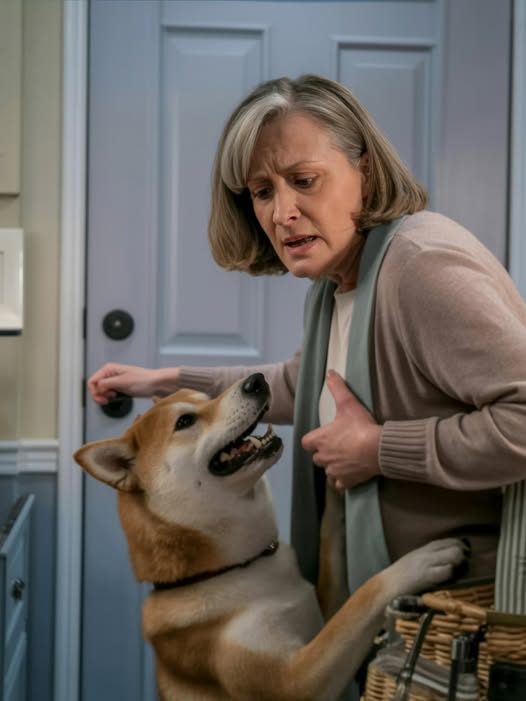
He released the jacket and stood up on his hind legs, placing his paws against my stomach, staring directly into my face. His eyes were bright and strained, as if he were running at the limit of what he could communicate.
I pushed him down. I found the lock with the key.
He barked.
Not his normal bark. This was sharp, repeated, urgent — a sound that went straight through me before I understood why.
I hesitated.
My hand was in the lock. Max was barking behind me with a desperation I had never heard from him, and for a moment I almost stopped.
I did not stop.
I turned the key.
I opened the door.
I stepped inside.
For half a second, it was simply my apartment. Dark, quiet, familiar. The smell of home. The held-breath stillness of a space left alone.
And then, underneath that, something else.
A smell that was not mine.
Not dramatic. Not immediately identifiable as danger. Just wrong — the presence of someone who had been inside my space when I was not there. The recognition formed before thought.
And I saw the drawer.
The hallway console drawer was open. Not fully. Not dramatically. Just slightly ajar — two inches, maybe, enough to say it had been opened and not properly closed again. A small detail. A decisive one.
I had closed it that morning. I remembered the exact moment.
It was open.
And then I heard it.
Very faint. A shift. A creak. The kind of sound that would normally disappear into the building’s background noise — except there was no background noise now. There was only me, the smell, the open drawer, and the realization that followed a fraction of a second later:
There was someone in the room.
I have a habit, after my evening walks, of trying to interpret what Max might be thinking.
It isn’t as strange as it might sound. Anyone who has lived closely with a dog for any meaningful stretch of time knows they carry an inner life that becomes readable if you learn how to observe it properly, and Max has always been especially legible in that way — a three-year-old shepherd mix whose face manages to communicate both deep emotional nuance and total openness at the same time. He doesn’t really conceal anything. When he’s happy, it shows through his entire body. When he’s unsure, his ears shift into a cautious, questioning posture. When he notices a cat across the street, every muscle in him locks into a kind of focused intensity that I have to admit I find almost admirable.
I brought him home eighteen months ago, when I moved into my apartment alone for the first time as an adult. The place itself was perfectly adequate — a modest two-room flat on the third floor of a quiet building in a quiet district, the kind of neighborhood where people recognize each other without necessarily knowing names, where evening air carries the smell of dinner from different kitchens, and where a courtyard bench is occupied each afternoon by the same two older men as though it were their assigned duty. I liked the apartment immediately when I saw it. But in the evenings, it had a silence that I had not anticipated and found more difficult to adjust to than expected.
Max changed that entirely.
He arrived as a puppy in early spring, already large for his age, paws too big for his body in a way that clearly suggested he would keep growing. He learned the space in the way puppies do — with enthusiasm and occasional destruction — and within weeks he had claimed every room as his own. He developed his routines: the armchair near the window in the mornings when the light hit just right, the rug in front of the radiator in the evenings, and the foot of my bed at night after deciding the floor near the window was too drafty. He fit himself into both the apartment and my life so completely that it quickly became hard to remember what evenings felt like before him.
What I appreciated most about Max was not only the obvious things, though those were certainly real — the way he greeted me at the door, the warmth of a living body in a cold room, the way a dog’s simple joy in small things (a stick, a scent trail on pavement, the idea of a walk) can quietly reset your own sense of scale. What stood out most was his attentiveness.
People say this about their dogs, but I mean something specific. Max had a quality of focus that I noticed early and never stopped finding remarkable. He watched things as though he was actively thinking about them, not reacting in anxiety but observing with intent, as if forming conclusions. He picked up patterns. He understood my routines better than I did. He knew when I was about to leave before I even reached for my keys, and he could distinguish between a short departure and an evening absence. And he noticed when something was off.
I saw this in small incidents. Once, when I had a mild illness — nothing serious, just a heavy cold that left me sluggish and slightly disconnected from myself — he stayed pressed against me all day in a way he normally wouldn’t, as if monitoring my condition. Another time, during a phone call I was trying to keep composed, he stood directly in front of me and tilted his head in a way that made it impossible for me to maintain the tone I was using. I ended the call and focused on him instead. He was simply more perceptive than I had expected a dog to be.
I explain this because I need it to be clear why, on the night in question, I initially ignored him.
Not immediately — at first I did notice. But then I stopped noticing, because I was tired and cold and mentally worn down, and what he was doing seemed irrational from my perspective. I overrode what he was communicating with my own assumptions.
That is the part I’ve returned to most often since then. Not the incident itself, and not even the outcome, which ultimately resolved without lasting harm. What stays with me is the distance between what Max understood and what I allowed myself to understand.
It was a Tuesday in November. The walk had been ordinary in every way: our usual route through the neighborhood, past the linden trees, around the small park where Max always investigates the same bench area with methodical focus, and back through the building courtyard. The evening had that typical November quality in this city — slightly damp, not particularly cold, fully dark by early evening, streetlights casting warm circles on wet pavement. Nothing notable. One of those evenings that becomes invisible through repetition.
Max had walked perfectly, as usual. He has excellent leash manners, something I trained carefully when he was young, and by now it’s simply how he moves — at my pace, checking in regularly, alert but not reactive. We had passed other dogs without issue. We had stopped so he could investigate a lamppost with unusual intensity. We returned home without anything out of the ordinary.
We entered the courtyard and crossed toward the building entrance. It was empty. The usual bench occupants were gone. The front door was slightly held open by a rubber stop that the ground-floor tenant had installed years ago and no one ever bothered to remove. I pushed it open and we went inside.
We climbed to the third floor. The corridor was quiet. The smell of cooking from earlier had faded. The lighting was the same dim overhead glow that had been discussed in building meetings and never improved.
I stopped at my door.
I shifted Max’s leash to one hand and reached into my bag with the other, searching for my keys, which were supposed to be in the same pocket as always but weren’t immediately there. I was mildly annoyed in that familiar way that comes from repeating the same minor inconvenience too often.
And then Max changed.
I felt it before I saw it. The leash went tight — not in a pulling way, but in a sudden, controlled stillness. I looked down.
He was staring directly at the door.
Not in the usual anticipatory way he looks at a door he knows will open soon, but differently. His ears were forward and rigid. His tail was still. His body had compressed into a focused readiness I had never seen from him in quite that form. And then came a sound I had only heard from him a couple of times before: a low, deep growl that seemed to come from somewhere below normal hearing range.
“Hey,” I said. “What is it?”
He didn’t respond. His attention stayed fixed on the door.
I found my keys and pulled them out. The small metallic sound they made caused him to turn abruptly toward my hand. He pushed his nose into my fingers holding the keys — not sniffing casually, but pressing with urgency, as if trying to redirect me physically.
“Max,” I said.
He repeated the gesture, then turned back toward the door and resumed the growl.
I was tired. My shoulders ached. My coat was slightly damp from drizzle. All I wanted was to go inside, feed him, and sit down. I rationalized his behavior as sensitivity — perhaps he had heard something from another apartment, a pipe noise, a television, something meaningless. That seemed reasonable.
I raised the key toward the lock.
Max stepped directly in front of me.
He positioned himself between me and the door with deliberate intent. Now he was looking up at me. His expression — which I didn’t yet have a framework for — was urgent in a way that carried something more than discomfort. It was communication under strain, as if he were pushing against the limits of what he could express.
“Move,” I said, more firmly.
He didn’t. He made a high, strained whine and pressed into my legs.
I tried to step around him. He shifted again, blocking me. Then he grabbed my jacket hem with his teeth and pulled me backward — not violently, but insistently.
“Max, stop,” I said, louder.
He released it, stood up briefly on his hind legs, and placed his paws against my torso, looking straight at me. His eyes were not normal — not calm, not playful, not even anxious in a familiar sense. They were sharp, concentrated, almost strained, like he was trying to transmit something beyond his vocabulary.
I pushed him down again and turned the key.
He barked.
Not his usual bark. Not excitement, not attention-seeking, not even standard alarm. This was sharper, more continuous, and it cut through me in a way I didn’t fully understand yet.
I hesitated.
My hand was already in the lock. Max was barking with a level of urgency I had never heard before. For a fraction of a second, I almost stopped.
But I didn’t.
I turned the key.
I opened the door.
I stepped inside.
At first, it was just my apartment — dark, quiet, unchanged. The familiar scent of wood and fabric and home. The usual stillness of a space left alone.
And then, beneath it, something else.
It was subtle — not a dramatic or obvious smell, not smoke or alcohol or anything immediately identifiable. Just the faint presence of someone who should not have been there. And my brain registered the wrongness before I consciously understood it.
Then I saw the drawer.
The hallway console drawer — the one I always close — was slightly open. Not wide, just enough to indicate interruption. I remembered closing it that morning. Clearly. Specifically.
A sound followed shortly after — a faint shift, almost imperceptible, but in that moment of heightened awareness it became unmistakable.
Someone was inside.
Not a possibility. A certainty.
And everything after that unfolded quickly: Max moving past me, the crash of the door, the barking escalating into something constant and purposeful, the sounds of struggle from inside the room, a man’s startled voice, impact, movement.
There was an intruder in my apartment.
I backed out into the hallway without fully thinking through the movement. My body acted before my thoughts caught up. I called the police, my voice steadier than I expected it to be. I stayed on the line.
Neighbors came out. The hallway filled. The shared presence of other people made the space feel more grounded, less isolated.
Inside, Max did not stop. He was not panicked — he was structured, focused, controlling the situation in the only way he knew how.
The police arrived quickly. They went in. I waited outside.
When it was over, they told me the intruder was detained and the dog was unharmed.
When I came back inside, Max was sitting near the hallway entrance to the room. Calm again. Breathing steady. He looked at me in a way I still think about — not emotional, not reactive, just complete presence, as if confirming that the situation had ended correctly.
I sat on the floor and held him.
And eventually, everything else resumed its normal shape.
The investigation later confirmed what had happened: entry through a back window left slightly ajar, time spent inside the apartment before we returned, systematic searching. He had not known about Max.
Max had known about him from the moment we entered the building — maybe even earlier. He had been trying, in every way available to him, to communicate that something was wrong.
And I had overridden him.
Not out of negligence, but out of interpretation. I had decided my version of reality — tired evening, normal walk, safe home — was more reliable than the signal in front of me.
That is what remains with me most clearly.
Not fear, not even relief, but the recognition of that gap: between signal and assumption, between observation and story.
Most of the time, that gap doesn’t matter. Most of the time, a dog reacting strangely is just a dog reacting to something minor or irrelevant. Life is full of noise, and we learn to filter it.
But not always.
Sometimes the signal is real.
The aftermath was ordinary, which I mean as something close to gratitude. Repairs were made. The window secured. A few items replaced. Life returned to normal within days.
Max returned to himself immediately, because he had never stopped being himself.
Nothing about him has changed. He still watches the world with the same clarity, the same attentiveness, the same steady presence. He still walks calmly beside me. He still sleeps in his usual places. There is no lingering fear in him, no residue.
Only me, pausing now at doors.
I have developed a new habit. Before I unlock the door, I look at him. Really look. Not casually, not as routine, but deliberately. I watch his posture, his ears, his attention. Most nights, there is nothing unusual — just calm readiness to go inside.
I don’t know what I would do if I saw that same intensity again. I think I would stop. I think I would listen differently. I think I would trust him sooner.
He knew before I did.
That is the part I return to again and again.
And when I think about what I owe him, I don’t think it can be neatly measured.
But he wouldn’t measure it either.
He would just keep walking beside me, doing what he has always done — paying attention to the world more completely than I sometimes can, and quietly trying, every day, to make sure I don’t miss what matters.