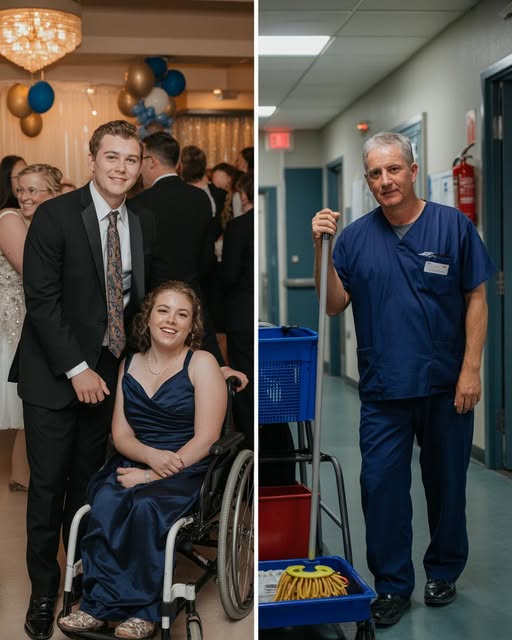
The drunk driver ran a red light on a Tuesday afternoon in October, and by the time Emily was awake enough to comprehend what had happened, six months of her life had already been rewritten for her. She was seventeen. She had been walking home from school with her earbuds in—something she always did, something she would later spend years unable to think about without a tangled mix of guilt and futility.
She woke in a hospital bed, listening to doctors speak around her in that careful way adults use when talking near injured children, uncertain of how much the child can process and therefore defaulting to treating her as if she were part of the furniture in the room. Both of her legs were fractured in three places. Her spine had sustained damage. The doctors used words she technically recognized but had never needed to truly understand before—terms like prognosis, rehabilitation, and maybe. She was seventeen, and she had just learned that “maybe” is one of the most terrifying words in the English language, not because it is vague, but because of what it quietly removes: certainty, as an option, no longer being offered.
The months that followed did not resemble the kind of story people usually repeat. There was no singular victorious moment, no swelling cinematic music, no morning when she simply stood and everything aligned again as though nothing had ever been broken. Instead, there was pain, there was paperwork, and there was the uniquely exhausting state of being both a patient and a person at the same time, which turns out to be one of the most demanding dual roles a human being can inhabit. Doctors spoke to her parents. Administrators spoke to her parents. Friends visited less frequently, arriving with expressions that shifted from shock to discomfort to a kind of forced normalcy that, in its own way, became harder to endure than the hospital itself.
By the time prom arrived in the spring, she had already made the decision that she would not attend.
Her mother appeared in the doorway of her bedroom one Thursday evening, holding a garment bag.
Emily looked at her and said, “I deserve not to be stared at.”
Her mother didn’t flinch. She didn’t offer reassurance in the form of speeches or printed advice about self-worth. Instead, she simply said, “Then stare back,” with the steady quietness of someone who had spent half a year watching her daughter fade inward while still physically occupying every room she entered.
That was the entire exchange.
Because it identified what no one else had said out loud. Emily had not only lost mobility; she had lost the sense that she was allowed to take up space in public at all. The accident had temporarily taken her legs, but it had also taken her willingness to exist visibly in the world, and her mother—without ceremony, without drama—was telling her that this second loss was the one worth resisting.
So she went.
Her mother helped her into the dress, helped her into the wheelchair, and drove her to the gymnasium where crepe paper had been strung across fluorescent lights in an attempt to transform it into something resembling celebration. Emily placed herself near the back wall, despite promising herself she wouldn’t, and spent the first hour doing exactly that anyway.
People approached in waves. Classmates who were kind in that careful, pre-planned way of individuals fulfilling a social obligation they had mentally assigned an expiration time to. Former friends who had stopped visiting after the third week in the hospital. Teachers who smiled too broadly and called her “inspiring” in a way that had begun to feel less like praise and more like a category she had been assigned. A boy from her English class told her she was “so brave,” as though surviving an accident required a specific personality trait rather than simply requiring survival. People who had signed her cast, who had briefly made her injury part of their own social participation, and who had then gradually returned their attention to their own lives—which was understandable, which she understood, and which she still felt a quiet bitterness about anyway.
They arrived, said the correct things, took photographs when appropriate, and drifted back toward the center of the room. Each departure confirmed something she was learning to recognize with increasing clarity: these were moments of attendance, not presence. She had become skilled at distinguishing between the two. Without noticing it fully, she had also begun to shrink her own presence in return, positioning herself at the edges of rooms that no longer seemed to allocate space for her. Smaller, quieter, easier to overlook. Only much later would she understand that this was injury disguised as practicality.
She had not yet learned Marcus’s surname when he crossed the room toward her. She knew him the way people in small schools know one another—by proximity, by reputation. In his case, that reputation was uncomplicatedly positive. Football team, but not the intimidating kind. A girlfriend sophomore year named Caitlin. Two rows ahead of her in AP History. The kind of boy whose most notable trait was how unremarkably decent he seemed, as though decency required no performance and no audience.
He stopped in front of her and said, “Hey.”
Emily instinctively looked past him, because there was no one behind him, and the idea that he might have come directly, intentionally, without being sent or prompted or assigned some kind of charitable duty, felt genuinely improbable.
He noticed. He laughed quietly, not unkindly. “No, I mean you.”
She looked back at him. “That’s brave.”
“You hiding back here?” he asked.
“Is it hiding if everyone can see me?”
Something shifted in his expression—not pity. She had learned to recognize pity over the past six months and could identify it instantly across a crowded gym. This was something else: less comfortable, more honest. “Fair,” he said. Then he extended his hand. “Want to dance?”
She stared at him. “I can’t.”
He nodded once, as if absorbing information rather than waiting for a chance to interrupt it.
“Okay,” he said. “Then we’ll figure out what dancing looks like.”
She laughed before she could stop herself. It came out unplanned, involuntary, and genuine. It surprised her—and apparently surprised him as well, because his face briefly lit with something like delight.
He wheeled her onto the floor before she had time to construct an objection.
She immediately stiffened. “People are watching.”
“They were already watching,” he said.
“That doesn’t help.”
“It helps me,” he replied. “Feels less awkward that way.”
She laughed again. Two real laughs within minutes—something so unfamiliar it almost felt disorienting.
He took her hands and moved with her rather than around her. That distinction mattered more than she could have articulated. He wasn’t performing inclusion; he was simply including her. Adjusting in real time, without commentary or hesitation, learning the movement of the chair as though it were just another variable in a shared space. He turned her gently once, then again with a bit more speed when he realized she wasn’t afraid. His expression carried the unguarded excitement of someone discovering they had stumbled into something unexpectedly good, like joy slipping past a checkpoint no one warned him about.
“For the record,” she said, “this is completely insane.”
“For the record,” he said, “you’re smiling.”
She was. She could feel it—an unfamiliar physical sensation, muscles doing something they had not done in months. Not the controlled smile she had been offering people for reassurance, but something unplanned, unearned, and real.
The song ended. He wheeled her back and stayed nearby for a while. They talked about ordinary things, which turned out to be the most meaningful conversation she had had since October. He asked about physical therapy without flinching when she answered honestly. He talked about football problems on the offensive line in a way that made her laugh again—then again, and again—and she noticed that he noticed, though he never pointed it out.
Before he left, she asked the question she couldn’t avoid.
“Why did you do that?”
He shrugged, and for the first time there was visible uncertainty in him, as though he hadn’t rehearsed the answer. “Because no one else was.”
That was all.
After graduation, her family moved for specialized rehabilitation programs that the next two years required. Whatever connection might have existed between her and Marcus dissolved with distance, as these things tend to do. She told herself it had been a single isolated moment—one kind gesture, one song, one boy acting decently at exactly the right time. She stored it away as that and resisted the urge to turn it into anything larger.
But she carried it anyway.
Rehabilitation was long, unromantic, and entirely uncinematic. She learned to transfer herself in and out of her wheelchair without help. She learned to walk short distances using braces, and later longer ones without them. She learned—more slowly than anything physical—that people often confuse survival with completion, mistaking the absence of visible struggle for the end of internal struggle. But she was not finished. Not even close. And she would not be finished for a long time, if ever.
In parallel, she developed a growing, precise awareness of how poorly most buildings accounted for people like her. Ramps placed beside service entrances because redesigning the front would have required effort. Accessible bathrooms that met legal requirements but communicated indifference. Elevator buttons positioned for standing users, with “accessible” controls added as obvious afterthoughts. Heavy doors labeled “push” in small polite lettering that did nothing to change the reality of their weight.
She noticed everything. She had to. Her body required it.
Over time, that attention hardened into something like anger—but a useful kind. She studied architecture, not because it was graceful or ideal, but because she was angry, and anger—when directed—can become design.
She took the jobs no one else wanted, the drafting work passed to whoever had the least leverage to refuse it. She pushed her way into firms that found her ideas far more valuable than they found her limp, which she recognized as progress without feeling compelled to celebrate it. She learned how spaces were built, how decisions were made, and how often accessibility was treated as an afterthought disguised as compliance.
She kept track of every failure: ramps hidden beside loading docks, bathrooms designed to satisfy code but not dignity, elevator controls placed too high for those who needed them most, doors requiring strength that contradicted their intended purpose. Every instance was recorded in detail, not because she needed to remember them, but because she needed to understand the system producing them.
Eventually, she started her own firm—because she was tired of explaining to others why human spaces should actually be designed for humans.
By the time she was fifty, she had achieved a level of financial stability she could not have imagined at seventeen, along with a respected architectural practice and a genuine reputation for designing public spaces that did not quietly exclude entire categories of people from full participation. Her work had been described in terms she found slightly embarrassing and ultimately beside the point. What mattered to her was simple: that when people entered her buildings, they felt welcomed. That was the only measure that counted.
And yet, through all those years, she had never fully stopped thinking about one song played at a high school prom.
The coffee shop was near a construction site, which is why she had stepped inside that Tuesday morning. She misjudged the lid of her takeaway cup, and in an instant, coffee spilled across her hand and over the counter in a complete, unrestrained mess.
A man wearing faded blue scrubs under a café apron looked up from the cleaning station. He picked up a mop and walked over. He had a noticeable limp in his left leg—permanent, the kind that remains when an injury was never given the rest it needed to heal properly.
He cleaned the spill without complaint, gathered napkins, and instructed the cashier to remake her coffee. When she offered to pay, he waved her off and had already begun counting coins from his apron pocket before the cashier stepped in.
That was when she stopped looking at his hands and looked at his face.
Older now, marked clearly by time in the way that comes from years of physical strain and postponed rest. Broader in the shoulders. A quiet exhaustion behind the eyes that builds when sleep is repeatedly sacrificed for responsibility. But the quality of attention in his expression was unchanged—the same direct, steady warmth that never seemed to perform itself or ask to be noticed.
She returned the next afternoon.
He was wiping tables near the window. When he reached hers, she said, as calmly as she could manage for a sentence she had rehearsed for twenty-four hours, “Thirty years ago, you asked a girl in a wheelchair to dance at prom.”
His hand stopped mid-motion.
He looked up slowly. Recognition arrived in stages—first her eyes, then her voice, then the memory locking into place behind both.
He sat down without asking.
“Emily,” he said. Her name sounded like something long misplaced that had finally found its way back.
He shook his head slightly, studying her with an expression of unsettled recognition. “I knew it. Last week, when you came in—I knew there was something familiar I couldn’t place.”
Over the next few visits, he told her his story in pieces. That summer, his mother had fallen seriously ill—an illness that reshaped everything, turning temporary hardship into an indefinite reality. His father was absent, something he stated plainly, without bitterness or explanation. Scholarships, sports prospects, and the forward momentum of his life at eighteen all dissolved into the immediate necessity of survival and care.
“I kept thinking it was temporary,” he said. “A few months. Maybe a year.”
He let out a short, humorless breath. “And then I looked up and I was fifty.”
He worked whatever jobs he could find—warehouse shifts, delivery work, care facility assistance, maintenance, the café. Anything that kept rent paid and his mother cared for. Somewhere along the way, his knee had been injured in a warehouse accident. He kept working through it long after he should have stopped, until pain became permanent rather than recoverable.
“I stopped counting the years I slept without pain,” he said, “because the number stopped meaning anything.”
She listened without interrupting.
When she finally said, “Let me help,” his response was immediate.
“No.”
“It doesn’t have to be—”
“That’s what people with money say right before it becomes charity.”
So she changed her approach.
Her firm was developing an adaptive recreation center for the city. They needed community consultants—people who understood what it meant to live inside a body that no longer behaved as expected, people who understood injury, identity, and pride without turning it into performance.
She asked him to attend one planning meeting. Paid. No obligations beyond that.
He refused at first. Then, reluctantly, he asked what he could possibly contribute to a room full of architects.
“Thirty years ago,” she said, “you crossed a room where everyone had already decided what I was and treated me like a person instead of a problem. That instinct matters. In my work, it matters more than anything.”
He still did not agree immediately.
What finally changed his mind was his mother.
Emily had sent groceries after a passing comment he made, not as charity, but as a practical response. His mother called to thank her and then invited her in. She was sharp-eyed, ill, and entirely unimpressed by Emily’s professional status—which, unexpectedly, put Emily at ease.
After Marcus stepped out, his mother said quietly, “He is proud. Proud men call it independence until it destroys them.”
Then she added, “If you have real work for him, don’t retreat just because he resists.”
He came to one meeting. Then another.
In the third, when asked what was missing from the design plans, Marcus studied them in silence before speaking.
“You’ve made everything technically accessible,” he said. “That’s not the same as welcoming. Nobody wants to enter a gym through a side door next to dumpsters because that’s where the ramp fit.”
Silence followed.
Then the lead architect nodded. “He’s right.”
After that, no one questioned his presence.
She arranged for him to see a specialist she trusted, offering information without pressure and waiting. He ignored it for nearly a week. Then his knee gave out during a shift, and he called her with reluctant acceptance.
The diagnosis was blunt. Some damage was permanent. But not all of it. Pain could be reduced. Mobility could improve. His daily life could change in real, meaningful ways.
After the appointment, he sat on a curb outside the clinic for a long time.
“I thought this was just my life now,” he said quietly. “I stopped imagining anything else.”
She sat beside him. “It was your life. It doesn’t have to stay that way.”
He looked at her. “I don’t know how to let people help me.”
“I know,” she said. “Neither did I.”
That moment—more than any meeting or decision—became the turning point. Not the professional collaboration, not the medical referral, but the quiet recognition between two people who had each learned, in different ways, how difficult it is to accept care without feeling it costs something essential.
The months that followed were uneven. He struggled with therapy. He resisted help. He alternated between gratitude and discomfort with that gratitude. But gradually, he learned.
He began working with the adaptive recreation center once it opened, then mentoring teenagers who had lost athletic identities and didn’t know what remained of them afterward.
One day a teenager told him, “If I can’t do what I used to do, I don’t know who I am.”
Marcus replied, “Then start with who you are when nobody’s clapping.”
The boy came back the next week. And the week after that.
Meanwhile, Emily found the prom photograph in an old box while searching for something else. She hadn’t seen it in years. The image was slightly faded: his hands holding hers, his grin unmistakable, her expression caught between disbelief and something softer—something real.
She brought it to the office without consciously deciding to. She left it on her desk.
When he saw it, he froze.
“You kept that?”
“Of course.”
He picked it up carefully, as if it might disappear. “I tried to find you,” he said. “After that summer.”
She stared at him.
“I asked around. But then my mom got sick, and everything became very small very fast.”
“I thought you forgot me,” she said.
He looked at her, almost offended by the idea. “Emily. You were the only person I actually tried to find.”
Thirty years. Years of missed timing, of lives bending in different directions at exactly the wrong moments. Thirty years of almosts that never aligned.
And still, something opened.
They are together now.
Not hurried. Not idealized. Carefully—like two people who understand exactly how easily life can take things away, and therefore refuse to treat ordinary time as guaranteed.
His mother lives in a care facility that meets her needs with dignity. He works in the adaptive recreation center and consults on Emily’s architectural projects. He has become an essential voice in how spaces are designed—not because of credentials, but because of lived understanding.
The community center opened in early spring.
Music filled the main hall, moving through the space like something alive. Emily stood near the entrance—wide, open, level with the street, designed for arrival rather than accommodation.
Marcus walked across the floor toward her and held out his hand.
“Would you like to dance?”
She looked at him. Then at the room. The ramps integrated into the main entrance. The absence of back-door compromises. The space itself built with the assumption that people like her and like him belonged in it without explanation.
She took his hand.
“We already know how,” she said.
And they danced in a place that had finally been designed for them, to music that didn’t ask permission to exist.