We were a family of three.
Dorothy, my wife. Nancy, our nine-year-old. And me.
Between my shifts at the plant and her hours at the insurance office and school pickup and homework and dinner, we rarely got through an uninterrupted conversation before about nine at night.
But Dorothy was the person I told everything to. Every worry about money, every stupid thing my supervisor said, every dream I’d had about my father.
And I’d always assumed it went both ways.
The One Subject
There was exactly one thing she would not discuss.
Her mother.
Dorothy had been letting that woman’s calls go to voicemail for as long as I’d known her. Years. I’d see the name come up — Mom — and I’d watch my wife turn her phone face-down on the table without a flicker.
I asked her about it once, early on.
“Everything okay?”
She flipped the phone over.
“Please don’t make me talk about her.”
I never asked again. Fifteen years and I never asked again, because I figured everybody’s entitled to one closed door and she’d open it when she was ready.
Then Her Mother Had a Stroke
March of last year. A serious one — left side, speech affected, six days in the ICU at Mercy before they moved her to a rehab floor.
And suddenly my wife’s coat pockets were full of hospital parking receipts.
She went Tuesday evenings. Then Tuesdays and Thursdays. Then Saturdays too.
“Another visit?” I asked one morning, watching her pick up her keys.
“She shouldn’t be alone in there.”
I put my hand on her shoulder. I remember feeling something like relief — the ugly, useful kind. Almost losing somebody has a way of rearranging things, and I thought whatever had been sitting between my wife and her mother for two decades was finally getting sorted out.
That’s what I thought.
The Saturday
Dorothy stood by the door in her good coat with Nancy beside her.
“Mom keeps asking for her,” she said. “I thought we’d try to cheer her up a little.”
Nancy held up a folded sheet of construction paper.
“I made a card. It has a garden on it.”
“Grandma’s going to love that, bug.”
I kissed the top of Nancy’s head, then Dorothy’s cheek.
“Drive safe.”
“We won’t be too late.”
She caught the storm door before it closed and gave me a smile over her shoulder. The one she’s been giving me since we were seventeen years old outside a diner on Route 6.
I trusted that smile over anything.
I didn’t know yet that I’d spend the next six hours wishing I hadn’t.
9:04 P.M.
My phone buzzed on the arm of the couch.
My cousin Jason. He’s two years younger than me and he texts in fragments.
Mark am I crazy or is this Nancy
That girl is her spitting image
I opened the photograph and spread two fingers across the screen to zoom in.
What Was in the Picture
An arena. Stage lights washing everything purple.
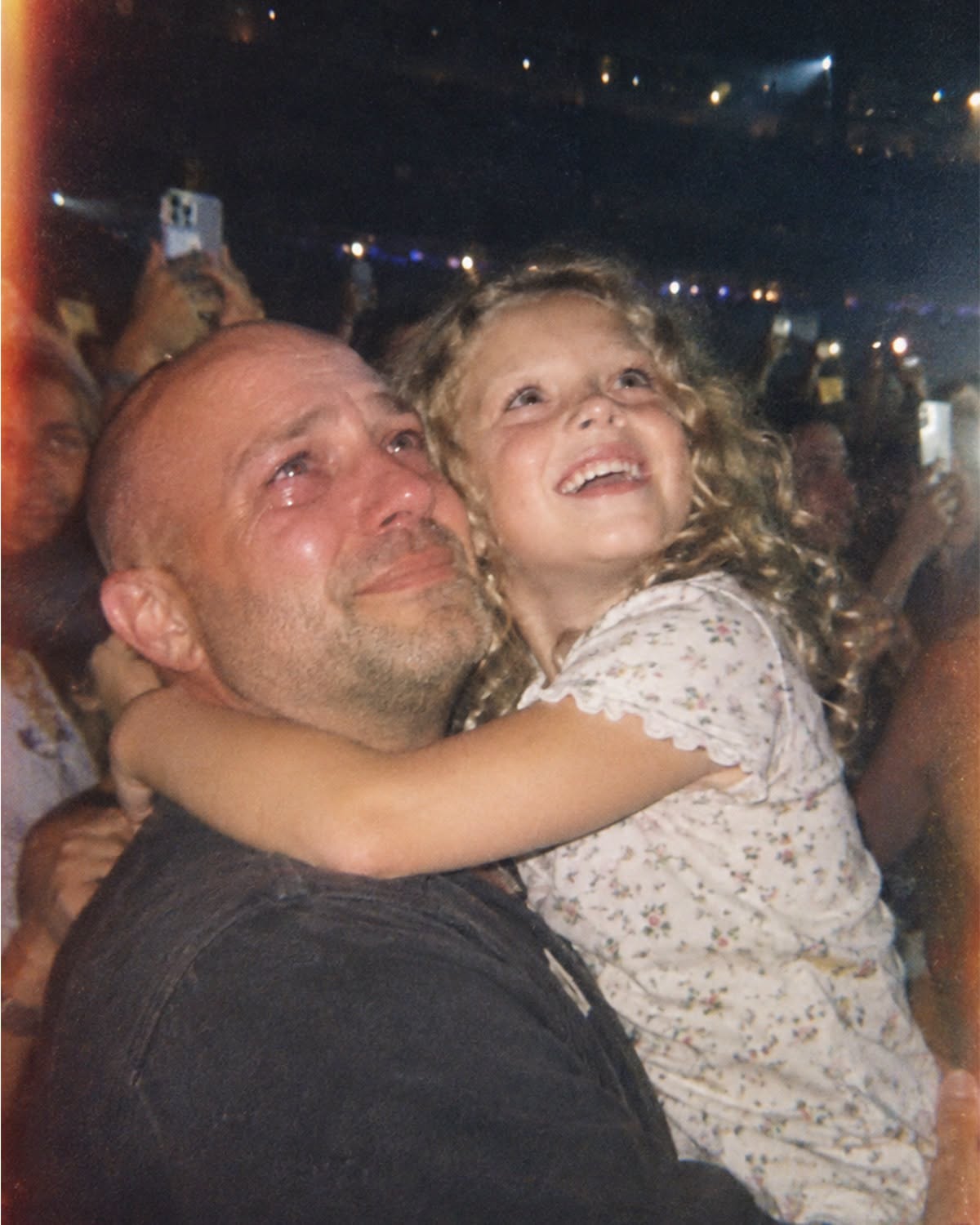
And my daughter — my daughter, in the green sweatshirt she’d put on that afternoon — with both arms wrapped around a man’s neck. Her mouth open mid-song. Her head tipped back, laughing.
He had a thick dark beard. From the angle and the beard I put him around Dorothy’s age. Forty-ish.
One of his hands was flat against her back. The other was holding her against his chest.
Another text came in.
It’s definitely her. She’s been with this guy the whole concert. He’s been holding her like 20 minutes
Why That Photograph Undid Me
You have to understand something about my kid.
Nancy hides behind me at school events. When the other parents say hello to her at pickup she pushes her face into my jacket. Her teacher used the word slow to warm at a conference in October and Dorothy and I laughed about it in the car because slow was generous.
She has never once in nine years voluntarily hugged an adult she didn’t know.
And there she was, wrapped around a complete stranger like she’d been doing it her whole life.
I Called My Wife
The first call rang out.
So did the second.
I stood in my kitchen with my keys already in my hand — I’d gotten up and taken them off the hook without deciding to — and I called four more times.
She picked up twenty-two minutes later.
“Where Are You?”
Silence on her end. Music behind her, then a door closing and the music cutting off.
“Where are you, Dorothy?”
“Mark — please don’t jump to conclusions.”
“Jason just sent me a picture of our nine-year-old at a concert, hanging off some man’s neck. You told me you were at the hospital.”
She inhaled sharply. I could hear it.
“Then tell me who he is.”
“I can’t explain this properly over the phone.”
“Try.”
“Mark. Please. Just wait for us.”
A pause.
“Us?“
“You’ll Meet Him”
“We’ll be home around ten. You’ll meet him. And then we’ll tell you everything.”
“Dorothy — “
“It is not what you’re imagining. I need you to hold onto that for one hour.”
And she hung up.
The Hour I Spent With That Photograph
I put my keys back on the hook, which was the hardest thing I did that night.
Then I sat at my own kitchen table and looked at that picture for an hour.
And I kept going back to Nancy’s face.
She wasn’t uncertain. She wasn’t polite-hugging the way kids do with a relative they’ve met twice. She was pressed flat against that man’s chest with her eyes closed, completely, absolutely at ease.
Which meant my wife hadn’t just lied about where they were going.
She’d taken our daughter to somebody who apparently needed no introduction.
10:06
The deadbolt turned.
Nancy came in first, holding the stranger’s hand.
And he looked much younger in person. Mid-twenties, under that beard. Twenty-five, twenty-six.
His eyes were red and swollen like he’d been crying for an hour.
Nancy let go of his hand when she saw me standing there.
“Dad. Please don’t be mad at Mom.”
“What Have You Told Her?”
I looked over Nancy’s head at my wife.
“What have you told her?”
And the man spoke.
“Mark. I’m really sorry you had to find out about me this way.”
About me.
“Apparently I’m the only person in this house who didn’t know.”
He lowered his eyes to the floor.
I reached past all three of them and pulled the front door open.
“Leave.”
The Look Between Them
He glanced at Dorothy.
And that — that silent thing that passed between the two of them, the way you look at somebody when you’ve got a history and a plan — made me grip that door handle hard enough that my knuckles hurt.
Dorothy caught my arm.
“Before you do that, Mark, you need to hear something that started twenty-five years ago.”
“Dorothy — “
“Please.”
Nancy Went Upstairs
She had edged over next to her mother, and she was doing the thing she does when adults are wrong with each other — going very small and very still.
Dorothy crouched down.
“You haven’t done a single thing wrong, sweetheart. Not one. Go on up and get ready for bed and we’ll handle this part.”
“Will you come up after?”
“Yes. I promise.”
We all stood there and listened to her footsteps on the stairs, and then the bathroom door.
Only then did I close the front door.
My Wife Sat Down
She took the chair by the window. The young man stayed standing near the entryway like he wasn’t sure he was allowed further in.
I stayed on my feet.
Dorothy started turning her wedding ring around her finger. She does that when she’s about to say something difficult. I’ve watched her do it before doctor’s appointments and before her father’s funeral.
“Twenty-five years ago,” she said, “I was sixteen years old.”
What She Told Me, in Her Own Words
My mother stood in my bedroom doorway holding a pregnancy test she’d found in the bathroom trash.
“Does he know?”
“Not yet. I was going to tell him tomorrow.”
I’d been carrying it around for four days trying to work out how to say it.
“Give me your phone.”
“No — Mom, please — “
“Now, Dorothy.”
The Boy Outside the Diner
At sixteen I’d fallen for a boy who waited outside the diner where I worked, doing his homework under the streetlight in the parking lot because he didn’t like being home.
We’d split a sandwich on the walk back. He always handed me the bigger half without being asked, every single time, and pretended he wasn’t doing it.
That was the whole thing. That’s all it took.
I wanted him standing next to me when I told my mother.
She called him instead.
What She Told Him
I found out much later — twenty-five years later, on a floor in her house — what my mother actually said on that phone call.
She told him I never wanted to see him again. That I’d said so myself and couldn’t face telling him.
And then she packed our apartment in eleven days and moved us four states away.
What She Told Me
What she told me was different.
“I told him about the baby.”
“What did he say?”
“He doesn’t want either of you, Dorothy.”
She was folding laundry when she said it. She didn’t even look up.
“Don’t humiliate yourself chasing after a boy who’s already gone.”
The Letters I Wrote
I wrote to him anyway.
Every week at first. Then every couple of weeks.
I gave the envelopes to my mother because she drove past the post office on her way to work and I didn’t have a car or a stamp or anywhere to be.
And every afternoon when she came home I’d ask her:
“Anything for me?”
And for a few months she’d say no.
And then eventually she stopped answering out loud and just shook her head at me on her way to the kitchen.
The Papers Beside My Breakfast
When my jeans stopped buttoning, my mother put a folder of adoption information next to my cereal bowl.
“I’m keeping my baby.”
“And where exactly will you live?”
“Here. I’ll work.”
She scoffed at me.
“Who’s going to watch him while you work? Who’s paying the bills while you finish high school? You’re sixteen years old.”
“I’ll figure it out.”
“Not in my house you won’t.”
“Two Lives Instead of One”
I pushed the folder back across the table.
She pushed it right back.
“You can give that baby two parents who are ready for him. Or you can ruin two lives instead of one. Those are your choices.”
I kept writing letters for another three months.
And then one night she found me crying over an unfinished one at the kitchen table, and she took the pen out of my hand.
“He’s moved on, Dorothy. It’s past time you did too.”
The Day He Was Born
He curled his fingers around mine before I’d even figured out how to hold him properly.
They put him on my chest and he was so warm, and I remember studying the little crease above his nose and the dark hair plastered flat to his head.
He opened his mouth and I thought he was going to cry.
He yawned instead.
“Hello,” I whispered. “I’m your mom.”
The Woman Waiting Beside the Bed
She was kind. I want to say that. She waited quietly and she didn’t rush me.
“May I?”
“Just — just another minute.”
I tucked the blanket under his chin twice, because the first time wasn’t right.
My mother reached over and took my hand.
“Dorothy. You signed the papers.”
When I finally lifted him toward that woman, his fingers were caught in the neck of my hospital gown.
I had to loosen them myself. One at a time.
That’s the part. That’s the part I’d give anything to not remember.
Counting Birthdays
Years later I had a job and an apartment and a phone I could let ring when my mother called.
But every year on the twelfth of June I counted.
Five. Eight. Ten.
I wondered whether he hated peas. Whether somebody put a hand on his forehead when he was sick. Whether anybody had ever explained me to him.
I never once let myself imagine seeing him again. That’s a discipline you have to learn.
Then, Ten Years Later, Somebody Said My Name
Dorothy stopped talking at that point and looked at me.
And I felt the floor of my own living room move.
Because I knew exactly what came next.
The Grocery Store
I was there. That’s my memory too, and I’ve told it at dinner parties for fifteen years as the best thing that ever happened to me.
A grocery store in Huntsville in 2009. Produce section. I was twenty-six and I looked up and there she was, standing at the end of an aisle with a cart.
“Do you have time for coffee?”
She looked at my left hand before she answered. I saw her do it.
“No wife,” I said. “You?”
“No husband.”