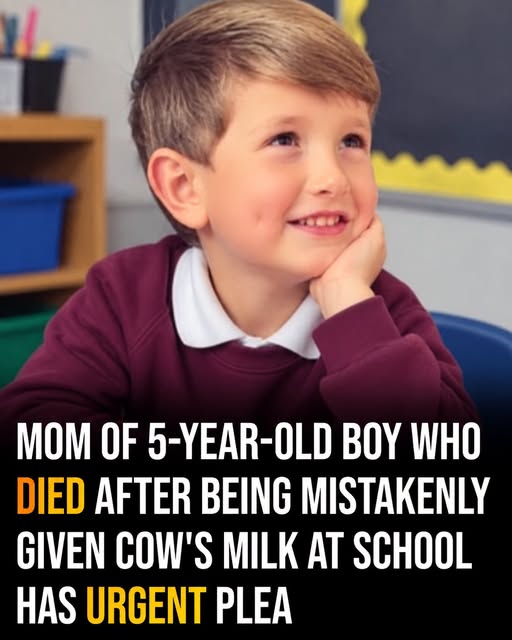
A little boy walked into school and never came home.
One missed step. One ignored plan. One preventable mistake that turned an ordinary school day into a parent’s worst nightmare.
Five-year-old Benedict Blythe should have spent that day learning, playing, laughing with classmates, and waiting to be collected at the end of the afternoon. Instead, an allergy reaction that his family had spent years preparing for became fatal.
His mother had done what parents are repeatedly told to do.
She warned the school.
She provided detailed information about his severe allergy.
She made sure medication was available.
She worked with staff so they would understand what to do in an emergency.
The safety plan existed.
The medication existed.
The warnings existed.
What failed was the system meant to connect them.
Benedict’s death exposed a devastating chain of failures that no family should ever have to discover only after losing their child. The agreed procedures were not followed as they should have been. His allergy care plan was not properly communicated, and milk containing cow’s milk protein was given to a child known to be severely allergic to it.
Then his body began reacting.
Anaphylaxis can move frighteningly quickly. A reaction that may begin with symptoms that appear manageable can rapidly become life-threatening as the airway narrows, breathing becomes difficult, and blood pressure falls.
For a child with a known severe allergy, every second can matter.
Benedict had an EpiPen.
But it was administered too late.
And the little boy who had walked through the school doors that morning would never walk back out.
For his parents, grief was not simply the pain of losing their son. It was the unbearable knowledge that they had tried to protect him.
They had told people.
They had provided the information.
They had trusted the adults responsible for keeping him safe.
And afterward, they were left asking questions no parent should ever have to ask.
How could this have happened?
Why wasn’t the plan followed?
Why wasn’t everyone who needed to know properly informed?
Why wasn’t emergency treatment given quickly enough?
Those questions could have remained private wounds.
Instead, Benedict’s parents turned them into a campaign.
They refused to allow their son’s death to become another tragic story that generated headlines for a few days before disappearing from public memory. They began pushing for meaningful changes to the way allergies are understood and managed in schools.
The campaign took years.
There were meetings, conversations, letters, pressure, setbacks, and relentless advocacy.
Their grief became determination.
Eventually, that determination helped lead to **Benedict’s Law**, strengthening expectations around allergy policies, staff training, and access to emergency adrenaline in English schools.
The name itself carries a painful reminder.
Behind the legislation was not an abstract policy problem.
There was a five-year-old boy.
There was a family.
There was an empty place at home.
And there was a question of what could be done to prevent another family from experiencing the same devastation.
The impact has reached classrooms and staff rooms across England.
Teachers have written to Benedict’s mother to tell her that they now feel better prepared to recognize an allergic reaction and respond with greater confidence. For those teachers, the changes may feel like training, guidance, emergency procedures, and another responsibility added to an already demanding school day.
But for a child experiencing anaphylaxis, that knowledge can mean the difference between life and death.
That is the heart of Benedict’s legacy.
An allergy plan cannot simply sit inside a folder.
A medication cannot simply exist somewhere in a building.
A policy cannot protect a child if the adults responsible for implementing it do not understand it.
And emergency procedures are only useful when people know them well enough to act without hesitation.
Benedict’s story is therefore about much more than one tragic mistake.
It is about what happens when a carefully constructed safety net develops gaps.
A parent may do everything possible.
A doctor may provide instructions.
Medication may be prescribed.
A school may have a policy.
But if communication breaks down at even one critical point, a vulnerable child can be placed in extraordinary danger.
That is why Benedict’s parents continue to speak about him.
Not because the words make the loss easier.
Not because legislation can bring their son back.
It cannot.
Nothing can.
But every teacher who becomes more confident because of Benedict’s story represents a small piece of the change his parents fought for.
Every staff member who checks an allergy plan carefully represents another opportunity to prevent tragedy.
Every school that treats emergency adrenaline as something that must be immediately accessible rather than merely available somewhere represents another child who may have a safer day.
Benedict walked into school as a five-year-old child.
He should have come home.
Instead, his name became part of a law designed to protect children he would never meet.
That is a heartbreaking legacy—but also a powerful one.
His parents could not save their son from what happened that day.
What they have fought to do since is make sure that the next parent who sends a child through a school gate does not have to wonder whether a carefully written allergy plan will actually be followed.
Because allergy care is not paperwork.
It is not an administrative box to tick.
It is not something that matters only when an emergency happens.
**For some children, it is the difference between coming home and never coming home at all.**
And that is why Benedict’s name must mean more than a policy on a page.
It must mean preparation.
It must mean vigilance.
It must mean action.
Above all, it must mean that when a child needs help, the adults around them are ready to give it—immediately, confidently, and without hesitation.