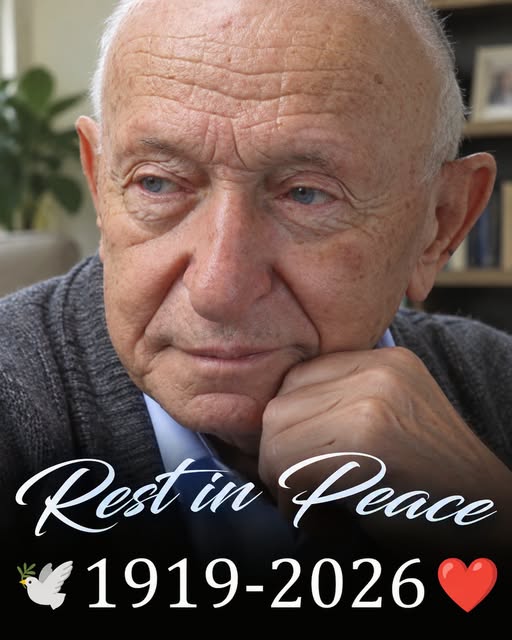
The last time he saw his parents, they were on the final transport to Auschwitz.
He walked out.
They never did.
For decades, Yehuda Aharon Widawski carried that image with him—a son forced to continue living while the people who had given him life were taken away. Around him, an entire world had been destroyed. Parents disappeared. Brothers and sisters vanished. Neighbors who had once filled streets with ordinary sounds were reduced to names, photographs, memories, and eventually, in the cold language of history, numbers.
But Yehuda refused to let his family become a statistic.
He had survived Auschwitz.
He had endured forced labor, starvation, terror, and the systematic destruction of nearly everyone he loved. Survival itself could have been considered an extraordinary victory. But for Yehuda, simply surviving was never enough.
He believed that remembering was another form of resistance.
When he eventually returned to Poland in 1978, decades after the Holocaust, he encountered something that wounded him in a completely different way.
Jewish cemeteries had been neglected.
Some graves were broken. Others were overgrown or difficult to identify. Tombstones stood damaged and forgotten, surrounded by traces of communities that had once lived, worked, worshipped, married, raised children, and dreamed about ordinary futures.
The people were gone.
And now even the physical evidence of their existence was disappearing.
For Yehuda, that was unbearable.
He had already witnessed an attempt to erase Jewish life through murder. Now he was seeing another kind of disappearance taking place through neglect, destruction, and silence.
Something inside him changed.
He had spent years carrying grief.
Now grief became purpose.
He began traveling across Poland, visiting Jewish cemeteries and searching for remnants of communities that had been nearly wiped from the landscape. He worked patiently, painstakingly restoring thousands of graves and recovering fragments of memory wherever he could find them.
There was nothing glamorous about the work.
There were no cheering crowds.
No dramatic ceremonies accompanied every restored stone.
Sometimes there was simply an old cemetery, weeds covering the ground, a damaged marker half-hidden beneath years of neglect, and an elderly survivor determined to make sure one more name could be seen.
One more person could be remembered.
One more family could be acknowledged.
One more piece of a destroyed community could be brought back into the light.
For Yehuda, every grave mattered because every grave represented a life.
A name carved into stone was not just a name.
It was proof that someone had existed.
Someone had loved.
Someone had belonged.
Someone had once been part of a community that the Nazis had tried to destroy completely.
Restoring those graves became his quiet revolt against oblivion.
The Nazis had wanted Jewish people erased not only from the present, but from history itself. Yehuda answered by doing the opposite. He spent his remaining decades making the dead visible again.
And while he restored the memory of others, he also rebuilt his own life.
In Israel, he created a new family and helped build a future from the ashes of the past. His life became a contradiction to the destruction he had witnessed: a survivor raising a family, creating memories, and continuing a people that the Nazis had tried to extinguish.
His survival was not passive.
It was an answer.
Years later, standing at Yad Vashem and lighting a memorial torch, Yehuda embodied the meaning of survival in a way no speech could fully capture.
He was not merely remembering history.
He was living beyond it.
He carried the names of people who had been denied the chance to grow old. He carried memories of parents who never returned. He carried the weight of Auschwitz and the countless losses that followed him throughout his life.
Yet he also carried something else.
Defiance.
Yehuda described his revenge in remarkably simple terms.
They lost.
The Jewish people live.
Free.
Strong.
Alive.
There was extraordinary power in that idea.
His revenge was not hatred consuming the rest of his life. It was existence. It was family. It was memory. It was returning to places where Jewish life had been destroyed and restoring the names that remained.
It was refusing to allow murder to have the final word.
When Yehuda Aharon Widawski died at the age of 107, the world lost a Holocaust survivor—but it also lost one of its living guardians of memory.
People like him carried history differently from books.
They carried it in their voices.
In photographs.
In names.
In memories of streets that no longer looked the same.
In the silence that followed when they remembered someone who had disappeared.
For decades, Yehuda carried his parents’ names.
He carried the names of relatives who never had the opportunity to grow old.
Then he spent years helping preserve the names of thousands of others.
That work matters because memory is fragile.
Cemeteries deteriorate.
Stones break.
Photographs fade.
Witnesses eventually die.
And when the last person who remembers a name is gone, the responsibility shifts to everyone else.
That is the inheritance Yehuda leaves behind.
Not simply the memory of what happened, but the responsibility to keep remembering it.
To tell the stories.
To preserve the names.
To visit the places.
To teach the next generation.
And when confronted with hatred, dehumanization, or historical denial, to refuse the temptation of silence.
Because Yehuda understood something profoundly important:
The opposite of erasure is remembrance.
The opposite of destruction is rebuilding.
And sometimes the most powerful answer to those who wanted you gone is simply to remain.
To live.
To love.
To raise children.
To speak the names of the dead.
To stand where they once stood and say, in effect:
**You were here.**
**You mattered.**
**We remember you.**
Yehuda survived Auschwitz, but he did more than survive.
He became a keeper of the names.
And now that he is gone, the task he carried for so long belongs to all of us.
Remember.
Tell.
Teach.
And never look away.