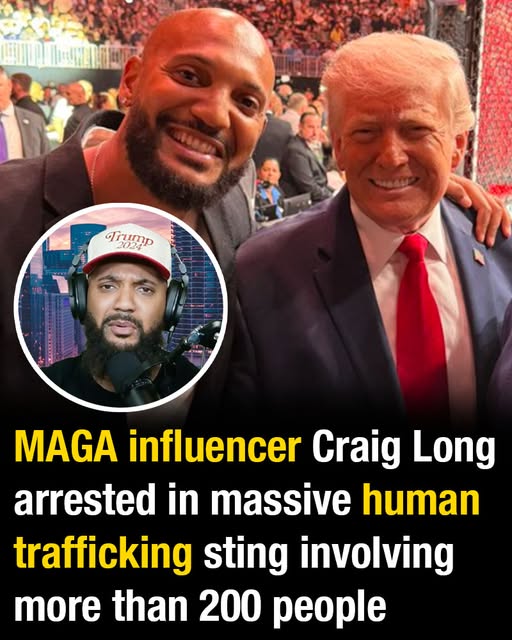
Craig Long built his entire public image around loyalty, discipline, patriotism, and unwavering support for the “law and order” message that became central to the MAGA movement. Online, he portrayed himself as a man transformed — a fitness influencer who stood proudly beside conservative figures, praised police officers, promoted traditional values, and presented himself as proof that redemption and hard work could rebuild a life. His social media feeds were filled with American flags, gym videos, political slogans, and smiling photos alongside Donald Trump and Donald Trump Jr. To thousands of followers, Long wasn’t just another influencer; he was a symbol of conservative identity, resilience, and devotion to the movement.
Then the headlines changed everything.
The man who had spent years celebrating police crackdowns and demanding accountability suddenly found himself on the other side of the law. During a large-scale undercover operation in Florida known as “Polk Around & Find Out,” authorities arrested dozens of suspects in connection with prostitution-related offenses and investigations tied to human trafficking. Among the names that shocked supporters and critics alike was Craig Long. The same influencer who had publicly applauded aggressive policing efforts was now being led away in handcuffs, accused of participating in the very kind of activity he once condemned online.
The arrest sent social media into immediate chaos. Supporters rushed to defend him, critics accused him of hypocrisy, and political commentators turned the story into another cultural battlefield. Screenshots of Long praising law enforcement began circulating next to his mugshot. Old photos of him posing proudly with conservative personalities resurfaced everywhere. Videos in which he spoke passionately about morality, patriotism, and protecting American values suddenly took on an entirely different tone. The contrast was impossible to ignore: the polished online persona versus the allegations now dominating national conversation.
Investigators say the broader operation uncovered far more than isolated prostitution-related encounters. Authorities described a disturbing network involving suspected trafficking victims, undercover communications, and cases in which some suspects allegedly brought children with them to illicit meetings. That wider context made the scandal even more explosive. What might once have been viewed by some as merely embarrassing behavior became linked to a much darker and more serious investigation involving exploitation and abuse. As details emerged, public reaction intensified, and Long’s name became tied to one of the most controversial sting operations in recent Florida memory.
What made the situation even more politically charged was Long’s connection to another man arrested in the same investigation: Ryan Yates, a fellow January 6 participant who had reportedly received a pardon from Donald Trump before later facing the same prostitution-related allegations. Their parallel stories created a narrative that critics quickly seized upon. Both men had publicly embraced Trump-era politics, promoted themselves as loyal conservatives, and become associated with the January 6 movement. Now both were facing criminal accusations that sharply contradicted the values they claimed to defend.
For many observers, the scandal highlights the dangerous power of internet celebrity and political branding. Influencers often build massive followings by presenting simplified versions of themselves online — stronger, wiser, more moral, more disciplined than ordinary people. Followers begin to see them not merely as entertainers or commentators, but as role models. Over time, carefully curated images can become more powerful than reality itself. In Long’s case, the collapse of that image felt sudden and dramatic because so much of his identity had been built around personal integrity and public righteousness.
The controversy has also reignited debates about redemption and second chances. Some supporters argue that accusations alone should not erase a person’s entire life story or political beliefs. Others counter that public figures who aggressively judge others while presenting themselves as moral authorities invite even harsher scrutiny when they fall short themselves. The tension between those views has fueled endless arguments online, where the case has become part scandal, part political warfare, and part cautionary tale about modern influencer culture.
For Long’s followers, however, the story cuts deeper than politics. Many had emotionally invested in the image he created — the disciplined patriot who appeared to stand firmly for faith, strength, accountability, and conservative values. Watching that image unravel in real time has left supporters confused, angry, or disillusioned. Some continue to stand beside him, insisting the full story has not yet emerged. Others feel betrayed, seeing the arrest as proof that online personas can hide realities audiences never truly see.
In the end, Craig Long’s downfall is about more than a single arrest. It reflects the fragile nature of modern public identity, where carefully constructed online reputations can collapse overnight under the weight of scandal. It also exposes the uneasy collision between politics, internet fame, morality, and personal behavior in an era where every public figure lives under constant digital scrutiny. One moment someone is celebrated as a patriot and influencer; the next, their name becomes a symbol of contradiction, hypocrisy, and shattered trust.