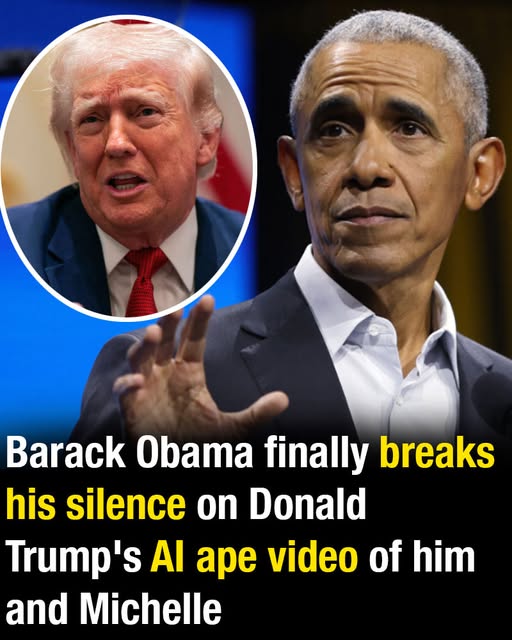
For a long time, Barack Obama chose silence. While political attacks, conspiracy theories, edited clips, and increasingly aggressive online content spread across social media, he rarely responded directly. But after Donald Trump shared an AI-generated video portraying Obama and Michelle Obama as apes, that silence finally ended. And when Obama responded, he did not explode in anger or descend into the chaos dominating modern politics. His reaction was quieter than many expected—but far more cutting. Calm, controlled, and deliberate, his words carried the weight of someone less interested in winning an argument than in warning about what society becomes when cruelty stops shocking people.
Obama made it clear that as a former president and public figure, he understands criticism comes with the territory. He acknowledged that politicians are constantly mocked, attacked, exaggerated, and turned into symbols by supporters and opponents alike. In his view, that scrutiny is part of public life. He openly stated that he himself is a fair target for political disagreement, satire, and criticism. But he drew a sharp distinction between political attacks and dehumanization. When his wife and daughters become part of imagery designed to strip them of dignity and humanity, he argued, something deeper and darker is taking place.
For Obama, the issue was not merely personal offense. It was about crossing a line that should exist even between the fiercest enemies in politics. He framed the situation not as a partisan disagreement, but as a test of basic decency. Democracies, he implied, cannot survive indefinitely if people stop recognizing each other as human beings deserving of some minimum level of respect. Once public discourse becomes entirely driven by humiliation, mockery, and digital cruelty, politics slowly transforms from debate into spectacle.
What made his response resonate with many people was its restraint. He did not demand censorship. He did not attempt to portray himself as uniquely persecuted. Instead, he widened the conversation beyond his own family and focused on the broader culture developing around AI-generated content and online outrage. According to Obama, the danger is not only racism or political hatred, though those elements remain deeply serious. The larger danger is how technology now allows human suffering, humiliation, and violence to be turned into entertainment at incredible speed.
He specifically warned about the growing trend of AI-generated videos that treat real people, wars, disasters, and public trauma like pieces of a grotesque digital game. In these manipulated clips, civilians become props, tragedy becomes comedy, and humiliation becomes viral content designed to generate clicks, reactions, and outrage. Obama argued that when people begin laughing at digitally altered images of suffering or degradation, society slowly loses its emotional connection to the humanity of others. The line between real pain and online amusement starts to disappear.
That concern reaches far beyond politics alone. AI technology has advanced so quickly that realistic fake videos, voices, and images can now spread worldwide before many people even realize they are fabricated. What once required sophisticated editing teams can now be created in minutes. As a result, public trust becomes weaker, truth becomes harder to identify, and outrage becomes easier to manufacture. Obama’s warning suggested that the deeper crisis is not simply misinformation, but emotional desensitization. If people consume endless streams of humiliation and cruelty every day, eventually even genuinely disturbing behavior begins to feel normal.
The imagery comparing Black public figures to apes also carries a long and painful historical context that cannot be separated from the controversy. For centuries, racist propaganda used animalistic depictions to dehumanize Black people and justify discrimination, violence, and exclusion. Because of that history, many observers viewed the AI video not merely as offensive political trolling, but as part of a much older pattern designed to deny dignity through humiliation. Obama did not spend much time emphasizing his own hurt, but his response clearly acknowledged the seriousness of imagery rooted in dehumanization.
At the same time, he resisted turning the moment into pure outrage politics. Instead of escalating the conflict emotionally, he focused on what repeated exposure to this kind of content does to society itself. He argued that when public discourse becomes built entirely around mocking enemies and generating emotional reactions, people gradually stop seeing opponents as neighbors, citizens, or fellow human beings. They become characters in a permanent online performance where cruelty is rewarded with attention.
That warning arrives during a period when political culture increasingly rewards extremity. Social media algorithms favor outrage because outrage generates engagement. The most inflammatory clips spread fastest. AI tools now amplify that environment by making it easier than ever to create humiliating or emotionally manipulative content. In such a system, the pressure to remain shocking constantly increases. Obama’s concern seemed rooted in the belief that societies eventually pay a moral price when humiliation becomes entertainment.
Supporters praised his response as measured, thoughtful, and necessary. Critics argued that politicians themselves have contributed to the culture of division and media spectacle over many years. Others debated whether responding at all simply gives more attention to inflammatory content. But regardless of political position, the moment highlighted how dramatically technology has changed public life. Political conflict no longer exists only through speeches, debates, or television coverage. It now unfolds through viral clips, edited memes, AI fabrications, and emotionally charged digital theater seen by millions within hours.
Obama’s words ultimately focused less on Donald Trump personally and more on the cultural direction he believes the country is moving toward. His message suggested that once people stop reacting to dehumanization with discomfort, the standards holding society together begin eroding quietly. Not all at once, but gradually. Joke by joke. Meme by meme. Clip by clip.
And that may be why his response felt so cold and restrained rather than explosive. Anger would have made the story about a feud between two political rivals. Instead, Obama attempted to make it about something larger: whether modern society can preserve any sense of shared humanity in an era where technology increasingly turns humiliation into entertainment and human beings into content.