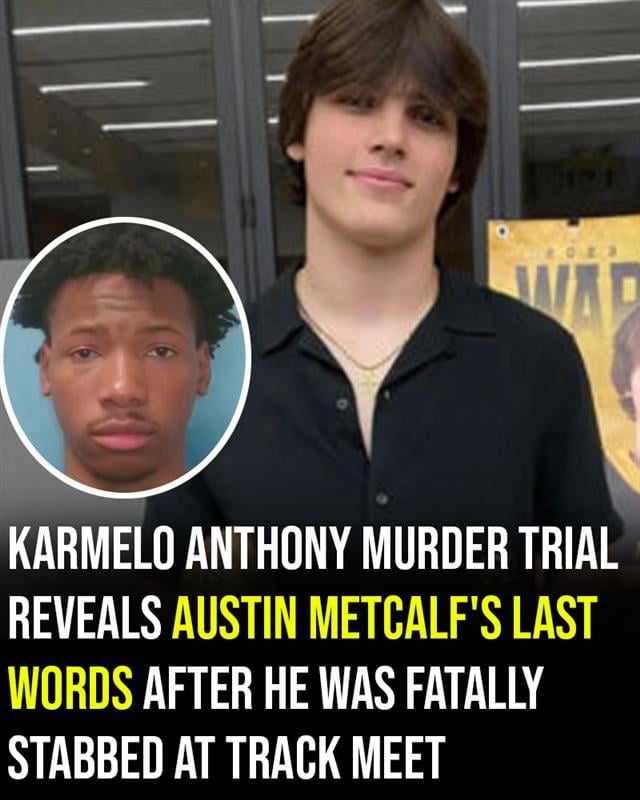
Austin Metcalf was dying before most people at the track meet even realized something had happened. What began as a routine spring competition filled with students, coaches, parents, and cheering spectators turned into a nightmare in a matter of seconds. One moment there was an argument between two teenagers. The next, panic spread through the crowd as a seventeen-year-old collapsed with a fatal wound to his chest. Now, months later, the question that continues to divide families, communities, and courtroom observers remains painfully simple: was this an act of self-defense born from fear, or a deliberate act of violence that took a young life?
The tragedy unfolded during what should have been an ordinary day. Athletes from different schools gathered to compete, friends laughed in the stands, and families watched from the sidelines. Like countless school events across America, it was supposed to be a day filled with memories, competition, and celebration. Instead, it became the setting for a confrontation that would alter multiple lives forever.
According to testimony and reports presented during the investigation, the conflict reportedly began over something seemingly minor—a disagreement involving seating beneath a tent area. Witnesses described a verbal exchange that escalated rapidly. What might have ended as a brief argument instead developed into a deadly encounter that no one present could reverse once it began.
For Austin’s family, the details of those final moments remain almost unbearable to hear.
Their son left home expecting to attend a track meet.
He never came back.
The pain is intensified by the fact that Austin’s twin brother, Hunter, was there when it happened. The two had shared a bond that few people can truly understand. Twins often describe a connection that feels deeper than ordinary sibling relationships, built on a lifetime of shared experiences, memories, and understanding. In a matter of moments, that lifelong connection was shattered.
Inside the courtroom, Hunter now faces the impossible task of describing what he witnessed.
Every question forces him to revisit memories most people would spend a lifetime trying to forget.
Every answer brings him back to the moment his brother fell.
Every detail serves as a reminder of a future that disappeared in seconds.
Observers inside the courtroom have noted the emotional weight carried by Austin’s family throughout the proceedings. For them, this is not simply a legal case. It is a daily confrontation with grief. Photographs, testimony, and evidence all point back to the same reality: a son, brother, friend, and student is gone.
Yet across the courtroom sits another teenager whose future also hangs in the balance.
Karmelo Anthony’s defense team presents a very different interpretation of the events.
They argue that the incident cannot be understood solely through its tragic outcome. Instead, they ask jurors to focus on what Anthony may have believed in the seconds before the stabbing occurred. According to the defense, fear played a central role. They contend that he perceived a threat, felt overwhelmed, and reacted instinctively during a rapidly unfolding confrontation.
From this perspective, the case becomes less about intent and more about perception.
What did he see?
What did he fear?
What did he believe was about to happen?
Those questions sit at the heart of the defense’s argument.
Prosecutors, however, paint a dramatically different picture.
They argue that the evidence points toward an unjustified act of violence. They focus on the decision to use a knife, the circumstances surrounding the confrontation, and actions taken immediately afterward. In their view, the case is not about reasonable fear but about a choice that led directly to the death of another teenager.
As testimony continues, jurors are being asked to navigate one of the most difficult responsibilities within the justice system. Unlike television dramas, real-life trials rarely offer simple answers. Witnesses remember events differently. Emotions affect perception. Critical moments unfold in seconds. Facts can be interpreted through competing narratives.
More than thirty-five witnesses are expected to contribute pieces of the story.
Some offer firsthand accounts.
Others provide forensic analysis.
Investigators explain evidence collected at the scene.
Medical experts describe the fatal injury.
Friends, classmates, and observers attempt to reconstruct a confrontation that lasted only moments but produced consequences that will last a lifetime.
For the jury, the challenge is enormous.
They must separate emotion from evidence.
They must evaluate competing versions of the same event.
They must determine whether fear justified action or whether that action crossed a legal line into criminal conduct.
Outside the courtroom, the case has sparked intense public discussion.
Many people see the tragedy as a warning about how quickly conflict can escalate among young people. Others focus on broader questions involving self-defense laws, youth violence, personal responsibility, and the presence of weapons in situations that might otherwise end with words alone.
Parents watching the case often imagine themselves in the position of Austin’s family.
Others imagine the possibility of their own children making a split-second decision with life-changing consequences.
Those fears help explain why the case has captured so much attention.
At its core, the tragedy is about far more than legal arguments.
It is about two families whose lives were permanently altered on the same day.
One family is grieving a son they can never bring back.
Another waits to learn whether a teenager’s future will be defined by a single moment.
No verdict can restore what was lost.
No courtroom ruling can erase the pain carried by those involved.
The justice system can only attempt to answer the question placed before it: what happened during those critical seconds, and how should the law respond?
As testimony continues and jurors listen to each witness, the outcome remains uncertain. What is certain, however, is that a simple disagreement became a tragedy that changed countless lives. The courtroom may ultimately decide legal responsibility, but the emotional consequences of that day will remain long after the final verdict is delivered.
For Austin’s family, the loss is permanent.
For Karmelo Anthony, the future hangs in the balance.
And for everyone watching, the case serves as a devastating reminder of how quickly a single moment can alter the course of multiple lives forever.