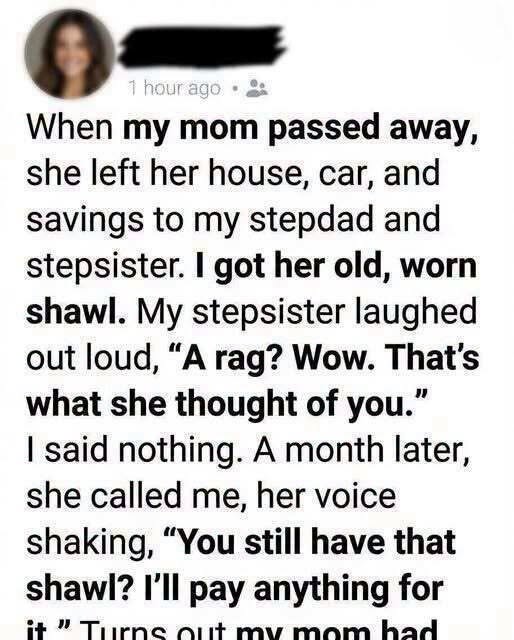
When my father passed away, I believed the hardest part would be saying goodbye. I never imagined that the weeks following his funeral would bring a second heartbreak—one that would leave me questioning everything I thought I knew about the man who had raised me. As our family gathered for the reading of his will, I expected sadness, perhaps a few disagreements over sentimental belongings, but nothing that would permanently divide what remained of our family. Instead, I learned that my older sister, Clara, had inherited our childhood home, nearly all of my father’s assets, and every major possession he had spent a lifetime building. My inheritance consisted of one old wristwatch that had clearly seen better days.
The room fell silent as the lawyer finished reading the document. Clara barely concealed her satisfaction. She accepted condolences with one hand while clutching the deed to the house with the other. I sat quietly, turning the heavy watch over in my hands, unable to understand why my father—who had always seemed fair—would leave me with almost nothing. Friends and relatives offered awkward words of comfort before leaving, but none of them could answer the question echoing endlessly in my mind.
Had my father really wanted this?
The days that followed became increasingly painful.
Although Clara allowed me to remain in the house temporarily, she made it obvious that she considered me nothing more than an inconvenience. The warmth that once filled our childhood home disappeared almost overnight. She rearranged furniture without asking, packed away family photographs that meant so much to me, and repeatedly reminded me that every room now belonged to her. Even familiar spaces began to feel unfamiliar.
We had spent our childhood running through those hallways together. We celebrated birthdays in the dining room, decorated the living room every December, and measured our height against the pantry doorframe every year. Those walls held decades of memories, yet suddenly I felt like a visitor inside the only home I had ever known.
Within a week, Clara replaced the front door locks.
She handed me a single spare key with a warning.
“Don’t expect this arrangement to last.”
Every conversation seemed designed to remind me of my situation.
“You should’ve built a better career.”
“Dad obviously knew who deserved responsibility.”
“At least he gave you something.”
She always glanced toward the old watch whenever she said those words.
At night, I slept on the small sofa in the living room because Clara had already claimed the larger bedroom and converted mine into her home office. Often, after the lights went out, I held the watch tightly in my hand, listening to its steady ticking while wondering why it had been the only thing my father chose to leave me.
The watch itself was unusual.
It felt heavier than expected.
Its craftsmanship was exceptional despite its worn appearance, and my father rarely removed it during his lifetime. Growing up, I remembered him absentmindedly winding it every evening before placing it on his bedside table. He once told me that good watches outlast the people who wear them.
At the time, I thought he was simply talking about craftsmanship.
Now I wasn’t so sure.
Eventually, overwhelmed by grief and confusion, I called our family’s attorney, Mr. Henderson.
I apologized for disturbing him before explaining everything.
I told him about Clara’s behavior.
I admitted I couldn’t understand why my father had left me so little.
There was a brief silence.
Then, to my complete surprise…
Mr. Henderson laughed.
Not loudly.
Not mockingly.
But enough to leave me stunned.
For a moment I felt completely humiliated.
I almost ended the call.
Before I could speak, however, his voice changed completely.
“Ashton,” he said calmly.
“Your father planned very carefully.”
“He wasn’t a man who left important things to chance.”
I remained silent.
“I think it’s time we met.”
The following morning I arrived at his office carrying the watch.
Mr. Henderson invited me inside and closed the door before removing a thick folder from his desk.
“What you saw during the reading of the will,” he explained, “was only part of your father’s estate plan.”
I stared at him in disbelief.
He continued.
“The will was public.”
“But your father also established a private trust.”
According to Mr. Henderson, my father had anticipated conflict after his death.
He worried that giving Clara immediate control of the house without conditions might encourage exactly the behavior she was now displaying.
So he created safeguards.
The trust named Clara as the initial steward of the property—but not its unconditional owner.
Her responsibility was very specific.
She was required to preserve the home while ensuring both of us always had a place there.
If she intentionally attempted to force me out or treated the property as exclusively hers, the trust granted the trustee authority to remove her from that role and appoint a new one according to the legal terms my father had established.
Mr. Henderson then looked toward the watch resting on my lap.
“Your father wanted you to have this.”
He carefully opened the back of the timepiece.
Hidden beneath the mechanism was a tiny compartment.
Inside rested a folded handwritten note.
With trembling hands, I unfolded the fragile paper.
It read:
“If you’re reading this, then things happened exactly as I feared.”
“I loved both of my children.”
“But love doesn’t always prevent poor choices.”
“The watch was never valuable because of what it is.”
“It is valuable because it reminds you that time reveals character.”
“Be patient.”
“Truth always arrives.”
I could barely read the remaining lines through my tears.
My father hadn’t forgotten me.
He had trusted me.
Just then, the receptionist quietly informed us that Clara had arrived unexpectedly.
She entered the conference room visibly upset.
“I can’t access the estate accounts,” she demanded.
“The bank says everything has been frozen.”
Mr. Henderson calmly invited her to sit.
Instead, she remained standing.
He opened another folder.
“The trust required you to provide shared access to the home.”
“You changed the locks.”
“You attempted to remove Ashton.”
“You represented yourself publicly as sole owner despite your responsibilities as trustee.”
One by one, he reviewed each documented action.
Clara’s confidence slowly disappeared.
“I inherited the house,” she argued.
“You inherited responsibility,” Mr. Henderson corrected.
“Not unrestricted ownership.”
He explained that because she had violated the conditions outlined in the trust, the court would now determine the appropriate administration of the property according to my father’s instructions.
She stared at him speechless.
Everything she believed she controlled had become uncertain.
For the first time since our father’s funeral, the room fell completely silent.
No one celebrated.
No one smiled.
Because despite everything that had happened, this wasn’t a victory.
It was another reminder of how deeply my father understood both of his children.
He knew Clara’s greatest weakness wasn’t greed alone.
It was believing she already knew the entire story.
My father had spent his life teaching me that patience often reveals truths hidden beneath the surface.
He couldn’t control what would happen after he was gone.
But he could leave behind instructions designed to protect both his home and the values he believed mattered most.
As the legal process continued, the trust was administered according to his wishes, ensuring that the property served the purpose he intended rather than becoming a source of permanent division. It didn’t erase the pain of losing him, nor did it instantly repair the relationship between Clara and me. Some wounds require far more time than any courtroom can provide.
I still wear my father’s old wristwatch today.
Not because it unlocked an inheritance.
Not because it became the center of a legal dispute.
But because every steady tick reminds me of the lesson hidden inside it.
Material possessions can divide families.
Time reveals who people truly are.
And sometimes the greatest inheritance a parent leaves behind isn’t wealth or property at all—it is the wisdom to recognize character, the patience to let the truth emerge, and the hope that, one day, even the deepest family wounds might begin to heal.