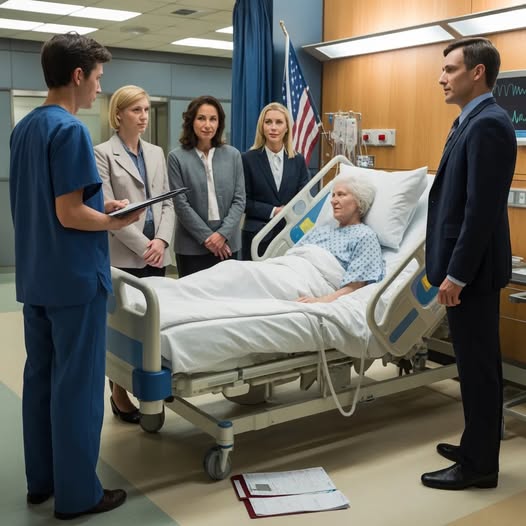
When I was still breathing, my son had already brought a notary into the ICU.
The fluorescent hospital lights buzzed softly above me while machines tracked every fragile beat of my heart. Tubes ran from my arms, medication dripped slowly through the IV beside my bed, and every breath felt heavier than the one before it. I was exhausted, frightened, and too weak to even adjust the blanket covering my legs.
And still, that was the moment my children chose to discuss paperwork.
My daughter-in-law leaned close to the hospital bed and gently pressed a pen into my hand as though she were helping me complete some harmless errand.
“Just sign it,” she whispered softly. “It’ll ease your mind.”
Ease my mind.
I remember staring at those words more than hearing them, because nothing about that room brought peace. Not the smell of antiseptic. Not the constant beeping of machines. And certainly not the expressions on the faces gathered around my bed.
My son stood near the foot of the bed beside the notary, impatiently pretending not to look impatient. My daughter avoided my eyes completely while smoothing invisible wrinkles from her sweater. My youngest son kept glancing toward the paperwork as though the signatures mattered more than whether I survived the night.
I looked at all three of my children and realized something that hurt more than the illness itself:
I no longer recognized any of them.
They had not come to hold my hand.
They had not come to comfort me.
They had not come because they were afraid of losing their mother.
They came because they believed death was approaching and they wanted to secure what they thought belonged to them before it arrived.
I said nothing.
Not because I was confused. Not because I was too weak to understand. But because in that moment silence revealed more than anger ever could. I simply stared at them while memories flickered painfully through my mind — scraped knees, school lunches, birthday cakes, nights I stayed awake worrying over fevers and heartbreaks and futures.
I had spent my entire life loving these people.
And somehow we had arrived here.
What none of them knew was that a month earlier, I had already changed everything.
Long before the hospital. Long before the ICU. Long before they realized my health was failing more seriously than I admitted.
I had seen the shift happening slowly over the years. The phone calls becoming shorter. Visits feeling transactional. Conversations circling quietly around finances, property, inheritance. Somewhere after their father died, I stopped feeling like their mother and started feeling like an eventual estate waiting to be divided.
So I made a decision quietly and completely on my own.
A decision none of them imagined I was capable of making.
Standing at the upstairs window of my home in Karago weeks earlier, I had watched evening light spread softly across the water behind the retreat center I built with my husband more than twenty years ago. Bradock Retreats had started as nothing more than grief and determination stitched together after his death. I created it for women who had lost husbands, partners, pieces of themselves. Women trying to survive empty houses and silent mornings after love disappeared from their lives.
I had spent decades helping strangers rebuild themselves after loss.
Guiding widows through first holidays alone.
First birthdays without their husbands.
First mornings where grief felt heavier than breathing.
The retreat became more than a business. It became proof that pain could still create something meaningful.
And yet, standing there at sixty-nine years old with tightness spreading through my chest, I realized I had ignored one painful truth about my own life:
I was lonely inside my own family.
The signs had been there for years. Invitations forgotten. Calls unanswered unless someone needed something. Visits shortened the moment conversations drifted away from money or property. I kept excusing it because mothers are skilled at protecting their children even from judgment they deserve.
But illness has a way of clarifying things quickly.
When my health worsened, their concern sharpened suddenly — but not in the way I once hoped. They became attentive to documents, accounts, ownership, legal details. Not me.
So one month before the ICU, I met privately with my attorney and changed everything.
Every property.
Every account.
Every legal arrangement they thought they understood.
A large portion of my estate went to keeping Bradock Retreats operating permanently for grieving women who needed it. Scholarships were established. Staff members who had cared for me loyally for decades received financial protection. Even the gardener who brought me tea every morning was remembered more generously than my children expected.
I left enough for my children that they could never claim cruelty.
But not enough to reward entitlement.
Back in the ICU room, they still believed those papers in their hands controlled the future. My son cleared his throat impatiently while the notary explained signatures in slow professional language.
Then I finally spoke.
“I already handled it,” I said quietly.
The room went still.
For the first time all day, every one of them looked directly at me.
“What do you mean?” my daughter asked carefully.
I looked from face to face — my children, my family, strangers wearing familiar skin — and something inside me settled peacefully for the first time in months.
“I changed everything weeks ago.”
No one smiled after that.
Shock spread across their faces first, then confusion, then anger barely hidden beneath forced composure. My daughter-in-law slowly removed the pen from my hand. My oldest son demanded to know what I meant exactly. Suddenly they were asking questions about lawyers and paperwork instead of my pain levels or whether I needed water.
And strangely, that answered every remaining question I still had about them.
They never imagined the frail old mother they dismissed could still make decisions for herself. They thought weakness meant helplessness. They thought age meant surrender.
But they forgot something important:
I built an entire life from grief once before.
I knew exactly how to survive disappointment.
And lying there in that hospital bed, watching their carefully controlled expressions finally crack, I realized something almost liberating:
The greatest inheritance I could leave behind was not money.
It was refusing to let the final chapter of my life be written by people who had already started treating me like I was gone before I even stopped breathing.