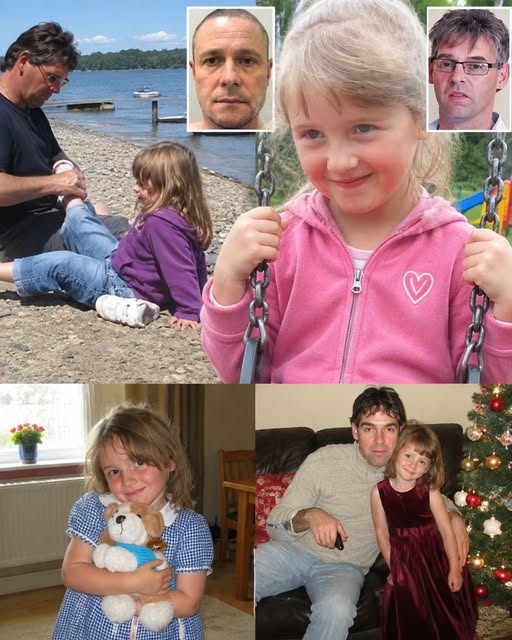
Paul Jones did not just lose his daughter once. He lost her hundreds of times.
Each reminder that April was gone ripped through a mind already under siege, as encephalitis stripped away his memories and weakened the fragile defenses that allowed him to understand the world around him. The illness did something cruel that ordinary grief never could: it prevented him from learning how to live with the loss.
Every time Paul forgot, he lost April again.
And every time he remembered, the pain returned as if the terrible news had just happened.
His wife, Coral, became the person forced to carry that unbearable responsibility. She had to keep breaking her husband’s heart to keep him connected to reality. She couldn’t allow him to live inside a comforting version of the world that no longer existed, but telling him the truth meant watching the devastation cross his face again and again.
Every day became another first day of the worst news imaginable.
There was no gradual healing.
No emotional distance created by time.
No ordinary process of accepting that someone you love is gone.
For Paul, the wound kept reopening.
Encephalitis had changed the rules of his grief. Memories that should have remained painful but stable became temporary. Information disappeared, only to return later with the same devastating force. The passage of time, which normally softens the sharpest edges of mourning, could not do its work because Paul could not reliably carry the past with him.
Coral had to live inside that impossible reality.
She wasn’t only grieving the disappearance of April.
She was grieving alongside a husband who could forget that their daughter was gone and then be forced to discover it again.
Imagine waking up beside someone you love and knowing that before long, you may have to tell them the same terrible truth you told them yesterday.
Imagine watching their face change as recognition returns.
Imagine knowing that the words you are about to say will cause genuine devastation, even though they are not new to you.
For Coral, this became part of everyday life.
She became both witness and messenger.
She carried her own grief while carrying Paul’s.
She had to decide when to remind him, how to explain it, and how to help him survive the emotional collapse that followed. Silence might protect him temporarily, but it could also leave him confused, searching for a daughter who was no longer there.
Honesty was painful.
But pretending could be cruel in another way.
Their love existed in that impossible space, where honesty and protection were always at war.
There were no perfect answers.
No sentence that could make the truth easier.
No medical explanation capable of explaining why a father should have to experience the same loss over and over.
Paul’s story was not simply about memory loss.
It was about what happens when memory and grief become tangled together.
For most people, memory is part of how grief evolves. We remember the person who died or disappeared. We remember their voice, their face, their habits, their favorite things. Those memories hurt, but they also become a way of carrying the person forward.
For Paul, memory itself had become unstable.
The same mind that should have preserved April’s place in his life kept erasing the knowledge of what had happened.
And when that knowledge returned, the shock returned with it.
April had disappeared from the world.
But she never disappeared from Paul’s heart.
That contradiction became the center of his final years.
He could forget the facts without forgetting the emotional connection.
He could lose the memory and still carry the love.
And Coral was left trying to navigate the space between those two realities.
The story also exposed another painful dimension of families dealing with a missing loved one.
When there is no definitive answer, grief doesn’t always have a clear ending.
There is no certainty.
No final chapter.
No simple place to put the pain.
A missing person can remain present in the imagination of everyone who loves them. Questions continue to survive because there is no complete explanation to replace them.
Where did she go?
What happened to her?
Could something have been missed?
Could someone still know the truth?
Could an answer still exist somewhere?
For families, those questions can become a permanent part of life.
And when illness is added to that uncertainty, the burden becomes even heavier.
Paul was not only dealing with the loss of his daughter.
He was losing the ability to consistently understand his own loss.
Coral therefore became the keeper of the story.
She remembered what Paul could not.
She carried the timeline.
She carried the facts.
She carried the grief.
And she carried the responsibility of deciding how much truth he could bear at any given moment.
It is difficult to describe that kind of love.
Because love is usually associated with comfort.
With protecting someone from pain.
With trying to make their world gentler.
But sometimes loving someone means telling them something that will hurt them.
Sometimes it means refusing to allow confusion to become a substitute for truth.
And sometimes it means absorbing the consequences of that truth yourself.
Coral had to do all three.
She had to watch her husband suffer.
Then she had to comfort him.
And afterward, she had to continue living with her own grief.
The emotional exhaustion of that kind of existence is almost impossible to measure.
There is no ordinary version of “moving on” when the person beside you keeps returning to the beginning of the tragedy.
The years passed, but Paul’s mind could repeatedly return to the moment when he first learned that April was gone.
For Coral, time moved forward.
For Paul, time could collapse.
Yesterday could become today.
Years could disappear.
A memory could vanish and then return without warning.
And every return carried the same unbearable weight.
Paul’s final years revealed a kind of suffering that defies easy language: a man forced to repeatedly rediscover the worst moment of his life.
Yet his story was also a testament to the endurance of love.
Coral did not have the power to restore Paul’s memories.
She could not bring April home.
She could not erase the illness.
She could not provide the answers everyone wanted.
What she could do was remain.
She could tell the truth.
She could hold his hand when the truth hurt.
She could remind him who April was.
And she could make sure that even when his memory failed, someone was still carrying the story.
After Paul’s death, the silence in their home did not necessarily bring peace.
Instead, it deepened the ache of questions that may never be answered.
The person who had carried so much of the family’s grief was gone too.
And with his death came another layer of absence.
Another voice disappeared.
Another witness to April’s story was lost.
But the questions remained.
That is perhaps the hardest thing about stories like this.
People die.
Memories fade.
Years pass.
Evidence disappears.
But unanswered questions can remain remarkably stubborn.
They survive generations.
They survive changes in families.
They survive illness.
They survive silence.
And sometimes, they survive the people who spent their entire lives searching for answers.
Paul’s story has therefore become more than a private tragedy.
It is a quiet rallying cry for better mental-health care, for stronger long-term support for families dealing with missing loved ones, and for a justice system that does not allow unresolved cases to disappear simply because years have passed.
Families need support long after the headlines fade.
They need someone to recognize that uncertainty can be its own form of trauma.
They need resources for caregivers who are carrying both their own grief and the psychological burden of caring for someone whose memory or understanding has been damaged.
And above all, they need the world to remember that a missing person is not a forgotten person.
April’s absence remained part of Paul’s life until the end.
Even when his memory failed, the emotional imprint remained.
Even when he had to hear the truth again, the love was still there.
And perhaps that is what makes his story so haunting.
Paul lost April again and again.
Coral had to tell him again and again.
But neither of them truly stopped loving her.
After Paul’s death, that love did not disappear with him.
It remained in the questions.
In the memories.
In the people who continue to speak her name.
And in the stubborn hope that somewhere, somehow, there may still be an answer waiting to be found.
Perhaps someone still knows what happened to April.
Perhaps a forgotten detail, an overlooked piece of evidence, or a person who has remained silent could one day change everything.
Until then, the story remains suspended between grief and hope.
A daughter missing.
A father gone.
A wife left carrying memories that cannot be forgotten.
And a family still living with a question that time has refused to answer.
In the end, what remains is not only sorrow.
It is the stubborn, echoing hope that someone, somewhere, still holds the key to April’s fate.
And the quiet knowledge that love, even shattered by time, illness, uncertainty, and loss, can outlast every lost year.