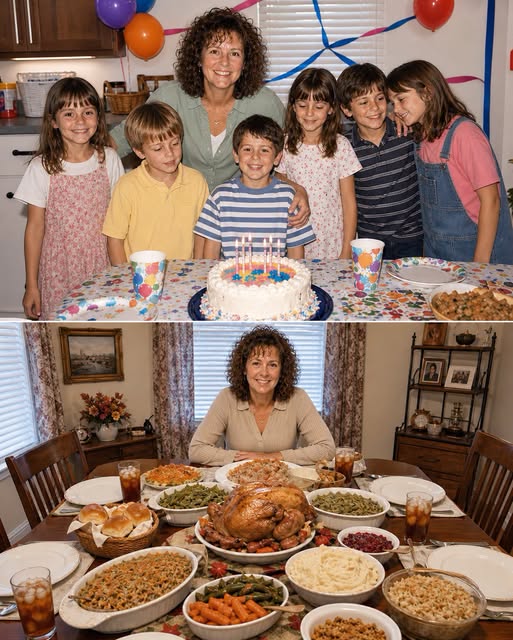
I spent my 60th birthday staring at six empty chairs.
Four hours.
Cold dinner.
A silent phone.
And a house that had never felt so quiet.
I kept telling myself there had to be a reason. Surely one of my children would call. Surely someone would knock on the door. Surely the silence was temporary, some misunderstanding that would be explained before the night was over.
But as the hours passed, hope slowly turned into anger.
Then anger turned into something worse.
Hurt.
I thought they had forgotten me.
I thought I had raised a family that had quietly moved on with their lives and somehow left me behind. I looked at those six empty chairs around my table and wondered when exactly we had stopped needing one another.
I never imagined that three hard knocks at the door, a police cruiser outside, and a handwritten note from my son would turn the worst birthday of my life into a night I would never forget.
I walked into that community center ready to be furious, not festive.
The balloons seemed almost offensive.
The cake looked too cheerful.
The banner hanging across the wall felt almost cruel compared with the memory of my empty dining room and the untouched dinner sitting at home.
Everyone was smiling.
Everyone was waiting.
And I was trying to understand how the same people who had made me feel forgotten could now be standing in a room decorated for my birthday.
My children weren’t careless.
Not exactly.
They were simply clumsy with love.
They had convinced themselves that a surprise party would make up for everything. They believed that if they could somehow create a dramatic enough reveal, the disappointment of not seeing them on my birthday would disappear.
They thought the surprise would be worth the waiting.
They didn’t understand what those four hours had felt like from my side of the story.
They didn’t understand that when a mother sits alone on her birthday, looking at empty chairs, she doesn’t immediately imagine a surprise.
She imagines absence.
She wonders whether her children still need her.
She wonders whether the family she spent decades building has quietly moved into a future where there is no longer a place for her.
And those thoughts can become very loud when the house is silent.
Then Grant stepped inside.
He was wearing a police uniform.
For a second, I couldn’t understand what I was looking at.
My son stood there carrying both his secret and my terror on his shoulders. The uniform, the cruiser outside, the mysterious note—it had all been part of the plan.
But the plan had gone terribly wrong.
What was supposed to be a dramatic surprise had created something none of them intended.
Fear.
Real fear.
The kind that takes over before your mind has time to catch up.
I had spent the entire evening believing my children had forgotten me.
Now I was standing in a community center surrounded by balloons, cake, and people I loved, trying to process the fact that they had been planning something all along.
Grant finally explained.
He had finished something difficult, something he had worked toward for a long time, and the uniform represented more than a costume or a dramatic entrance. It represented a milestone he desperately wanted his mother to see.
He wanted to surprise me.
He wanted me to be proud.
He wanted to create a birthday memory I would never forget.
He succeeded.
Just not in the way he imagined.
Because I would never forget those four hours either.
The silence had changed me.
The empty chairs had made me confront fears I usually kept buried. I had spent years being the person everyone could call. The person who remembered birthdays, packed extra food, checked in after difficult days, and made sure everyone knew there was always a place at my table.
But that night, for a few painful hours, I wondered whether anyone remembered to make sure there was still a place for me.
And that was the part my children finally understood.
Love is not always about grand gestures.
Sometimes love is showing up.
Sometimes it is making the phone call.
Sometimes it is sitting beside someone for ten quiet minutes.
Sometimes it is simply keeping a promise to be there.
The biggest surprise in the room was not the balloons or the cake.
It was realizing how much my children still cared.
They had never abandoned me.
They had simply become so focused on creating a perfect moment that they forgot the importance of an ordinary one.
They thought they needed to make my birthday extraordinary.
What I had wanted was much simpler.
I wanted them at the table.
That night, we talked about it.
Really talked.
There were apologies.
There was laughter.
There were tears.
And there were several moments when nobody knew what to say.
Because sometimes families need to admit that love can become tangled in good intentions.
You can love someone deeply and still hurt them.
You can plan something beautiful and accidentally create something painful.
You can believe you are doing the right thing while completely misunderstanding what the other person needs.
That night taught us all something.
We made a rule.
No disappearing.
Not from birthdays.
Not from holidays.
Not from each other.
And especially not from the small moments that quietly hold a family together.
No elaborate explanation.
No complicated promise.
Just show up.
If you say you are coming, come.
If you cannot come, call.
If something changes, tell someone.
Because silence creates stories.
And the story I had created in my own mind during those four hours was devastating.
I had convinced myself that my family had moved on without me.
They had convinced themselves that I would love the surprise.
Both sides were acting from love.
But only one side knew what the silence felt like.
Later that night, we went back to the house.
The roast I had prepared was still sitting there, untouched.
The food had gone cold hours earlier.
But somehow, it no longer mattered.
We gathered around the long table instead.
There was bad singing.
Far too much laughter.
Someone told a story that made everyone groan.
Someone else laughed so loudly that we had to stop the conversation.
It was messy.
It was noisy.
It was completely imperfect.
And it was exactly what I had wanted.
For the first time that evening, I stopped looking at the empty chairs.
They were no longer empty.
My children were there.
The people I had spent decades worrying about, raising, feeding, encouraging, and loving were sitting around my table again.
And suddenly, the entire night looked different.
I hadn’t been abandoned.
I had been loved badly for a few hours.
There is a difference.
A painful difference.
But an important one.
My children hadn’t forgotten me.
They had simply forgotten how fragile a mother’s heart can be.
They had forgotten that when someone loves deeply, even a small absence can feel enormous.
And I had forgotten something too.
That children, even grown children, can still be learning how to love their parents.
They can make mistakes.
They can become distracted.
They can misunderstand.
They can get so caught up in their own lives that they fail to realize how much one simple phone call can mean.
That does not necessarily mean the love is gone.
Sometimes it means the family needs to find its way back to the same table.
That night, we did.
The birthday that had begun with four hours of silence ended with too much noise.
And I wouldn’t have traded that noise for anything.
The cake was cut.
The stories continued.
The singing was terrible.
Someone spilled something.
Someone laughed until they cried.
And for a little while, the world felt exactly as it should.
Not perfect.
Just together.
That is what I remember most.
Not the police cruiser.
Not the uniform.
Not even the dramatic surprise.
I remember the chairs.
The same six chairs that had looked so empty earlier now had people sitting in them.
And suddenly I understood something I had forgotten.
A family is not measured by how perfectly everyone behaves.
It is measured by whether people are willing to come back.
To apologize.
To listen.
To forgive.
To sit down again.
To choose each other again.
My 60th birthday began with me wondering whether my children had quietly moved on.
It ended with me realizing they had never really left.
They were simply trying, imperfectly, to find their way back to me.
And maybe that is what families do.
They lose their way.
They misunderstand one another.
They hurt each other without meaning to.
Then, if they are lucky, they find the table again.
The roast at home went untouched.
The candles burned down.
The balloons slowly lost their air.
But around that long table, surrounded by bad singing and too-loud laughter, I realized something I would carry with me long after my 60th birthday was over.
I hadn’t been abandoned.
I had been needed all along.
We just had to remember that sometimes the greatest gift isn’t a surprise.
It isn’t a grand gesture.
It isn’t a room full of decorations.
It is simply showing up.
And staying.
And making sure the people you love never have to sit alone, staring at empty chairs, wondering whether they still matter.
That night, my family found its way back to the same table.
And for me, that was the real birthday gift.