The official reading of my grandmother Margaret’s will took place six days after her funeral.
The atmosphere felt disturbingly cheerful.
My father, Richard Harrow, arrived wearing one of his most expensive tailored suits and carried himself with the confidence of a man already calculating future profits. My mother, Vivian, looked immaculate as always, dressed entirely in black designer clothing that probably cost more than my monthly rent. My sister Celeste entered the conference room carrying a luxury handbag and smiling as though she had already won something.
Meanwhile, I sat quietly near the end of the table.
Still grieving.
Still trying to process the fact that my grandmother was gone.
The only person in the room who seemed remotely uncomfortable was the attorney reading the will.
His name was Martin Keene.
A nervous man in his sixties with silver hair and reading glasses that kept sliding down his nose.
He cleared his throat.
Opened the file.
And began.
The first portion of the estate unfolded exactly as everyone expected.
My father inherited a collection of investment portfolios worth several million dollars.
My mother received stock holdings, vacation properties, and various financial assets.
Celeste inherited luxury real estate, trust accounts, and enough money to guarantee she would never need to work another day in her life.
Each announcement produced satisfied smiles around the table.
Then Martin turned the page.
His expression changed slightly.
“Finally,” he said, glancing toward me, “the property located at 214 Willow Lane in Ridgefield, along with all structures and contents therein, is hereby transferred in full ownership to my granddaughter, Elise Harrow.”
Silence.
Complete silence.
Then Celeste laughed.
Not loudly.
Just enough.
“The old house?”
My father smirked.
“The collapsing one?”
Martin nodded.
“Yes.”
My mother exchanged a glance with Richard.
“Well,” she said, “that’s certainly… sentimental.”
The word felt like an insult disguised as kindness.
Nobody mentioned that the house was falling apart.
Nobody mentioned that maintaining it would cost a fortune.
Nobody mentioned that the property had sat mostly abandoned for decades.
They didn’t need to.
Their expressions said everything.
By the time we left the law office, my family looked thrilled.
I looked defeated.
Outside, my father adjusted his cufflinks and smiled.
“Looks like your grandmother gave you exactly what you could handle.”
My mother laughed softly.
Celeste grinned.
I simply stared at the rusted key resting in my palm.
Part of me wanted to cry.
Part of me wanted to throw it into the nearest storm drain.
Instead, I slipped it into my pocket.
Because no matter how unfair it felt, arguing never accomplished anything.
That afternoon, I drove to Ridgefield.
The old house stood exactly where I remembered.
Weathered.
Silent.
Forgotten.
Tall grass covered portions of the yard.
Several shutters hung crookedly.
The white paint had faded into a patchwork of gray and cream.
Most people would have seen a liability.
A burden.
An expensive mistake.
But as I stood there staring at it, I remembered something my grandmother once told me.
“There are things hidden inside this house.”
At the time, I assumed she meant memories.
Now I wasn’t so sure.
The front door creaked loudly when I unlocked it.
Dust floated through sunlight streaming from the windows.
The interior smelled of old wood and age.
Every room looked untouched.
Almost frozen in time.
I spent hours walking through the house.
Opening cabinets.
Checking closets.
Examining shelves.
Nothing.
Just old furniture.
Boxes.
Photographs.
Family heirlooms.
Exactly what I expected.
By sunset, disappointment had begun settling in.
Maybe my grandmother really had left me a crumbling house and nothing more.
Maybe my family had been right.
Maybe this was simply a sentimental gesture.
I was preparing to leave when I noticed something strange.
One of the photographs hanging in the hallway wasn’t level.
It tilted slightly to the left.
Normally I would have ignored it.
Instead, I reached up and straightened the frame.
The moment I touched it, I heard a faint click.
I froze.
Slowly, I removed the photograph from the wall.
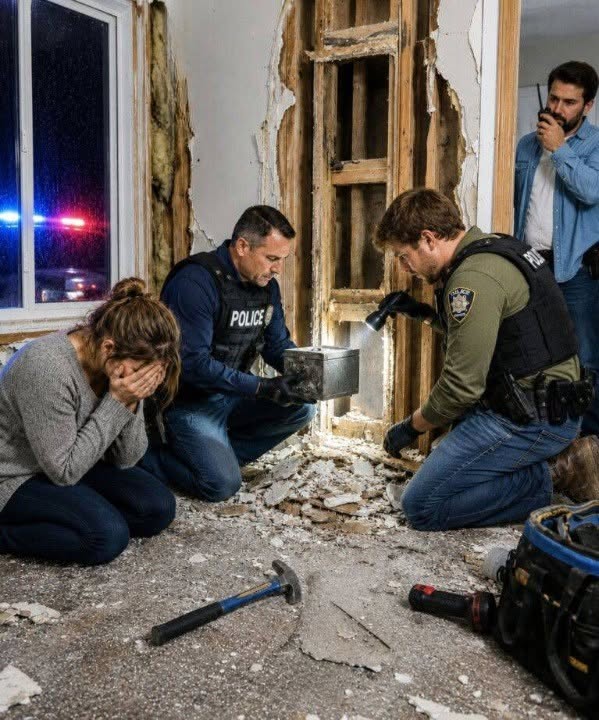
Behind it was a small metal compartment built directly into the wood.
My pulse quickened.
Inside sat a folded envelope.
Nothing else.
Just an envelope.
Across the front, written in my grandmother’s unmistakable handwriting, were four words.
For Elise. Only Elise.
My hands trembled as I opened it.
Inside was a single sheet of paper.
And one key.
Not the rusted house key.
A different key.
Small.
Brass.
Ancient.
Alongside it was a note.
Elise,
If you’re reading this, then you did exactly what I hoped you would.
You came here yourself.
Not because of money.
Not because someone told you to.
But because you cared enough to look.
That means you’re ready to learn the truth.
The house was never the inheritance.
It’s only the beginning.
Trust no one until you find Gordon Blake.
Especially not your father.
My heart nearly stopped.
I read the sentence again.
Then again.
Trust no one until you find Gordon Blake.
Especially not your father.
The room suddenly felt colder.
Because I knew that name.
Gordon Blake.
The man I had seen outside my grandmother’s hospital room the night she died.
The man I assumed was an attorney.
The man nobody had ever mentioned again.
I turned the note over.
On the back was an address.
And beneath it, one final sentence.
They think they inherited Margaret Harrow’s fortune.
But they only inherited what I wanted them to see.
For several seconds, I couldn’t breathe.
Then I looked around the empty house.
The old walls.
The dusty floors.
The fading photographs.
And for the first time, I began to suspect that my family hadn’t won anything at all.
Because whatever my grandmother had truly left behind…
She had hidden it somewhere nobody else had bothered to look.