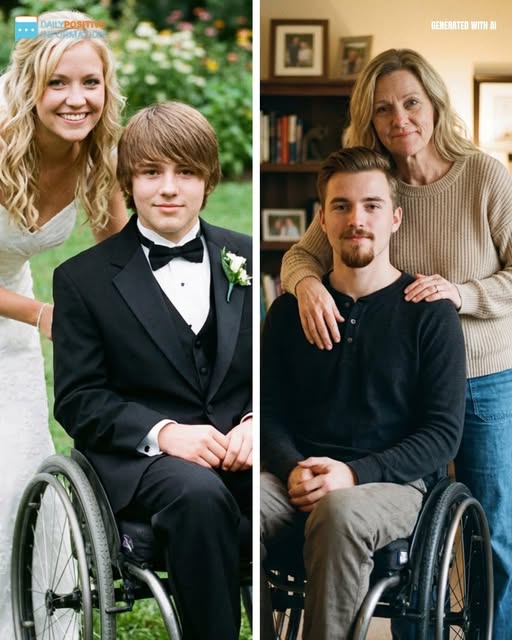
I met my husband during our senior year of high school, back when life felt both simple and endless—when the future stretched out like an open road, and we truly believed that love alone could carry us through anything.
We were both seventeen, growing up in a mid-sized town in Pennsylvania where everyone seemed to know everyone else’s story. We were young enough to believe in love without limits, yet old enough to make plans that felt permanent. We talked constantly about the future—about applying to the same colleges, sharing a tiny apartment with more charm than comfort, and building careers we barely understood but fully believed in.
His name was Michael, and he was my first love in every sense of the word—the kind that stays with you, shaping everything that comes after. He told me I was his first love too. When he smiled at me across the crowded cafeteria or reached for my hand in the hallway, the world felt steady, safe, exactly as it should be.
Then, one week before Christmas of our senior year, everything we believed in fell apart.
The accident that changed everything
Michael was driving to his grandparents’ house on a snowy December evening, carrying Christmas presents. It was one of those nights when the weather turns suddenly dangerous—black ice forming invisibly on quiet roads. There was an oncoming truck. There was no time to react.
The details were always unclear, but the outcome was devastating.
Michael survived—but he was paralyzed from the waist down. A complete spinal cord injury. No movement, no sensation below his torso.
I still remember the hospital vividly—the sterile smell of antiseptic, the steady rhythm of machines, the coldness of his hand in mine. Most of all, I remember the doctor’s voice:
“I’m very sorry… he will never walk again.”
The words didn’t just describe a condition—they rewrote our entire future.
Michael sat in stunned silence. His mother cried softly. His father stood rigid, trying to process it.
I was still trying to understand it myself when my parents arrived.
They stood at the foot of the bed, offering brief sympathy that already felt distant. I could see it in their expressions—they weren’t just reacting, they were calculating.
On the drive home, they didn’t ask about Michael’s pain or recovery. They asked about me—but not with concern. With intention.
“This is not the life you want,” my mother said, her tone calm but firm. “Not at your age.”
“You’re only seventeen,” my father added. “You can find someone else. Someone healthy. Someone who can give you a normal future.”
To them, Michael had gone from a promising young man to something else entirely—something inconvenient, something to leave behind.
I told them I loved him.
They told me love wasn’t enough.
When I refused to leave him—when I kept visiting every day, choosing him again and again—they followed through on their warnings.
They cut me off completely.
No financial support. No college fund. No safety net.
And then they told me not to contact them again until I “came to my senses.”
I packed a single bag and walked out.
I went straight to Michael.
The family that didn’t let me fall
Michael’s parents welcomed me without hesitation. They gave me a room, a place at their table, and something I hadn’t expected—unconditional support. They never made me feel like a burden.
I helped care for Michael as he adjusted to his new reality. I learned things I never imagined I would—how to assist him physically, how to support him emotionally, how to stay strong when he felt like he was falling apart.
I worked part-time at a grocery store. I studied for my GED. I learned how to survive without anything to fall back on.
When prom came around, I convinced Michael to go with me.
People stared. Some whispered. Some didn’t know how to react.
I didn’t care.
To me, he was still the same person I loved—funny, kind, strong in ways no one else seemed to understand.
Building a life from nothing
We got married young. I was nineteen, he was twenty. It was a small courthouse ceremony—simple, quiet, without my parents.
But it was real.
We built a life together, step by step. It wasn’t easy, and it wasn’t perfect, but it was ours.
At twenty-three, I gave birth to our daughter. She had Michael’s eyes and my stubbornness.
I thought maybe—just maybe—my parents would reach out then. That becoming grandparents might change something.
It didn’t.
No calls. No cards. Nothing.
Fifteen years passed like that.
Fifteen years of birthdays, holidays, milestones—without them.
And through it all, I believed Michael and I were unbreakable. We had survived so much together that I thought nothing could shake us. No secrets, no cracks—just strength built through everything we had endured.
I met my husband during our senior year of high school, back when life still felt both simple and endless—when the future stretched out before us like an open road, and we truly believed love alone could carry us through anything.
We were both seventeen, growing up in a mid-sized town in Pennsylvania where everyone knew each other’s business. We were young enough to believe completely in love, yet old enough to make plans that felt permanent. We talked about applying to the same colleges, about tiny apartments we’d somehow make feel magical, about careers we barely understood but spoke about with confidence.
His name was Michael, and he was my first love—the kind that stays with you forever, quietly shaping everything that comes after. I was his first love too, or at least that’s what he told me over and over. When he smiled at me across the cafeteria or reached for my hand between classes, everything felt right.
Then, one week before Christmas, everything fell apart.
The accident that changed everything
Michael was driving to his grandparents’ house on a snowy evening to drop off Christmas presents. It was one of those nights where the roads look safe but aren’t—black ice hidden beneath a thin layer of melted snow.
A truck couldn’t stop in time.
The details never mattered as much as the outcome.
Michael was left paralyzed from the waist down.
I still remember the hospital—the sterile smell, the quiet beeping of machines, the coldness of his hand in mine. And the doctor’s voice:
“The damage is complete. He will never walk again.”
Michael went silent. His mother cried. His father stood frozen.
I didn’t even have time to process it before my own parents arrived.
They stood at the foot of his bed, offering polite sympathy—but I could already see it in their eyes. They weren’t thinking about his pain. They were calculating my future.
On the drive home, they made it clear.
“This is not the life you want,” my mother said.
“You’re seventeen,” my father added. “Don’t throw your future away.”
They weren’t asking. They were deciding.
But I told them I loved him. That love meant staying.
They called me naive.
When I refused to leave Michael—when I kept showing up every day, when I chose him over their approval—they followed through on their threats.
They cut me off completely.
No money. No college fund. No support.
And then they told me not to come back until I “came to my senses.”
The family that stayed
I packed a single bag and went to Michael.
His parents took me in without hesitation. No judgment, no conditions. Just kindness.
I helped care for him—learning everything from physical therapy routines to daily tasks he now needed help with. I worked part-time, studied for my GED, and learned how to survive without a safety net.
When prom came, I convinced him to go.
People stared. Some whispered.
I didn’t care.
To me, he was still the same person I loved.
We got married young—quietly, at a courthouse. No big ceremony. No parents on my side. Just us, his family, and a few friends.
We built a life slowly. Imperfectly, but honestly—or at least, that’s what I believed.
We had a daughter when I was twenty-three. I waited for my parents to reach out.
They never did.
Fifteen years passed in silence.
And I thought we were strong—unbreakable, even. We had survived everything.
Until one ordinary afternoon proved I was wrong.
The truth I was never meant to know
I came home early from work one day because of a power outage.
As I stepped inside, I heard voices in the kitchen.
Michael’s voice—tense.
And another voice I hadn’t heard in fifteen years.
My mother.
She stood there, furious, holding a stack of papers.
“How could you lie to her?” she shouted. “How could you steal her life?”
I froze.
“Mom?” I whispered.
She turned to me.
“You need to know the truth.”
Michael looked like he might collapse.
“Please,” he said. “Let me explain.”
My hands were shaking as I took the papers.
Medical records.
Reports.
Dates I didn’t recognize.
And then I saw it.
A single line that changed everything.
The paralysis had not been permanent.
Doctors had determined—years ago—that he could regain mobility. With treatment, surgery, therapy… he could have walked again.
I looked at him, unable to breathe.
“You told me there was no hope.”
He broke down.
“I was scared,” he said. “I thought you’d leave. I thought you’d regret staying if things didn’t work out.”
“So you lied?” I asked. “For fifteen years?”
He nodded.
Then my mother spoke again.
“He came to us,” she said. “Asked us to fund the surgery. But only if we promised never to tell you.”
I turned to her, stunned.
“You knew?”
She looked away.
“We thought you were trapped,” she said quietly.
Everything collapsed in that moment.
Every sacrifice. Every long shift. Every defense of him. Every story I told our daughter about her “brave” father.
It had all been built on something that wasn’t true.
“I chose you,” I said. “When I lost everything, I chose you.”
“I love you,” he said.
“But you didn’t trust me,” I replied.
And that was the part that hurt the most.
What came after
I didn’t scream.
I didn’t argue.
I packed a bag—just like I had years before—and left with our daughter.
The divorce was quiet, but final.
The truth was undeniable.
And strangely, something else changed too.
My parents came back—but this time, differently.
Not controlling. Not cold.
They apologized.
Not for trying to protect me—but for taking away my choice.
For cutting me off.
For deciding my life for me.
I didn’t forgive them right away.
But slowly, we rebuilt something.
What I carry now
Years later, my life is different.
Quieter. More honest.
I don’t regret loving him. Those years taught me strength, loyalty, and resilience.
But I learned something deeper:
Love cannot survive without truth.
And no matter how big the sacrifice, it loses its meaning if it’s built on a lie.