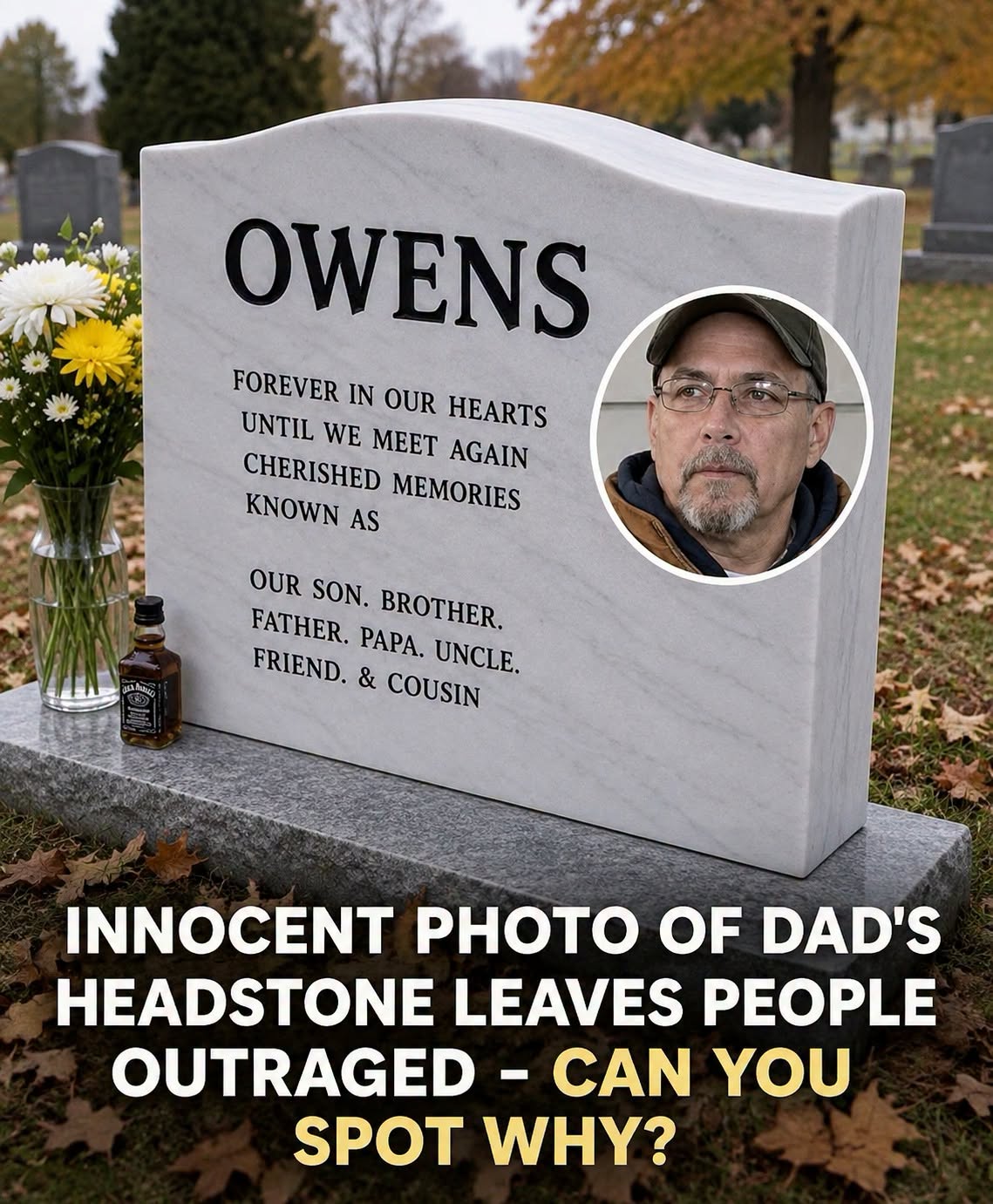
**A gravestone is supposed to end a story. Here, it lit the fuse.** One small, hidden word carved into a father’s headstone has exploded into lawyers, outrage, and a bitter fight over who owns the dead. To his children, it is a final joke—a private message preserved in stone, exactly the kind of irreverent humor their father was known for. To cemetery officials, it represents something much larger: a challenge to the rules governing shared spaces, public standards, and every future burial that might follow.
What began as a detail that most visitors might never notice has become a dispute over grief, memory, property, and the limits of expression. The family insists the inscription was never intended to shock strangers. It was meant for the people who knew the man, understood his humor, and could recognize the personality behind the words.
The cemetery sees something different.
And neither side appears willing to give way.
### The Hidden Message
The controversy centers on a single acrostic.
At first glance, the inscription appears ordinary. The words are arranged like a conventional memorial, offering familiar sentiments about a life, a family, and memories that remain after death.
But when the first letters are read together, they quietly spell a profanity.
It was apparently deliberate.
The family says that was precisely the point.
Their father had a sense of humor that could be inappropriate, sarcastic, mischievous, and occasionally outrageous. He enjoyed jokes that made people roll their eyes before laughing anyway.
The hidden message, they argue, was his final joke.
Not a public statement.
Not an attempt to insult anyone.
Just one last wink from a man who had spent his life refusing to take himself too seriously.
To his children, that distinction matters.
They don’t see the gravestone as a public billboard.
They see it as their father’s final piece of personal expression.
### “That’s Who He Was”
One family member reportedly described the proposed alteration as more than a correction.
It would be an erasure.
If the cemetery removes the coded message, the family argues, it isn’t simply removing an offensive word. It is changing something their father intentionally chose to leave behind.
That is where grief becomes complicated.
When someone dies, families often preserve the details that made them human.
The embarrassing stories.
The strange habits.
The jokes.
The phrases they repeated.
The things that irritated everyone but somehow became beloved over time.
Death has a tendency to make people seem more polished than they really were.
Obituaries often emphasize accomplishments.
Memorial speeches focus on kindness.
Photographs show smiling faces.
But real people are messier.
They swear.
They tease.
They make inappropriate jokes.
They annoy their children.
They laugh at things they probably shouldn’t.
The family believes the hidden profanity keeps their father’s memorial honest.
It says, in effect:
**This was him.**
Not an idealized version.
Not a sanitized version.
Him.
### The Cemetery’s Responsibility
The cemetery trustees see the issue through a completely different lens.
A cemetery is shared space.
Hundreds or thousands of families may visit the grounds, each carrying their own grief, traditions, beliefs, and expectations.
A rule that appears insignificant at one grave can become difficult to enforce when applied across an entire cemetery.
That is the trustees’ concern.
If one family is allowed to use a coded profanity, what happens when another family wants something more explicit?
What if someone places an offensive political message on a headstone?
What if another family uses insulting language toward a living person?
What if memorials gradually become personalized advertisements, jokes, or provocations?
The trustees argue that regulations exist precisely because a cemetery isn’t an entirely private environment.
It is a community space dedicated to mourning.
And maintaining that environment requires boundaries.
### Where Does Ownership End?
The dispute also raises a surprisingly complicated question:
**Who owns a memorial?**
The family may have paid for the stone.
They may have selected the design.
They may have chosen the words.
But the stone exists on cemetery property governed by contracts and regulations.
That creates a gray area between private expression and shared rules.
A family can reasonably feel that its loved one’s grave belongs to them emotionally.
A cemetery can reasonably argue that every grave exists within a larger system.
Those two ideas aren’t necessarily compatible.
And once lawyers become involved, the argument stops being merely about taste.
Contracts matter.
Burial agreements matter.
Cemetery bylaws matter.
Local regulations may matter.
Even the precise language used in the original agreement could determine how much authority the cemetery actually has.
### The Fear of a Precedent
For cemetery officials, this may be less