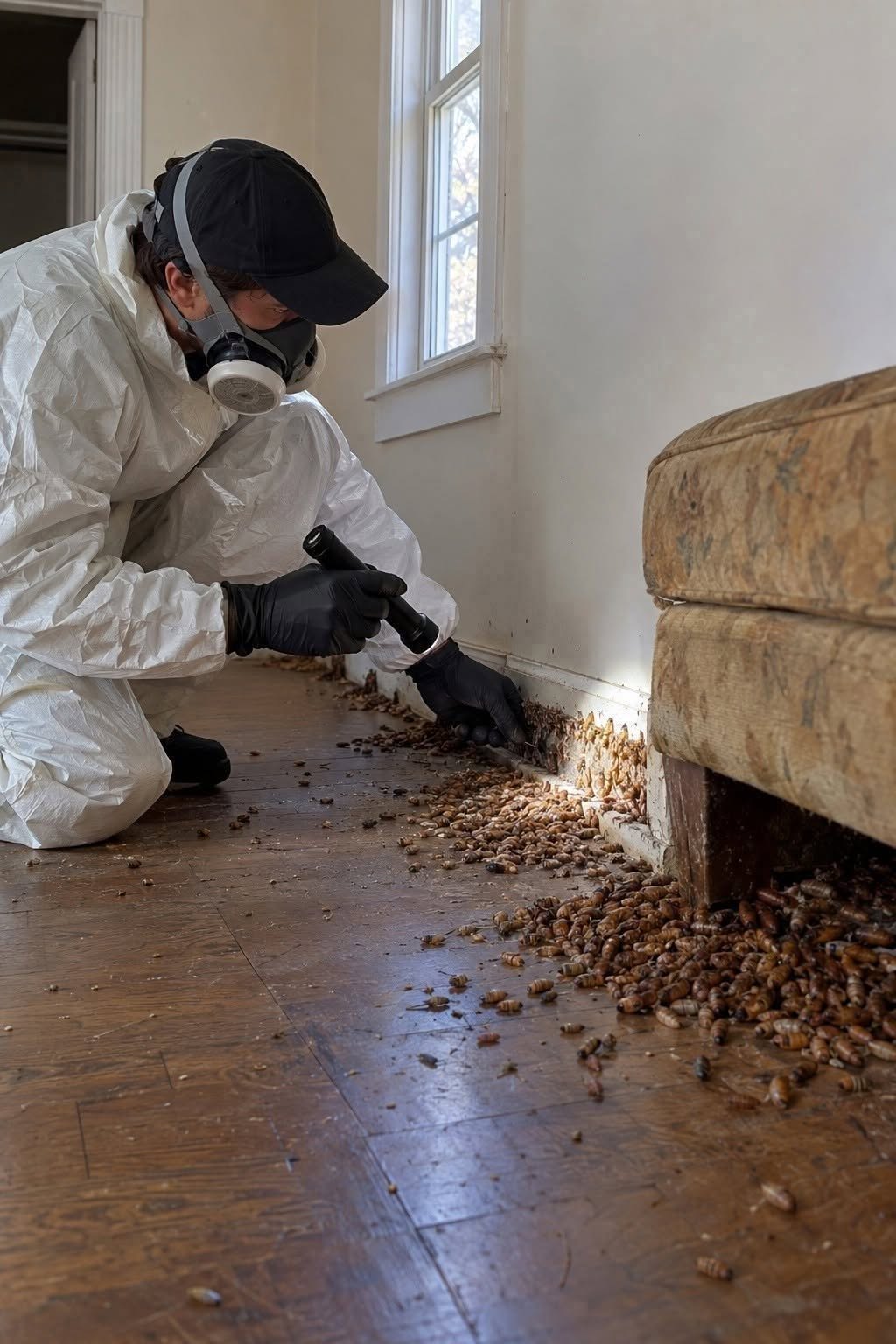
He Smelled Something Strange in His House, Then Opened the Wall and Found This
After more than two decades in the pest-control business, Nick Castro had learned that houses can hide some remarkable surprises.
As the owner of Nick’s Extreme Pest Control in California, Castro had spent years investigating the kinds of problems most homeowners would rather never encounter. Animals could squeeze into spaces that seemed impossibly small. Insects could establish colonies behind walls without being noticed. Strange noises coming from an attic could turn out to have an explanation very different from what a homeowner initially imagined.
After more than 20 years on the job, there wasn’t much that Castro believed could genuinely surprise him.
Then he received a call involving a woodpecker.
At first, the problem sounded relatively ordinary. A homeowner had noticed that a woodpecker was repeatedly drilling holes into the exterior siding of the house.
The visible damage was frustrating, but nothing about it suggested what was happening on the other side of those walls.
The bird wasn’t simply pecking at the house.
It was using the structure for storage.
And by the time the wall was opened, the scale of what had accumulated inside was enough to astonish even an experienced pest-control professional.
It Began With Some Suspicious Holes
From outside, the first signs of the problem didn’t look particularly dramatic.
There were holes in the home’s siding, apparently created by a woodpecker that had taken an interest in the property.
Woodpeckers peck at wooden surfaces for several reasons. Depending on the species and situation, they may be searching for insects, communicating, creating nesting cavities, or storing food.
In this case, food storage was the key.
The bird had been collecting acorns and pushing them into holes in the home’s exterior.
An acorn here or there would hardly have been remarkable. Even several dozen might have seemed like little more than an unusual inconvenience.
But the design of the house created an unexpected problem.
The holes didn’t function like shallow storage spaces.
Instead, they provided access to the hollow cavities behind the siding and inside the walls.
When the woodpecker inserted an acorn, gravity could pull it farther down into the structure.
The bird could then return with another acorn.
And another.
And another.
From the outside, all anyone could see were relatively small openings.
Inside the walls, however, a hidden collection had quietly been growing.
The First Opening Revealed Something Extraordinary
When Castro began investigating, he expected to encounter some acorns.
The evidence already suggested that the bird had been storing them around the house, so discovering a small collection would not have been surprising.
What happened when part of the wall was opened was another matter entirely.
Acorns began coming out.
Not just a few.
They poured from the wall cavity in a steady stream.
Imagine cutting into a section of drywall expecting to find perhaps a handful of nuts, only to discover that the space behind it has effectively become a reservoir.
The more material Castro removed, the more acorns appeared.
At first, the sight was amusing and unusual.
Then the scale of the accumulation became apparent.
This wasn’t a bird’s small emergency food supply.
There were enormous quantities of acorns hidden inside the structure.
The wall itself had essentially become a giant container.
The Acorns Had Spread Through the Wall Cavities
Finding a concentrated pile in one small area would have been remarkable enough.
As additional sections were examined, Castro discovered that the acorns had accumulated through the cavities and reportedly reached toward the attic.
That detail transformed the story.
This wasn’t something that had happened during a handful of visits.
The woodpecker had apparently returned again and again, repeatedly depositing food into the house.
Each individual trip probably seemed insignificant.
One bird carrying one acorn doesn’t look capable of creating a major structural headache.
But repetition changes everything.
A single acorn becomes ten.
Ten become a hundred.
Hundreds become thousands.
And when the food continues dropping into spaces where it can’t easily be seen—or retrieved—the accumulation can continue without anyone realizing what is happening.
For the homeowner, the evidence outside the house offered only a small clue.
Behind the siding was the real story.
Nearly 700 Pounds of Acorns Were Removed
Eventually, the amount removed from the property was estimated at roughly 700 pounds of acorns.
That number is what turned an already strange pest-control story into something almost difficult to imagine.
Seven hundred pounds is far beyond the amount most people would associate with a single bird’s food-storage behavior.
According to accounts of the discovery, the enormous collection was enough to fill around eight large trash bags.
For Castro, it was unlike anything he had encountered during more than two decades in pest control.
That experience mattered.
Professionals in his field routinely see things hidden from ordinary homeowners: nests in attics, insects inside walls, rodents using crawl spaces, animals finding their way into chimneys, and all sorts of unexpected activity around buildings.
Yet a wall filled with hundreds of pounds of acorns was something different.
The house hadn’t merely attracted an animal.
Part of it had inadvertently become an enormous pantry.
How Could One Bird Store So Much?
At first glance, the obvious question is how a woodpecker could possibly accumulate such an enormous amount of food.
The answer lies in persistence and the unusual structure of the storage location.
The bird was reportedly collecting acorns and placing them into holes in the exterior siding.
Under more natural circumstances, food stored in a suitable cavity would remain close enough for the bird to retrieve later.
But a house isn’t a tree.
Once an acorn entered certain openings, it could drop down into the hollow wall cavity instead of staying near the entrance.
That meant the storage space effectively had far more capacity than the bird may have expected.
The woodpecker could insert an acorn, watch it disappear, and then return with another.
If the nut fell out of reach, there was still room for the next one.
And because the interior cavity wasn’t visible from outside, the homeowner couldn’t easily see the growing pile either.
This could continue repeatedly.
Day after day, trip after trip, the bird’s tiny contributions accumulated.
Eventually, the house contained hundreds of pounds of food.
The Woodpecker Had Accidentally Created an Inaccessible Pantry
There is an almost comical—and slightly unfortunate—side to the situation when viewed from the bird’s perspective.
The woodpecker was doing exactly what its instincts told it to do.
It was gathering food and attempting to preserve it for later.
Each acorn required effort.
But the investigation suggested that the problem extended much farther.
The bird had to locate it, collect it, transport it back to the property, find a suitable opening, and place it inside.
But there was one major flaw in the plan.
Many of the acorns apparently weren’t remaining where the woodpecker put them.
They were falling farther into the wall.
In other words, the bird was repeatedly filling a pantry that it might not have been able to empty.
From a human perspective, hundreds of pounds of acorns inside a wall is an extraordinary property problem.
From the woodpecker’s perspective, it may have been hundreds or thousands of successful-looking food deliveries followed by mysteriously disappearing supplies.
The very feature that made the house such an attractive storage location—its enormous hidden cavities—also made it a terrible place to retrieve the food.
Why Didn’t Anyone Notice Earlier?
Perhaps one of the most surprising aspects of the story is how much material could accumulate without the scale of the problem immediately becoming obvious.
Walls conceal a tremendous amount of empty space.
Homeowners usually think of a wall as a solid barrier, but many residential walls contain cavities between structural components. Those spaces may hold insulation, electrical wiring, plumbing, or simply empty areas.
When wildlife gains access to them, activity can remain hidden for quite some time.
From outside, a person might see only a few holes.
From inside the room, the wall may appear completely normal.
Meanwhile, something entirely unexpected can be happening in the space between those two surfaces.
In this case, acorns were accumulating out of sight.
It wasn’t until the structure was opened that the full scale of the stash became visible.
That moment—when acorns began pouring from the wall—was essentially the reveal of something that had likely taken considerable time to create.
A Pest-Control Problem With an Important Difference
Despite the name of the industry, not every animal involved in a pest-control call should simply be viewed as something to destroy.
The woodpecker wasn’t attacking the homeowner out of aggression or deliberately attempting to damage the property.
It had simply discovered that the house provided a useful feature.
To the bird, the siding and cavities offered potential storage locations.
The resulting property damage was an unintended consequence of ordinary animal behavior interacting with an artificial environment.
That distinction influenced the response.
Rather than harming the woodpecker, Castro’s team reportedly took a humane approach.
The objective was straightforward: remove the accumulated acorns and stop the house from continuing to function as a food-storage site.
The bird itself didn’t need to be harmed.
Instead, the environment needed to change.
The Solution: Close the Access Points
Once the huge quantity of acorns had been removed, preventing the problem from returning became the next priority.
The holes created in the siding needed to be addressed.
If they remained accessible, the woodpecker could simply return and begin the entire process again.
The openings were therefore patched, and the homeowner reportedly planned to install new vinyl siding.
This is a useful principle in many wildlife conflicts around homes.
Simply removing whatever is inside a structure doesn’t always solve the underlying problem.
If an animal still has access to the same opening—or if the feature that attracted it remains unchanged—it may return.
A lasting solution often involves changing the environment so the structure no longer offers the same opportunity.
In this case, closing the holes meant removing the bird’s access to the enormous hidden cavities.
The woodpecker could then seek a more appropriate location for its food-storage behavior.
The Bird Wasn’t the Villain
It would be easy to frame a story like this as a battle between a homeowner and a destructive animal.
But that misses one of its most interesting aspects.
The woodpecker wasn’t behaving maliciously.
It didn’t know the siding belonged to someone.
It didn’t understand construction, property boundaries, repair costs, or wall cavities.
It simply recognized a surface that could be used.
Wild animals make decisions based on survival opportunities.
Does this place offer shelter?
Can food be found here?
Is there somewhere to nest?
Can something valuable be stored safely?
Human buildings often accidentally answer “yes” to one or more of those questions.
An attic may resemble a protected nesting space.
A chimney can resemble a hollow tree.
A gap beneath a deck can provide shelter.
And, apparently, holes in siding can look like excellent places to hide acorns.
The conflict begins because the animal and homeowner assign completely different meanings to the same space.
Wildlife Is Remarkably Good at Adapting to Human Environments
This incident also illustrates something broader about wildlife.
Animals can be remarkably adaptable.
As towns, suburbs, roads, and homes expand into natural habitats, many species learn to take advantage of human-built environments.
Some birds nest on buildings.
Other animals use sheds, crawl spaces, roofs, garages, drainage systems, or landscaping for shelter and food.
These adaptations aren’t necessarily deliberate in the human sense.
Animals simply exploit opportunities that help them survive.
The California house offered the woodpecker an unusual opportunity: a surface into which it could place food and a vast hidden cavity behind it.
The bird couldn’t understand that the cavity belonged to a house.
It simply discovered something that appeared useful and continued using it.
That is what makes the story simultaneously funny, fascinating, and frustrating.