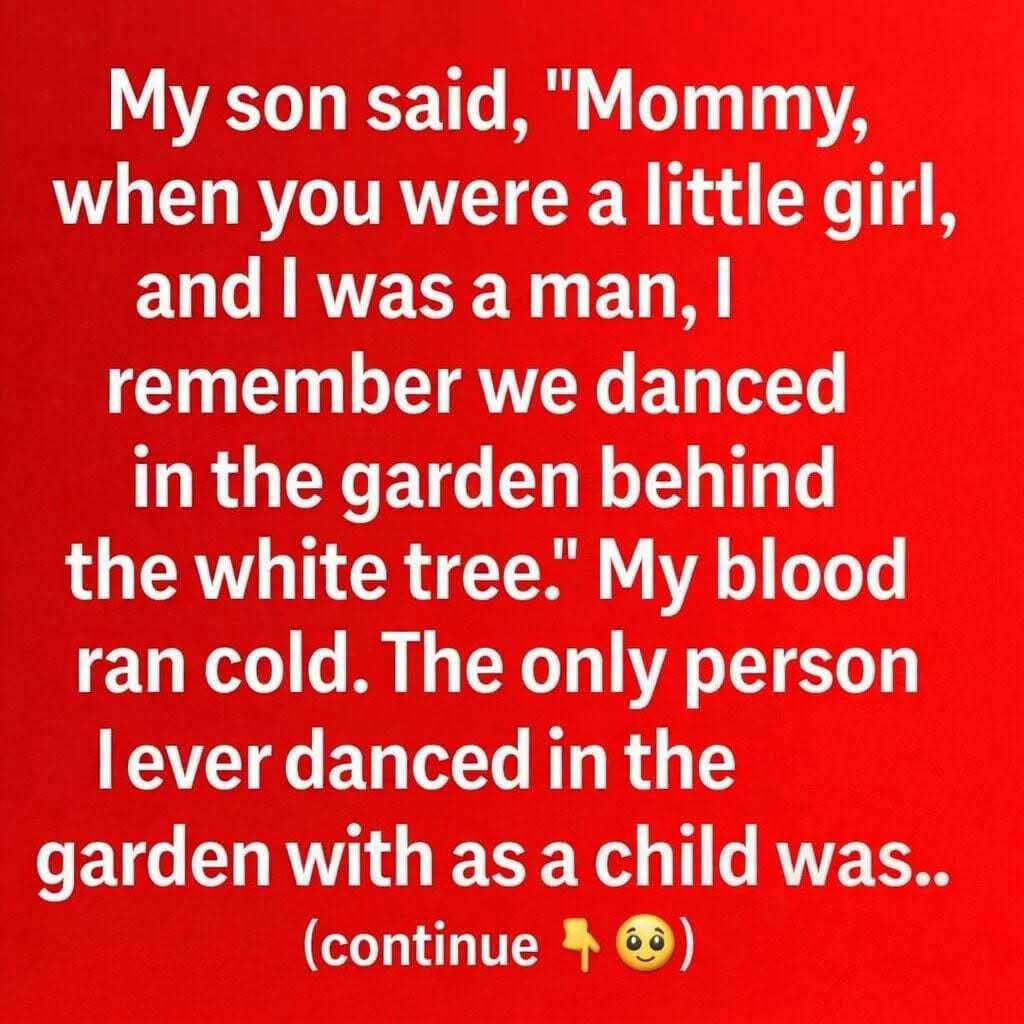
Those words came from my young son so unexpectedly that, for a moment, I could do nothing but stare at him. His voice was calm and natural, as though he were telling me about something that had happened only yesterday. There was no hesitation in the way he spoke, no sign that he was trying to make up a story or get my attention. He simply looked at me with the innocent confidence of a child who believes that what he is saying makes perfect sense. At first, I almost smiled, thinking he had confused something he had heard with one of his own imaginative ideas. Children often create wonderful stories from fragments of conversations, pictures, and dreams. But something about his words felt different. The mention of the garden and the white tree stirred a memory I had not thought about in years, a memory so personal that I had rarely spoken about it even with the people closest to me.
Suddenly, I was no longer entirely focused on the little boy standing in front of me. My thoughts had carried me back to my childhood, to the garden behind my grandfather’s house and the tall white oak that had stood there for as long as I could remember. That tree had been one of the most familiar parts of my early life. Its branches stretched high above the grass, creating a quiet place where the afternoon sunlight filtered through the leaves and painted shifting patterns on the ground. To an outsider, it might have been nothing more than an ordinary tree in an ordinary garden. To me, however, it was connected to some of the warmest memories I had of my grandfather and the time I spent with him.
I remembered the old radio that often played in the garden during those afternoons. Its sound was sometimes faint and crackling, but the music seemed to fill the entire space, giving even the quietest day a sense of life. My grandfather would stand nearby, and before long, we would begin dancing together on the grass. I would take off my shoes and run barefoot through the garden, laughing whenever I lost my balance or stepped on a patch of uneven ground. He would hold my hands and gently guide me as we turned in circles beneath the branches of the white oak. I never worried about how I looked or whether I knew the correct steps. I was simply a child enjoying the company of someone who made me feel loved and safe.
Those afternoons had belonged to a private corner of my childhood, a place in my memory that remained untouched by the responsibilities and complications of adult life. Whenever I thought about my grandfather, I remembered the patience in his voice, the warmth of his hands, and the way he seemed to have all the time in the world for me. He never made me feel that my questions were unimportant or that my happiness was something he had to fit into a busy schedule. When we danced beneath the white oak, the rest of the world seemed far away. I did not understand how precious those moments were at the time. I only knew that I wanted them to continue for as long as possible.
As I grew older, life gradually carried me away from that garden. Childhood gave way to school, responsibilities, relationships, and eventually the experience of becoming a mother myself. My grandfather’s memory remained important to me, but the details of those early years became something I revisited only occasionally. I carried the feeling of being loved by him, even when I was no longer able to return to the garden and dance beside him. There were things I remembered clearly and others that had softened with time, but the white oak, the old radio, and the afternoons spent turning barefoot through the grass had never completely disappeared from my mind.
That was why my son’s words affected me so deeply. He had mentioned a place and an experience that belonged to a part of my life I considered entirely my own. I had never sat him down to describe those afternoons, and I had not told him the story of dancing beneath my grandfather’s tree. I had certainly never explained how those moments had made me feel or how much I had wanted them to last. Yet he spoke as though he knew the scene personally, describing it with a certainty that made it difficult for me to dismiss the conversation as an ordinary childhood invention.
Before I could fully process what he had said, he continued talking. He mentioned my yellow dress, the way we had spun around in the garden, and the feeling of moving to the music while the old radio played nearby. Each detail seemed to bring another part of my childhood into focus. I could almost picture the yellow fabric moving around my legs as I turned, the sunlight falling across the grass, and my grandfather smiling as he held my hands. The memories came back with a vividness that surprised me, as though my son’s words had opened a door I had not realized had remained closed for so long.
Then he repeated something that made my heart tighten.
“Don’t let me go.”
Those words were especially difficult to hear because they carried an emotional meaning I recognized immediately. They reminded me of the way I had clung to my grandfather’s hands when we danced, afraid that if he released me, the moment would end. I remembered being small enough that his hands seemed enormous compared with mine and feeling comforted by the certainty that he would guide me through every turn. I could not say with complete confidence that I remembered speaking those exact words on a particular afternoon, but the feeling behind them was unmistakable. As a child, I had wanted to remain in that garden with him for as long as I could.
What unsettled me most was that I had never shared that particular memory with my son. I had not shown him photographs of the garden or described the yellow dress in a story. I had not told him about the music, the dancing, or the quiet fear of being separated from someone I loved so much. His words seemed to touch details that were deeply personal to me, and I struggled to understand how he could have arrived at them. For a moment, I wondered whether I had spoken about those things without remembering doing so, perhaps during a conversation I had long forgotten. I considered whether he might have encountered some small clue in an old photograph or overheard a fragment of a story. But I could not identify an explanation that accounted for everything he had said.
I looked at him carefully, searching his expression for some indication that he understood how unusual the conversation felt to me. He did not appear frightened or confused. There was no dramatic change in his behavior, no sense that he was trying to convince me of something extraordinary. He seemed completely at ease, speaking with the same quiet confidence he might have used to tell me about a game he had played or a dream he had experienced. His innocence made the moment even more powerful. He had no reason to understand why his words were affecting me so deeply. To him, he was simply telling me something that seemed familiar.
As I continued looking at him, the emotions I had been trying to hold back finally overwhelmed me. Tears began to fill my eyes, and before I could stop them, they ran down my cheeks. I had not expected to cry, especially not in front of my son, but the combination of surprise, memory, and longing had become too much to contain. I thought about my grandfather, about the years that had passed since those afternoons in the garden, and about all the things I wished I could tell him now. I wished I could return to that place for just a few minutes, hear the old radio playing again, and feel his hands guiding mine as we turned beneath the white oak.
My son noticed that I was crying. He did not respond with alarm or begin asking a series of questions about what was wrong. Instead, he reached up and gently touched my cheek. His small hand brushed against my skin with a tenderness that seemed entirely natural to him. Then he looked at me with the same calm expression he had worn throughout the conversation, as though he understood that I was experiencing something important even if he could not explain it in words.
That simple gesture affected me in a way I had not anticipated. For a brief moment, I felt an unexpected sense of comfort, a tenderness that reminded me of the safety I had once experienced with my grandfather. I did not believe that my son had somehow become my grandfather, nor did his words provide evidence that anything supernatural had occurred. Yet the emotional connection I felt was real. His presence brought my attention back to something I had carried inside me for years: the memory of being loved without conditions, of being held through moments of uncertainty, and of feeling that someone would remain beside me when I needed them most.
I gently held my son close, allowing myself to experience the mixture of emotions that had surfaced. I felt happiness because he was there in my arms, sadness because I missed my grandfather, and wonder because of the unexpected way those two parts of my life had seemed to meet. The experience did not provide a clear explanation, and I knew that my feelings could not establish what my son’s words actually meant. Children sometimes say things that surprise adults, drawing on imagination, forgotten conversations, subtle observations, or experiences that we may not fully understand. It was possible that there was an ordinary explanation for what he had said, even if I could not identify it at that moment.
Still, knowing that there might be an ordinary explanation did not make the encounter meaningless. The emotional power of the experience did not depend on proving that my son had remembered something from another time or that his words carried a message from beyond my understanding. What mattered was the way the conversation had brought me back to a memory I treasured and reminded me of the love that continued to shape my life. For years, I had thought of those afternoons with my grandfather as something that belonged entirely to the past. Yet in that unexpected moment, the feelings associated with them seemed to return with remarkable clarity.
I began thinking about the ways love can remain present long after the people we love are no longer with us. My grandfather could not stand beneath the white oak with me anymore, and I could not return to those afternoons exactly as they had been. Time had moved forward, and my own life had changed in ways the little girl dancing in the garden could never have imagined. But the love I had experienced with him had not disappeared. It had become part of the way I understood safety, family, tenderness, and the importance of making someone feel cherished. Perhaps that was why my son’s words touched me so deeply: they reminded me that the past was not simply a collection of events that had ended, but something that continued to influence the person I had become.
That evening, I found myself thinking about the yellow dress again. I remembered the freedom of spinning until I became dizzy, the sound of music drifting through the garden, and the laughter that followed when my grandfather and I lost our rhythm. I remembered how small I had been and how large the world had seemed. Most of all, I remembered the feeling that I could trust him completely. When I had said, “Don’t let me go,” I had been expressing the simple fear of a child who wanted a beautiful moment to last a little longer. I could not know whether my son had somehow encountered that exact memory or whether his words had emerged through a different process. But I could recognize the truth of the feeling they had awakened in me.
As the night continued, I realized that I did not need to solve the mystery in order to appreciate what had happened. My mind had initially searched for an explanation because the details seemed so personal and unexpected. I wanted to understand how my son could have spoken about something I had never knowingly shared with him. Yet the more I thought about it, the more I understood that not every meaningful experience needs to be reduced to a definite conclusion. I could remain curious about his words without deciding that they proved something extraordinary. I could acknowledge the uncertainty while still allowing myself to feel grateful for the comfort the moment had brought.
Later, as I held him close, I listened to his breathing and felt the familiar warmth of his little body against mine. I thought about the people who had shaped my life, the memories I carried from childhood, and the new experiences I was creating as a mother. My grandfather had once held my hands beneath the white oak, helping me find my balance as we danced. Now I was holding my own child, responsible for offering him the same kind of love and security that had meant so much to me. The circumstances were different, and the years between those moments were impossible to ignore, but there was a quiet connection between them that I could feel without needing to explain it.
I also understood that my son did not need to be the source of a mysterious message for the moment to matter. He was already a precious part of my life, and his presence gave me a reason to experience the world with curiosity and tenderness. His words had unexpectedly reminded me of someone I loved, but he was not simply a bridge to the past. He was his own person, with his own thoughts, imagination, and future. I wanted to honor the memory he had awakened without placing expectations on him or asking him to explain something he might not fully understand himself.
In the days that followed, I continued to think about the conversation. Sometimes I wondered whether my son would mention the garden again, or whether the memory would remain a single, unusual moment in our lives. I considered asking him more questions, but I did not want to lead him toward a particular answer or encourage him to say something merely because he sensed that it mattered to me. Instead, I decided to let the conversation remain what it had been: an unexpected exchange that had touched a deeply personal part of my history. If he spoke about it again, I would listen with an open mind. If he never mentioned it again, I would still remember how it had made me feel.
What stayed with me was not a definitive answer to the question of how he knew those details. It was the tenderness of the moment itself. My son had spoken about a garden I had not described, a dress I remembered from childhood, and a plea that seemed to capture the feelings I had carried for my grandfather. His words had surprised me, but his gentle touch had brought me back to the present, reminding me that I was no longer the little girl afraid of being separated from someone she loved. I was now a mother holding a child of my own, with the ability to give him comfort and create memories that might one day become precious to him.
For the first time since the conversation began, I stopped searching for an explanation. I accepted that I might never know exactly what my son had meant or where his words had come from. I did not have to decide whether they were the product of imagination, an unnoticed memory, or something I could not readily explain. The uncertainty could remain without taking anything away from the experience. I could cherish the moment for the feelings it had awakened and for the way it had reminded me of a love that had never truly left my heart.
That night, as I held my son close, I felt a quiet sense of peace settle over me. The memory of my grandfather was still accompanied by sadness, because love does not make the absence of someone we have lost any less real. But the sadness was no longer the only feeling present. There was gratitude for the years I had shared with him, tenderness toward the child resting in my arms, and a growing understanding that the love we receive can continue to shape the way we love others.
I thought once more about the white oak, the old radio, and the little girl in the yellow dress who had asked her grandfather not to let her go. I could not return to that garden or hear the music exactly as I had heard it then. But I could carry those memories into the life I was living now. I could let them remind me to hold my son a little longer, listen to his stories with patience, and recognize the importance of the ordinary moments that might one day become the memories he treasured most.
The mystery of my son’s words remained, but I no longer needed to solve it. For that night, it was enough to remember my grandfather while holding the child I loved, feeling the past close to my heart and the future resting safely in my arms.