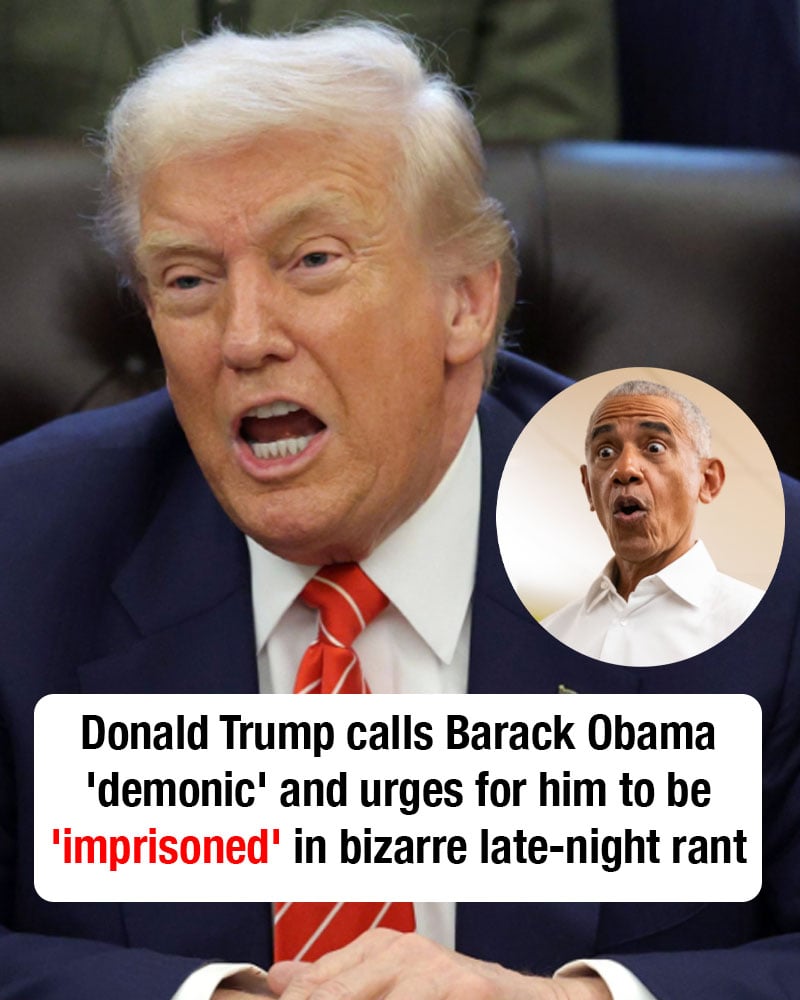
Donald Trump didn’t merely criticize Barack Obama during his latest late-night Truth Social outburst. He escalated the rhetoric into something far darker, more personal, and far more revealing about the political climate now consuming American public life.
In a rapid series of posts shared deep into the night, Trump amplified fringe accusations against Obama, recycled long-debunked claims about surveillance and election interference, and elevated inflammatory calls demanding the former president be “arrested.” The tone was not one of ordinary political rivalry anymore. It carried the language of betrayal, punishment, and moral warfare — the kind of rhetoric designed not simply to persuade supporters, but to intensify emotional loyalty through outrage.
At the center of the barrage sat an old strategy Trump has used repeatedly throughout his political career: turning political opponents into existential enemies rather than competitors with different ideas.
For years, Obama has occupied a uniquely symbolic place inside Trump’s political narrative. He is not merely a former president in Trump’s rhetoric. He represents an entire worldview Trump built his movement against — globalization, elite institutions, multicultural symbolism, and the political establishment Trump claims betrayed ordinary Americans. Every renewed attack against Obama therefore serves a dual purpose: reopening old grievances while reactivating the emotional energy of Trump’s political base.
But this latest episode pushed beyond familiar campaign-style attacks.
The language surrounding Obama became intensely personal, conspiratorial, and emotionally charged, especially as online supporters spread increasingly extreme claims alongside AI-generated imagery and manipulated content designed to provoke outrage and dehumanization. Among the most disturbing examples was an AI-generated ape-themed video targeting Obama and his family — content many critics condemned as racially inflammatory and deliberately degrading.
Obama’s response reportedly reflected a striking contrast in tone.
Rather than escalating publicly or engaging directly with the personal insults aimed at him, he focused attention on the impact such rhetoric has on families. While brushing aside attacks against himself, he drew a firmer boundary around the targeting of Michelle Obama and their children, arguing that political conflict should never descend into dehumanization or attacks against loved ones.
That distinction matters because it highlights a deeper fracture now defining American political culture.
One side increasingly embraces escalation as strategy — outrage feeding outrage until every disagreement becomes existential and every opponent becomes dangerous by definition. The other side warns that constant rhetorical escalation eventually erodes the boundaries separating democratic conflict from something more unstable and corrosive.
What makes these moments especially powerful online is not simply the statements themselves, but the emotional ecosystem surrounding them. Social media rewards intensity. Algorithms amplify outrage faster than nuance. Political identity increasingly functions less like policy preference and more like tribal allegiance, where emotional satisfaction often matters more than factual certainty.
Inside that environment, accusations once considered extreme begin feeling normal through repetition.
And perhaps that is the most unsettling part of episodes like this.
Not that political figures attack one another — American politics has always contained bitterness and personal hostility — but that the emotional temperature keeps rising while fewer people seem interested in lowering it.
Every new escalation becomes the baseline for the next one.
Every outrage demands something louder afterward to maintain attention.
Meanwhile, ordinary citizens absorb the psychological consequences daily: exhaustion, distrust, fear, cynicism, and the growing sense that political opponents are no longer merely wrong, but fundamentally irredeemable.
For supporters, Trump’s posts represent defiance against institutions they believe failed them.
For critics, they represent a dangerous normalization of conspiratorial thinking and personal incitement against democratic rivals.
And caught between those interpretations is a country increasingly trapped in permanent emotional escalation, where even former presidents are no longer treated as retired national figures, but as active symbols in an endless cultural and political war that never fully cools down.