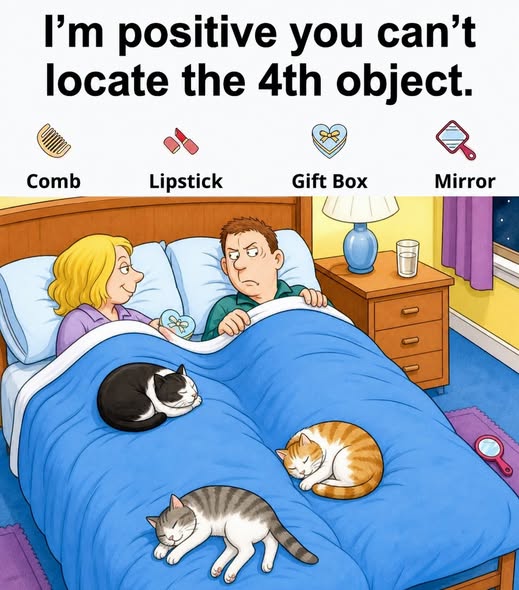
The husband is seconds from losing it. The wife is perfectly calm, three smug cats have completely claimed the bed, and somewhere inside this cozy little disaster, four tiny objects are hiding in plain sight.
They are there.
Your eyes will swear they are not.
You will scan the picture once, twice, maybe three times, convinced that whoever created the puzzle must have made a mistake. But the objects are not missing. They are simply hiding where your brain has been trained not to look.
They have merged with fabric, wood, shadows, patterns, and fur so naturally that your mind keeps dismissing them as part of the room. The longer you stare, the more frustrating it becomes. You know there are four objects somewhere in the scene, but your eyes keep sliding right over them.
That is what makes this puzzle so difficult.
The objects are not necessarily hidden behind anything.
They are hidden **inside what you are already looking at**.
So slow down.
Forget the husband for a moment. Ignore the wife. Stop watching the cats. Instead, divide the room into sections and examine every strange line, unusual shape, and patch of color.
Keep staring, because once you spot the first one, the rest suddenly become easier.
Look first where the night seems calmest.
The nightstand.
At first glance, there is nothing suspicious about it. It looks like an ordinary collection of nighttime clutter, with books, boxes, and familiar household objects sitting exactly where you would expect them to be.
But near the edge of a book or box, there is a vertical pattern that looks almost too regular.
That is where the **comb** is hiding.
Its teeth are positioned so that they echo the surrounding lines of the wood, making the object appear to be part of the furniture rather than something placed on top of it. Your brain sees the repeated vertical marks and automatically categorizes them as texture.
That is the trick.
The comb is not invisible.
It is simply disguised by repetition.
Once you recognize the individual teeth, the shape suddenly becomes obvious. You may even wonder how you missed it the first time.
But don’t stop there.
Just above the nightstand, near the wife’s pillow, there is another object playing an even subtler game.
Look closely along the border of the pillow.
There, the **lipstick** is masquerading as a narrow, colored stripe. It follows the edge of the pillow so precisely that it initially looks like part of the fabric’s decorative pattern.
It does not stick out.
It does not cast an obvious shadow.
It simply runs along the border as though it belongs there.
That alignment is what makes it difficult.
Your brain is very good at recognizing patterns, but it is also very good at ignoring something that appears to fit perfectly into an existing pattern. Because the lipstick follows the pillow’s edge, your eyes interpret it as decoration rather than an object.
So move slowly.
Do not search only for recognizable shapes.
Search for something that looks **slightly too perfect**.
A line that should not be there.
A color that does not quite belong.
A shape that seems to continue farther than it should.
Now shift your gaze toward the center of the bed.
This is where the puzzle becomes even more deceptive.
The blanket appears chaotic, filled with folds and overlapping shadows. There are countless curves and creases competing for your attention, which makes it the perfect hiding place for the third object.
Somewhere among those folds is the **heart-shaped gift box**.
At first, you may think you are simply looking at two folds in the blanket that happen to curve toward one another. But look carefully.
Two subtle curves meet at a small point, creating the unmistakable outline of a heart.
The box is only slightly brighter than the surrounding fabric, which helps it disappear into the blanket rather than stand out against it. Its edges are softened by the folds around it, so your brain reads the shape as part of the bedding.
Again, the trick is not invisibility.
It is camouflage.
The object has borrowed the visual language of its surroundings.
The blanket has curves.
The box has curves.
The blanket has shadows.
The box has shadows.
The result is an optical illusion that makes the object feel like it was never there at all.
But once your brain finally recognizes the heart shape, you will have a hard time looking at the blanket the same way again.
And now there is only one left.
Move your eyes toward the edge of the mattress.
This is where many people will probably get stuck because the object looks almost exactly like an ordinary patch of light.
Near the mattress edge is the **hand mirror**.
Its round glass appears to be nothing more than a pale spot within the surrounding pattern. There is no obvious reflection screaming for attention. The circular shape is subtle enough to blend into the bedding and shadows.
But then look beneath it.
A narrow handle disappears into the darker area near the edge of the bed.
That handle is the giveaway.
Once you connect the pale circular shape with the thin handle, the disguise falls apart.
You suddenly realize you were looking directly at the mirror all along.
And that is the cruel brilliance of the puzzle.
The four objects are not hidden in some impossible location.
They are hidden in ordinary places.
They are disguised as ordinary things.
The comb becomes texture.
The lipstick becomes a stripe.
The heart-shaped box becomes a fold.
The hand mirror becomes a patch of light.
Your eyes are doing exactly what they are supposed to do.
Your brain is the one being fooled.
It is constantly simplifying the image, deciding what matters and what can be ignored. In a crowded scene, that filtering system is useful. It allows you to focus on faces, movement, danger, and familiar objects without consciously processing every tiny detail.
But in a hidden-object puzzle, that same ability becomes your biggest enemy.
The husband looks frustrated, so your attention naturally goes toward him.
The wife appears calm, so your eyes register her expression.
Three cats occupy the bed, creating movement, texture, and visual distractions.
The bedding contains countless folds.
The furniture contains lines and patterns.
And somewhere inside all of that visual noise are four tiny objects quietly waiting to be noticed.
The puzzle is designed to make you look everywhere except exactly where you need to look.
That is why rushing will not help.
Slow down.
Divide the scene into zones.
Start with the nightstand.
Then move toward the pillow.
Next, scan the center of the blanket.
Finally, inspect the mattress edge.
Look for shapes that seem just slightly different from their surroundings.
Look for repeated lines.
Look for isolated colors.
Look for circles.
Look for symmetry.
And most importantly, look for objects that appear to have become part of something else.
Because that is the secret.
The objects were never truly invisible.
They were simply wearing the room as camouflage.
And once you see them, you can’t unsee them.
The comb suddenly looks like a comb.
The lipstick suddenly looks like lipstick.
The heart-shaped box suddenly pops out from the blanket.
The hand mirror suddenly reveals its handle.
The same picture that felt impossible a moment ago becomes almost embarrassingly obvious.
You may even find yourself wondering how your eyes managed to miss them.
That is the fun of a good hidden-object puzzle.
It doesn’t require perfect eyesight.
It requires patience.
Your first instinct is to search quickly, hoping the answer will jump out at you.
But the puzzle rewards the opposite approach.
Slow down.
Look closer.
Question the patterns.
And don’t trust the first thing your brain tells you you’re seeing.
Because somewhere in that cozy chaos, four tiny objects are still sitting there, completely exposed and completely hidden at the same time.
And once you finally find all four, the husband may still be losing his mind, the wife may still be perfectly calm, and the three cats may still own the entire bed.
But at least the mystery is solved.
The objects were there the whole time.