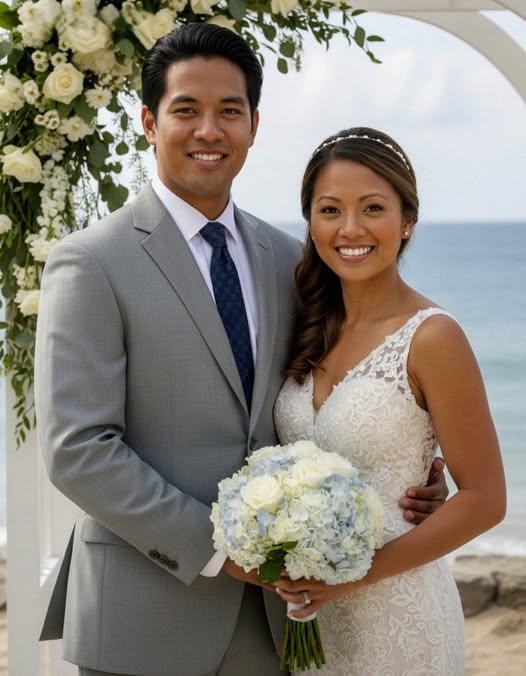
The smell of crushed lilacs and the thick, muggy air of a midwestern summer cloud the memory of that evening. Spinning over an improvised plywood dance floor beneath strings of golden Christmas lights, my sister Laura was a picture of ivory lace and dazzling ecstasy. Her marriage to Luke was meant to be the start of a long, predictable period of happiness because she was the jewel in the crown of our little Iowa town. I recall thinking that life would never be this ideal again as I watched her laugh, her bare feet grimy from the dirt patches between the boards.
Luke was the “golden boy,” a man whose affection for my sister was as obvious as daylight. He gazed at her as if she were the only stationary point in a whirling universe. However, as the celebration came to an end and the fireflies started to fade, I noticed something that I was too young to identify at the time. Her smile briefly stopped short of her eyes as she leaned on the lemonade table. She appeared more like a ghost plagued by a future she wasn’t sure she wanted than a bride. The haunting materialized by dawn.
The disappearance was as precise as surgery. There were no indications of a struggle in the motel room where they spent their wedding night. Her engagement ring rested on the table next a phone she had forgotten, and her outfit was folded on the bed with eerie neatness. There was no urgent text, no letter, and no guidance. She had just vanished. Police sirens, search teams slicing through the dense Iowa undergrowth, and the excruciating sound of the pond being pulled dominated our lives for months. My mother’s heart seemed to stop every time a diver surfaced, only to resume with a new, sharp pain when they discovered nothing but muck and shadows.
It was ten years later. A family can’t hold their breath for ten years. No amount of cleaning could get rid of the heavy coating of dust that became a permanent inhabitant of our farmhouse: stillness. The gospel anthems that used to mark our mornings were no longer sang by my mother. With no body to bury, my father’s grief caused his shoulders to droop and his pace to halt. Luke truly made an effort to stay. He sent flowers every Sunday and patched our leaky roof, but finally the sight of us—the memories of what he had lost—became too much. I entered the void he left behind when he moved away to start over.
Living in Laura’s former room, I was surrounded by the smells of her wildflower shampoo and vanilla lotion. Eventually, I put her life into cardboard boxes, shoved them into the attic’s shadowy corners, and made a self-promise to deal with them once the pain was less severe. Ten years later, on a wet Tuesday, that day finally arrived. I opened a box marked “College Stuff” while looking for an old photo book. There was a simple white envelope with my name on it tucked down the very bottom, under a pile of old textbooks.
Her handwriting was clearly hers; it was rushed, exquisite, and slanted. The morning following the wedding was the date on the back. I could hardly rip the seal since my hands were shaking so much. The world as I knew it tipped on its axis as I read. Laura had not experienced foul play or been abducted. Her existence felt like a cage, and she had been fleeing from it. She wrote that she was expecting, but not Luke’s child. Everything had altered after a quick, covert meeting months before the wedding. She was unable to look Luke in the eye, confront the embarrassment, or endure our parents’ disappointed expressions. Instead of the slow poison of lying, she had opted for the kindness of a clean split.
An address in a small Wisconsin town was included in the letter. I sat my parents and a visiting Luke down at the kitchen table that night. As I read the confession out loud, lengthy, dramatic shadows were created by the flickering above light. The hush that ensued was like the sound of glass breaking, unlike the silence of the previous decade. Luke uttered the question that would follow him forever, his face going pale and his voice breaking: Why didn’t she trust me? My mother sobbed for the daughter who believed there were restrictions on our love. My father remained silent, staring at the wood grain of the table, his heart aching anew for the ten years he had wasted on a mystery with an easy, agonizing solution.
I kept my plans a secret from them. I drove through the night after waiting till they were sleeping and packing a tiny backpack. I followed the location to a peaceful, sunny street with old maples lining it. The porch swing moaned quietly in the breeze, and the house was a simple, happy yellow. In the brilliant afternoon light, tall sunflowers stood guard in the front yard, nodding.
On the porch steps, a small girl, perhaps nine or ten years old, was using blue sidewalk chalk to create hearts. Her eyes were bright, wide, and inquisitive like Laura’s. My heart pounded like a trapped bird against my ribs as she dashed inside to fetch her mother. Then she appeared when the screen door cracked open. Laura’s face was aged by ten years of actual life, making her appear older, but she had a hard-won serenity on her face.
There weren’t many words needed. We watched Maddie, the girl, chase butterflies while we sat on her back porch. Laura informed me about the true father, the man she had met, who was a stable and kind figure in their life. She described to me how she had started over, living under a false identity and teaching piano, constantly watching her back but never regretting the decision to be truthful with herself. She had fled in search of a reality she was unable to discover at home.
It seemed like a lengthier drive returning to Iowa than the journey there. My mother was waiting on the porch swing when I arrived into our driveway, her eyes seeking mine for the miracle she had hoped for each night for three thousand days. She wanted to know if I had located her.
I thought of Luke, who had at last found a new lady to love, as I gazed at my mother’s weary face and the house that had at last found a rhythm of quiet acceptance. Laura’s yellow house and the young child sketching hearts in the sun came to mind. The scandal, the hurt, and the animosity would return if I were to bring Laura back. I would ruin the tranquility she had created and the precarious stability my parents had at last attained.
I lied while staring my mother in the eye. I informed her that the address was a dead end and that there was no indication of her. I went over to the fireplace, lit a match, and saw the letter turn into black ash. Some facts are too much for the people we care about to bear. I experienced an odd sense of closure as the final sparkles faded. Laura was just living; she was no longer missing. And knowing she was content was eventually sufficient in the stillness of the Iowa night.