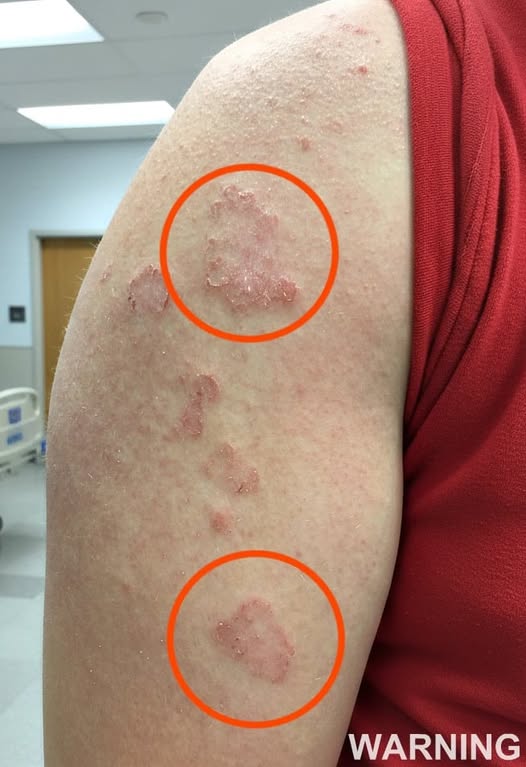
Red, perfectly shaped circles begin to appear on your skin—at first just one, easy to ignore. Then another. They itch. They slowly expand. And before long, you catch yourself pulling your sleeve down, hesitating before touching someone you love, wondering what exactly is happening to your own body.
Is it something contagious? Something dangerous? Or something coming from within?
The unsettling truth is that the answer often hides in small details—details most people overlook at the beginning. And in that uncertainty, many make a common mistake: reaching for the wrong creams, treating symptoms blindly, and unintentionally making the condition worse. What starts as a minor concern can quickly turn into something more widespread, more persistent, and far more stressful than it needed to be.
Those red, circular patches are not just a surface issue—they are your skin trying to communicate something important. When you look closely, the clues are there. If the edges of the patch are raised, slightly rough or scaly, and the center looks clearer or less inflamed, forming a ring-like shape that slowly expands outward, there is a strong chance you are dealing with Ringworm—despite its misleading name, not a worm at all, but a fungal infection.
This type of infection thrives in environments most people encounter every day without thinking twice—warmth, moisture, and shared surfaces. Sweat after a workout, damp clothing, locker rooms, gym mats, even something as simple as a shared towel can create the perfect conditions for it to spread. It can also pass quietly from animals to humans; a pet’s fur might carry it without obvious signs.
That’s why it often seems to appear “out of nowhere.” In reality, it only takes a small, unnoticed exposure. And once it begins, it can spread across your own body or to others through skin contact or shared items.
But here’s where things become more complicated—and more important.
Not every circular rash is something you can catch. Some conditions look nearly identical at first glance but come from entirely different causes. Nummular Eczema, for example, creates round, itchy patches that can resemble ringworm but are rooted in skin inflammation, not infection. Similarly, Psoriasis can produce red, scaly areas that may confuse even experienced eyes in the early stages.
These conditions are not contagious. You cannot pass them to someone else, and they do not come from external sources like fungi or bacteria. Instead, they are linked to how your immune system behaves—how your body responds internally, sometimes overreacting and creating inflammation on the skin.
And this is where many people unintentionally make things worse.
A cream that helps one condition can aggravate another. For example, using a steroid cream on a fungal infection like ringworm might temporarily reduce redness, making it look like it’s improving—but underneath, the fungus can continue to grow, spreading more aggressively once the treatment stops. On the other hand, antifungal creams won’t calm an inflammatory condition like eczema or psoriasis, leaving you frustrated as the patches refuse to disappear.
So the pattern becomes confusing:
The rash spreads. The itching intensifies. The shape changes. And nothing you try seems to fully work.
These are not random developments—they are signals.
If the patches continue to grow, appear in new areas, burn instead of just itch, or resist over-the-counter treatments, that is your body telling you it’s time to stop guessing. Waiting too long can lead to wider spread, unnecessary discomfort, and even the risk of passing a fungal infection to others if that’s the cause.
The good news is that the solution is often simple once the diagnosis is clear. A quick visit to a doctor—sometimes involving nothing more than a visual check or a small skin scraping—can immediately distinguish between fungal infections and inflammatory conditions. That small step can replace uncertainty with clarity.
And with clarity comes the right treatment.
For fungal infections, targeted antifungal medications can stop the spread and clear the skin effectively. For eczema or psoriasis, proper anti-inflammatory treatments can calm the immune response and restore the skin barrier. In both cases, the right approach doesn’t just treat the surface—it addresses the cause.
More importantly, it removes the fear.
Because what makes these situations so stressful isn’t just the rash itself—it’s the unknown. The hesitation to touch others. The worry about spreading something. The frustration of trying solutions that don’t work.
Understanding what your skin is telling you changes everything.
It allows you to act early, treat correctly, and protect both yourself and the people around you. And in many cases, it turns what feels like a frightening mystery into something manageable, temporary, and entirely treatable.