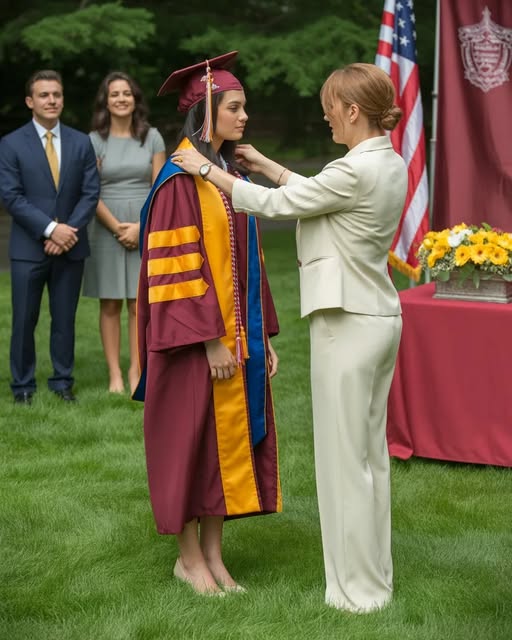
The graduation ceremony dragged on the way graduation ceremonies always do, filled with endless speeches from people who seemed convinced that the longer they talked, the more meaningful they sounded. By the halfway point, most of us sitting beneath the rows of caps and gowns had stopped pretending to listen. The June heat pressed down relentlessly, turning the thick polyester robes into portable ovens, and my diploma cover had already grown damp in my hands from sweat and nervous fidgeting.
I sat somewhere in the middle of the endless sea of folding chairs doing mental calculations that had absolutely nothing to do with my future. Mostly, I was wondering whether returning the diploma cover without scratches would actually get me the full forty-dollar deposit back. My parents had mentioned that deposit at least three separate times that week, each reminder carrying the subtle implication that losing it would somehow become proof I wasn’t responsible enough for adulthood.
At that moment, shade and cold water felt more important than accomplishment.
Then I heard her voice.
My grandmother arrived late, exactly as everyone expected because Vivien Brennan had apparently spent seventy-eight years refusing to organize her life around anyone else’s schedule. Yet somehow, lateness looked intentional on her. She moved through the crowd slowly but with complete confidence, her cane touching the ground with more elegance than necessity. Other people apologized when they arrived late. My grandmother behaved as though the event itself had simply started too early.
She wore a cream-colored suit so perfectly tailored it made everyone else nearby look unfinished. Her silver hair was swept into its usual immaculate chignon, and oversized sunglasses rested on her face with the effortless glamour of someone who had never once doubted her own importance. Family stories described her as intimidating in business meetings, impossible to manipulate, and entirely capable of reducing grown men to silence with a single raised eyebrow.
To me, she had always just felt unstoppable.
My father had saved her a seat near the front, though she still managed to make reaching it feel like a performance. Conversations paused as she passed. Even strangers seemed to instinctively move aside for her. When she finally lowered herself into the folding chair, she glanced across the rows until she found me.
Then she winked.
That tiny gesture somehow cut through all the boredom, heat, and exhaustion immediately. It felt conspiratorial, almost mischievous, like she was reminding me that none of this ceremony mattered nearly as much as the life waiting afterward.
That wink carried me through the remaining speeches, through the endless alphabetical procession toward the stage, through the awkward handshakes and forced smiles. And when my name was finally called — “Maggie Brennan, summa cum laude” — my grandmother’s voice erupted above the polite applause with the enthusiasm of someone cheering at a championship game rather than an academic ceremony.
People turned to stare.
Some laughed softly.
Others smiled automatically at the sheer force of her pride.
And somewhere beneath my embarrassment, warmth spread through me so suddenly it almost hurt.
After the ceremony ended, everyone drifted toward the refreshment tents where melting fruit trays and lukewarm lemonade waited beneath strips of shade. Families crowded together taking photographs while graduates pretended not to sweat through their formal clothes.
My grandmother found me immediately.
She pulled me into a hug that smelled faintly of Chanel perfume and peppermint mints, the same scent she had carried my entire life, and held me tightly enough that the sharp edges of my graduation cap pressed awkwardly between us.
“My granddaughter graduated summa cum laude,” she announced loudly to absolutely no one in particular, as though delivering official news to the nation itself.
Nearby strangers smiled politely. My father chuckled. My mother wore the tight practiced smile she reserved for public situations — the expression she used when she understood she was expected to look proud, even if genuine emotion never quite reached her eyes.
But my grandmother did not care about appearances.
She kept introducing me to random people standing nearby, repeating my accomplishments with complete delight. It could have felt overwhelming or theatrical coming from anyone else. With her, it simply felt sincere.
Because Vivien Brennan had spent her entire life building things from nothing — businesses, buildings, opportunities, entire futures — and she treated my graduation as though it belonged among those accomplishments.
And standing there beneath the white tent, diploma still clutched in my sweaty hands, I realized something quietly important:
For all my parents’ concern about deposits, appearances, and practicalities, my grandmother was the only person there who made me feel like the achievement itself mattered more than the performance surrounding it.
She celebrated me like success was something joyful rather than merely useful.
And somehow, that meant more than the diploma ever could.