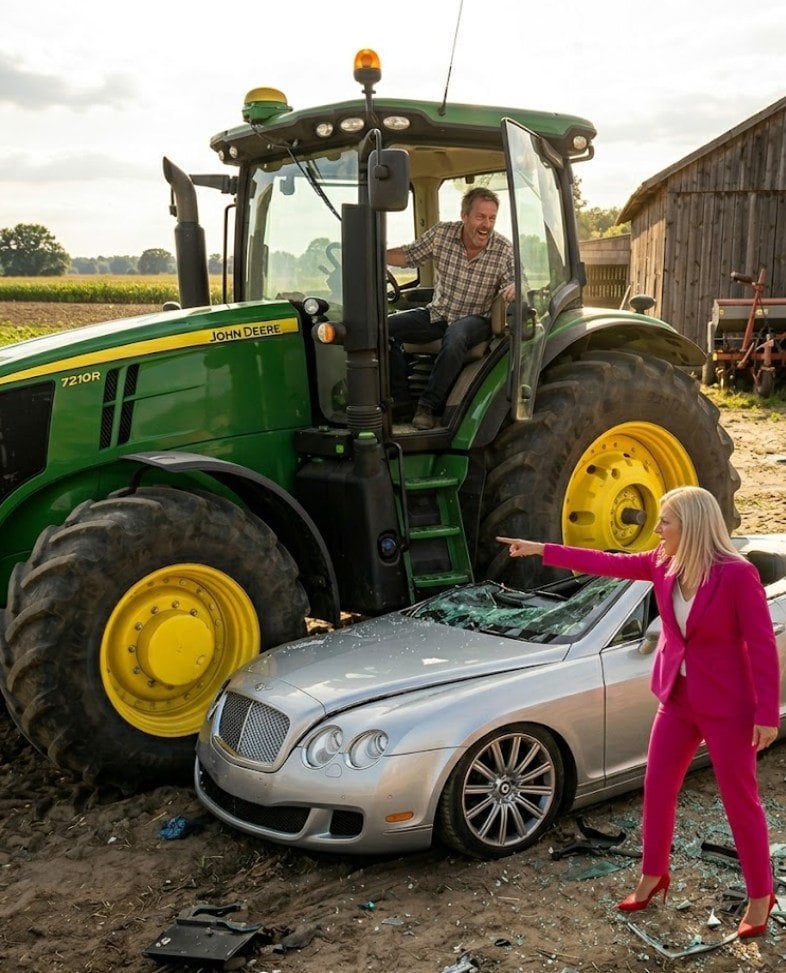
What started as a normal morning on the farm quickly turned into something nobody in town would forget. All I wanted to do was feed my cattle, open the barn, and get through the day’s work. Instead, I walked outside to find a car parked directly across my access road, blocking the barn doors completely. My livestock couldn’t get through, my equipment couldn’t move, and my patience disappeared fast.
The car belonged to Karen.
Around here, everybody knew Karen liked control. If there was an argument to start or a rule to twist, somehow she always found herself in the middle of it. But this time she crossed a line. This wasn’t about a petty neighborhood disagreement anymore. This was my livelihood, my animals, and responsibilities that couldn’t simply wait because someone wanted to prove a point.
At first, I tried handling it calmly.
I walked over to her fence and called out politely.
“Karen, I need you to move the car. You’re blocking access to the barn.”
She barely looked up from where she stood with her arms folded.
“You can wait,” she replied coldly. “I’m tired of your tractor tearing up the edge of my property.”
I stared at her in disbelief.
“The cattle need feeding now.”
“Not my problem.”
By then, a couple neighbors had already started gathering nearby, pretending to check fences or mailboxes while obviously watching the situation unfold. Everyone knew Karen loved creating scenes, but nobody expected her to block a working farm entrance over some personal grudge.
I tried once more.
“Karen, I’m asking nicely. Move the car.”
Instead, she smirked like she was enjoying every second of the standoff.
That’s when something inside me shifted.
Not anger.
Not rage.
Just certainty.
The work had to get done.
I climbed back onto the tractor while the entire fence line went quiet. Even the neighbors stopped whispering. Karen suddenly looked less confident when the engine roared to life.
I eased the tractor forward slowly.
Very slowly.
The heavy machine rolled toward the blocked entrance until the front loader gently pressed against the bumper of her car.
Karen’s eyes widened instantly.
“You wouldn’t dare!”
I kept my voice calm.
“I asked you three times.”
The tractor nudged forward again — just enough metal against metal to make the point crystal clear.
That’s when Karen finally lost control.
She started screaming about lawsuits, destruction of property, harassment, and “abuse of power,” even though she wasn’t the one trying to feed livestock trapped behind blocked gates.
One of the neighbors quietly called the sheriff.
Within twenty minutes, two patrol vehicles pulled up beside the property while half the road stood around pretending not to watch.
Karen immediately launched into her performance.
“He threatened me! He tried to ram my car!”
The sheriff listened patiently before turning toward me.
“What’s going on here?”
I explained everything simply:
the blocked access road,
the livestock,
the repeated requests,
the refusal to move.
Then one of the deputies looked past us toward the barn and asked the obvious question.
“Your cattle are back there?”
“Yes, sir.”
The deputy nodded slowly.
That changed the entire tone of the conversation.
Because blocking access to livestock isn’t just rude — in many places, it can become a serious legal issue when it interferes with animal care and agricultural operations.
Karen’s confidence started fading fast.
The sheriff finally looked directly at her.
“Ma’am, you cannot intentionally block farm access like this.”
“But it’s near my property line!”
“That doesn’t matter. Move the vehicle.”
For the first time all morning, Karen looked genuinely rattled.
Under the silent stare of half the neighborhood, she climbed into the car and backed it away from the gate.
The second the road cleared, I drove straight through to the barn.
The cattle were fed.
The work got done.
And life moved on.
But the story didn’t end there.
At the next town council meeting, people finally started speaking openly about Karen’s behavior. Neighbors shared stories about threats, intimidation, petty disputes, and years of unnecessary drama everyone had quietly tolerated.
Once people stopped staying silent, the pattern became impossible to ignore.
A few weeks later, Karen lost her position on the local community board.
Not because of one blocked driveway.
Because eventually people get tired of power being used to bully others.
In the end, I didn’t feel victorious.
I felt relieved.
The barn doors stayed open.
The cattle were cared for.
And the boundaries around my work were finally respected.
Sometimes standing your ground isn’t about pride or revenge.
Sometimes it’s simply about protecting the responsibilities that depend on you every single day.