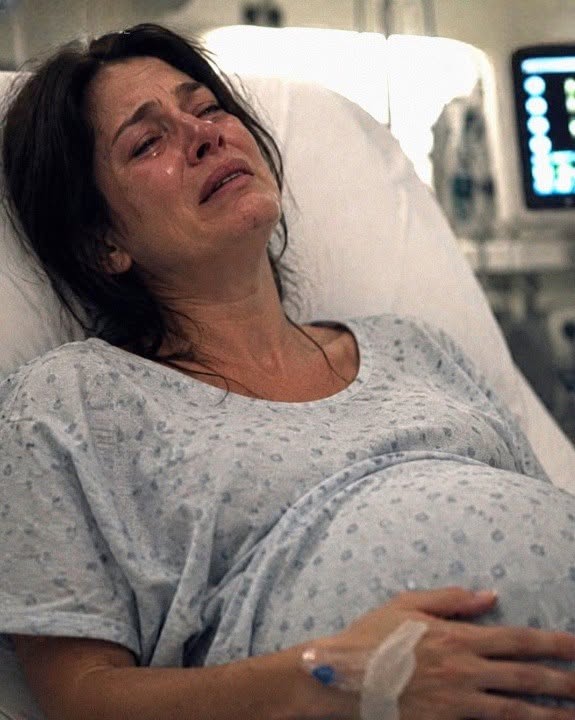
Dr. Harmon remained motionless behind his desk long after everyone else had left the department for the evening. The fluorescent lights reflected against stacks of medical files spread across his workspace while the second radiologist’s report sat open directly in front of him.
Something was wrong.
Not with Emilia.
With the diagnosis itself.
Over thirty years in medicine had taught him to trust his instincts when details refused to fit together. Every specialist involved in Emilia’s case agreed that her condition was extraordinarily rare, but the newest review exposed discrepancies that should never have been overlooked.
He picked up the phone.
“Get me Ultrasound Room Three,” he said.
Minutes later, another technician joined him.
Together they reviewed every scan Riverside Clinic had performed over the previous six months.
Frame by frame.
Measurement by measurement.
And the longer they looked, the more uncomfortable everyone became.
At 7:42 p.m., Dr. Harmon stood up so abruptly that his chair rolled backward into the wall.
“That’s impossible,” the technician whispered.
Dr. Harmon didn’t answer.
Because he was staring at something that should have been discovered months earlier.
Back upstairs, Emilia struggled to sleep.
The conversation about choosing between her life and her baby’s echoed relentlessly through her mind. Every time she closed her eyes, she pictured Noah.
His tiny fingers.
His tiny face.
The four precious hours she had been allowed to hold him.
She pressed her hand against her stomach again.
Movement.
Then another movement.
This time from a completely different area.
Her eyes opened.
Slowly.
Confused.
The sensation happened again.
One movement high beneath her ribs.
Another lower and farther to the side.
Almost as if two separate rhythms were responding to her touch.
Before she could think much about it, the door opened.
Dr. Harmon entered.
And one look at his face told her something had changed.
Rosa followed closely behind him.
Neither looked relaxed.
“Emilia,” Dr. Harmon said carefully. “I need to perform another ultrasound immediately.”
Fear shot through her.
“Is something wrong with my baby?”
He hesitated.
“That’s exactly what we’re trying to determine.”
Within minutes she was being wheeled into the imaging room.
The atmosphere felt completely different from previous examinations.
More people.
More equipment.
More tension.
Nobody spoke much as the technician applied gel to her stomach.
The monitor flickered to life.
For several seconds, silence filled the room.
Then the technician froze.
Rosa gasped.
Dr. Harmon stepped closer.
The screen displayed what looked like a small hand.
Then another.
Another heartbeat appeared.
Then another.
The room became impossibly quiet.
Emilia looked from one face to another.
Nobody moved.
Nobody blinked.
Finally, she whispered:
“What is it?”
Dr. Harmon stared at the screen for several more moments before turning toward her.
His voice sounded almost disbelieving.
“Emilia…”
Her heart hammered inside her chest.
“What?”
The doctor swallowed.
“The original diagnosis was wrong.”
The words barely registered.
“What do you mean wrong?”
He pointed toward the monitor.
“There isn’t one baby.”
Emilia’s breath caught.
“What?”
The technician adjusted the image.
More shapes became visible.
Tiny limbs.
Separate heartbeats.
Distinct movements.
Dr. Harmon looked at her again.
“Months ago, Riverside’s equipment failed to properly distinguish multiple fetal positions. Combined with the severe complications you were experiencing, everyone focused on the immune disorder and overlooked what was right in front of them.”
Tears filled Emilia’s eyes.
“I don’t understand.”
The doctor smiled for the first time since she had met him.
“Emilia… you’re not carrying one baby.”
The room fell silent.
Then he delivered the sentence nobody expected.
“You’re carrying three.”
For a moment nobody spoke.
Not Rosa.
Not the technicians.
Not even Emilia.
After fifteen years.
After seven failed pregnancies.
After burying one child.
After being told repeatedly that motherhood might never happen.
She stared at the screen where three tiny heartbeats flickered back at her.
Three.
Her hands flew to her mouth.
“No…”
But the tears already told her she believed it.
Rosa began crying before Emilia did.
“Oh my God,” Rosa whispered.
Dr. Harmon continued reviewing the images.
“The unusual pressure. The abnormal measurements. The elevated immune response. Much of it suddenly makes sense.”
Emilia couldn’t stop staring.
Three babies.
Three lives.
Three heartbeats.
All fighting alongside her.
The realization was overwhelming.
And then another thought hit her.
David.
The man who had walked away.
The man who left a voicemail instead of standing beside her.
The man who told her they were fighting nature.
For the first time since hearing that message, she felt absolutely nothing.
No anger.
No sadness.
No regret.
Because at that moment, none of it mattered.
The only thing that mattered was the screen in front of her.
Three tiny miracles.
Three children who were still alive.
Three reasons to keep fighting.
Dr. Harmon eventually cleared his throat.
“There is still significant risk,” he said honestly. “We aren’t out of danger.”
Emilia nodded.
“I know.”
“But now we understand what we’re dealing with.”
She looked down at her stomach.
Then smiled through tears.
For the first time in months, it wasn’t a smile built on desperation.
It was built on hope.
Hope backed by evidence.
Hope she could actually see.
That night, long after everyone else left, Emilia lay awake in her hospital room with both hands resting gently across her stomach.
And for the first time since Noah died, she allowed herself to imagine something she had been too afraid to picture.
Three cribs.
Three tiny blankets.
Three children filling the little house on Grover Street with noise instead of silence.
Outside, the Ohio sky remained dark and heavy.
But inside Room 314, the darkness no longer felt quite so overwhelming.
Because somewhere beneath her heartbeat, three others were quietly beating back.