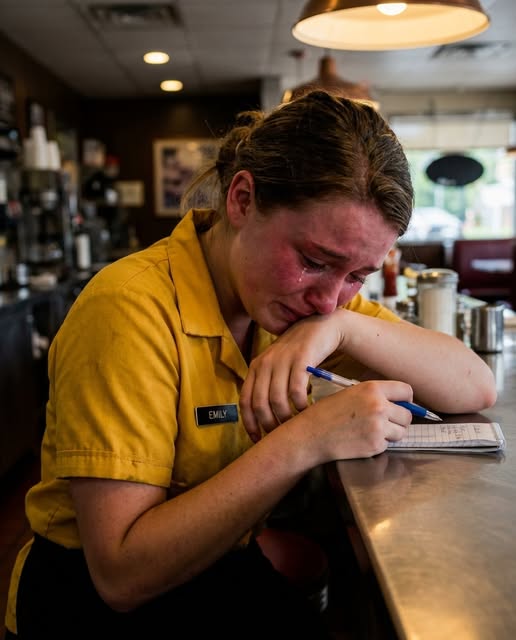
Every Friday, without fail, I found myself in the same back corner of that small café. I would order a coffee I barely touched, letting it grow lukewarm in my hands while I quietly watched my daughter move through the room. To anyone else, I probably looked like just another regular customer passing time, but in truth, I was there for one reason only: Maya. At seventeen, she carried more weight on her shoulders than most people twice her age. When my knee gave out and the doctors told me I needed surgery and weeks off my feet, she didn’t hesitate. She picked up extra shifts, rearranged her school schedule, and stepped into responsibility without ever asking why it had to be her.
I had raised her alone since she was a baby. There were no shortcuts, no shared burdens—just the two of us figuring life out as we went. And somewhere along the way, she became the kind of person who didn’t wait to be asked for help. She saw what needed to be done and did it. She never complained, never made me feel like I owed her anything, never turned her sacrifices into guilt. That’s why, sitting there that Friday, watching her rush from table to table with tired but steady hands, I felt both pride and something heavier—an awareness of just how much she was giving without ever being asked.
The café was unusually busy that day. The staff was short, the espresso machine kept stalling, and orders were backing up faster than they could be filled. I could see the strain in Maya’s movements—the slight tension in her shoulders, the way she moved faster but still tried to smile at every table. She had always handled pressure with quiet grace, but even grace has limits when everything starts going wrong at once.
There was a couple who came in often. Regulars, technically—but not the kind anyone looked forward to serving. The husband was quiet, observant, rarely saying much. The wife, on the other hand, always seemed to be searching for something to criticize. A drink too cold, a plate too slow, a napkin folded the wrong way—there was always something. That day, it was a lemon.
Maya had forgotten to bring it with her water.
It was such a small thing, something that could have been fixed in seconds. But instead of asking calmly or waiting, the woman stood up abruptly, her chair scraping loudly against the floor. Her voice cut through the café, sharp and unforgiving. She called Maya careless, lazy, said she couldn’t even handle a simple task. Heads turned. Conversations stopped. And then, as if that wasn’t enough, she went further—speaking to her like she was less than human, as if wearing an apron somehow stripped her of dignity.
Something inside me went cold.
Not hot anger—not yet. Just that sudden, heavy stillness that comes before it. My hand tightened around my cup before I even realized I had stood up. My chair scraped back, louder than I intended, and I started moving toward them, ready to say something, ready to stop it before it went any further.
But I didn’t get there in time.
The woman’s husband stood up first.
His voice wasn’t loud, but it carried weight. He told her to stop. Just that—firm, controlled. For a moment, I thought that might be enough. But she didn’t back down. She kept going, her anger feeding on itself, her words getting sharper, more personal.
And then he said it.
Five words that didn’t just interrupt the moment—they shattered it.
“Maya is your biological daughter.”
Everything stopped.
The air itself felt like it froze. The noise of the café disappeared, replaced by a silence so complete it felt unreal. Maya stood there, tray still in her hands, her expression shifting from confusion to something deeper—something shaken and searching. She looked at the man, then at the woman, and then, finally, at me.
I crossed the room without thinking.
I took her hand before anyone else could speak again, before the moment could twist into something worse. I could feel her trembling, even though she was trying to stay steady.
The man began to explain.
Years ago, before their marriage, his wife had told him about a child she had given up. A decision buried in the past, something she had never gone back to face. But he had. Quietly, over time, he had searched. Not out of obligation, but out of something deeper—a need to understand, maybe even to connect. Eventually, he found Maya. He knew where she worked. He knew who she was.
And instead of forcing the truth into the open, he waited.
They had been coming to the café because of that. Week after week, sitting at the same table, watching from a distance. He had been waiting for the right moment, the right way to say something without causing harm. But while he waited, he also watched something else—his wife, unknowingly, treating her own daughter with coldness, impatience, and cruelty.
The woman standing in front of us changed in an instant.
All the confidence, all the sharpness—it collapsed. Her face drained of color, her posture broke, and before anyone could process it, she dropped to her knees. The same voice that had been loud and cutting just moments before was now desperate, filled with apologies that came too fast and too late.
But Maya didn’t step back. She didn’t lash out either.
Her voice, when she spoke, was calm. Steady.
She said that respect should have existed before any truth was revealed. That it shouldn’t take blood to recognize someone’s worth. That kindness isn’t something you turn on only when it becomes personal.
And in that moment, I felt something stronger than shock.
I felt pride.
Real, overwhelming pride.
Because even with everything she had just learned, even with the ground shifting beneath her, she stood there with clarity I hadn’t even taught her—something she had built on her own.
Then she squeezed my hand.
Tighter than before.
And she said quietly, but firmly, “I have a mother.”
It wasn’t said with anger. It wasn’t meant to hurt. It was simply the truth, spoken without hesitation.
And that truth settled everything.
The man, later, approached us again. His tone had changed too—less certain, more careful. He offered to help pay for my surgery. He said it wasn’t meant to fix anything or replace what had already been lived. It wasn’t about forgiveness or obligation. It was just… support. Recognition, maybe, of what had been given over the years.
I told him we would think about it.
Because some moments don’t end cleanly. Some truths don’t arrive with simple answers. They open doors, yes—but they also reopen things that had long been closed.
And I knew this was one of those moments.
But as Maya and I walked out of that café together, side by side, something felt certain in a way nothing else did.
Biology can explain where a life begins.
But it cannot explain love.
It cannot measure sacrifice, or consistency, or the quiet, everyday choices that build a bond over years.
Those things are earned.
And as her hand remained in mine, steady and sure, I knew that whatever else the world might say, whatever truths had just surfaced—
I had never needed anything else to know I was her mother.