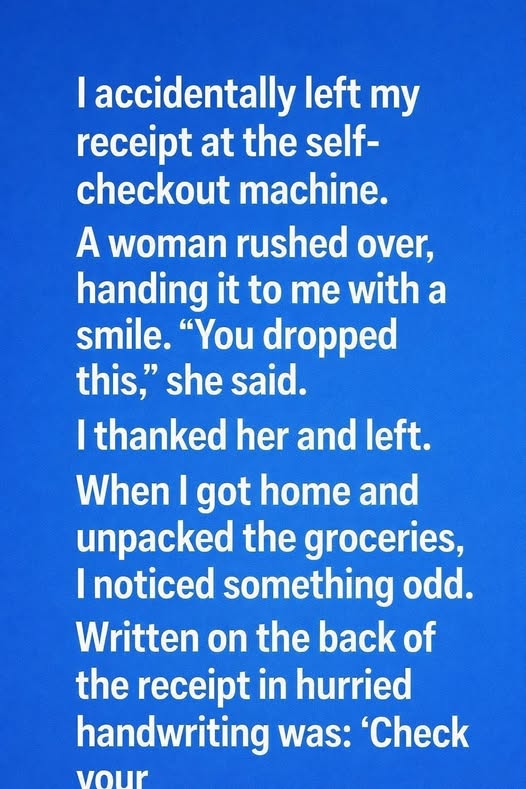
She only said three words.
“You dropped this.”
Nothing more. No explanation, no pause long enough to invite questions, no hint that there was anything unusual about the moment. Just a brief exchange, the kind that happens every day between strangers who will likely never see each other again. But something about it didn’t settle as easily as it should have. There was a quiet weight behind it, something subtle that lingered even after she had already walked away.
The real message wasn’t in her voice. It wasn’t even in the words themselves. It was hidden somewhere else—somewhere most people wouldn’t think to look. A quick, almost careless-looking line of handwriting, the kind that could easily be dismissed at a glance. But the more I looked at it, the less it felt accidental. It carried intention, even if it didn’t immediately reveal what that intention was.
At first, it felt like a warning. Not an obvious one, not something direct or urgent, but something that hinted at the possibility of danger. The kind of message that leaves you unsure whether you’re overthinking or missing something important. One sentence—simple, ordinary—but capable of meaning far more depending on how you interpreted it. It could have pointed to something serious, something urgent, something wrong. Or it could have been something else entirely, something far less dramatic but still meaningful in its own quiet way.
Standing there in the stillness of the evening, the world around me calm and unchanged, I opened my car and replayed the moment in my mind. The way she approached, the way she handed it to me, the way she left without waiting. It hadn’t been rushed, but it hadn’t invited conversation either. It was deliberate in its simplicity.
And then the realization shifted.
What I had assumed might be something ominous slowly revealed itself to be something much smaller—and somehow much more meaningful. It wasn’t about danger. It wasn’t about hidden threats or warnings disguised in cryptic language. It was something far more human, far more ordinary, yet no less important because of it.
I hadn’t expected a forgotten receipt to become anything more than a minor inconvenience. Something you notice, maybe sigh about, and move on from. But in that moment, it became something else entirely—a quiet reminder that people still pay attention, that they still notice small things, and that sometimes they choose to act on them even when they don’t have to.
The woman could have ignored it. She could have walked past, assuming I would realize it on my own later. She could have decided it wasn’t worth the effort, that it wasn’t her responsibility to step in for a stranger. That would have been easy, and completely understandable.
Instead, she made a different choice.
It wasn’t a grand gesture. There was no need for recognition, no expectation of gratitude, no attempt to draw attention to what she had done. It was small, almost invisible, but it was intentional. She noticed something that didn’t belong where it was, took a moment to think about it, and found a simple way to return it without disrupting anything.
That’s what stayed with me long after the moment passed. Not the receipt itself, not even the brief interaction, but the quiet decision behind it. The understanding that kindness doesn’t always arrive in obvious or dramatic ways. Often, it exists in the background of our day, in actions so small they can be overlooked if you’re not paying attention.
It’s easy to think of kindness as something larger—something that requires time, effort, or sacrifice. But moments like that suggest something different. They show that it can be as simple as noticing, as subtle as acting without being asked, as quiet as leaving something where it will be found.
The note itself wasn’t elaborate. It didn’t try to explain or justify anything. It didn’t need to. Its simplicity was part of what made it meaningful. It existed just long enough to serve its purpose, then became part of a memory that extended far beyond the moment it was written.
We rarely see the full impact of these small choices. We don’t follow them forward to see how they shape someone else’s day, how they shift a mood, or how they quietly influence the way someone chooses to act next. But they do leave something behind.
That night, standing beside my car with my wallet in my hand, I realized how easily things could have gone differently. How easily that moment could have passed without notice. And how something so small could still carry enough meaning to stay with me.
It changed the way I thought about the unnoticed parts of everyday life—the quick decisions, the brief interactions, the moments that seem too minor to matter. Because sometimes, those are the ones that carry the most weight.
We may never meet those people again. We may never have the chance to return the favor directly. But what they leave behind isn’t meant to be returned in the same way—it’s meant to be carried forward.
A small reminder to pay a little more attention.
A quiet push to act when something could be made easier for someone else.
A simple understanding that even the smallest gesture can travel further than we expect.
And sometimes, all it takes is three words to start that chain.