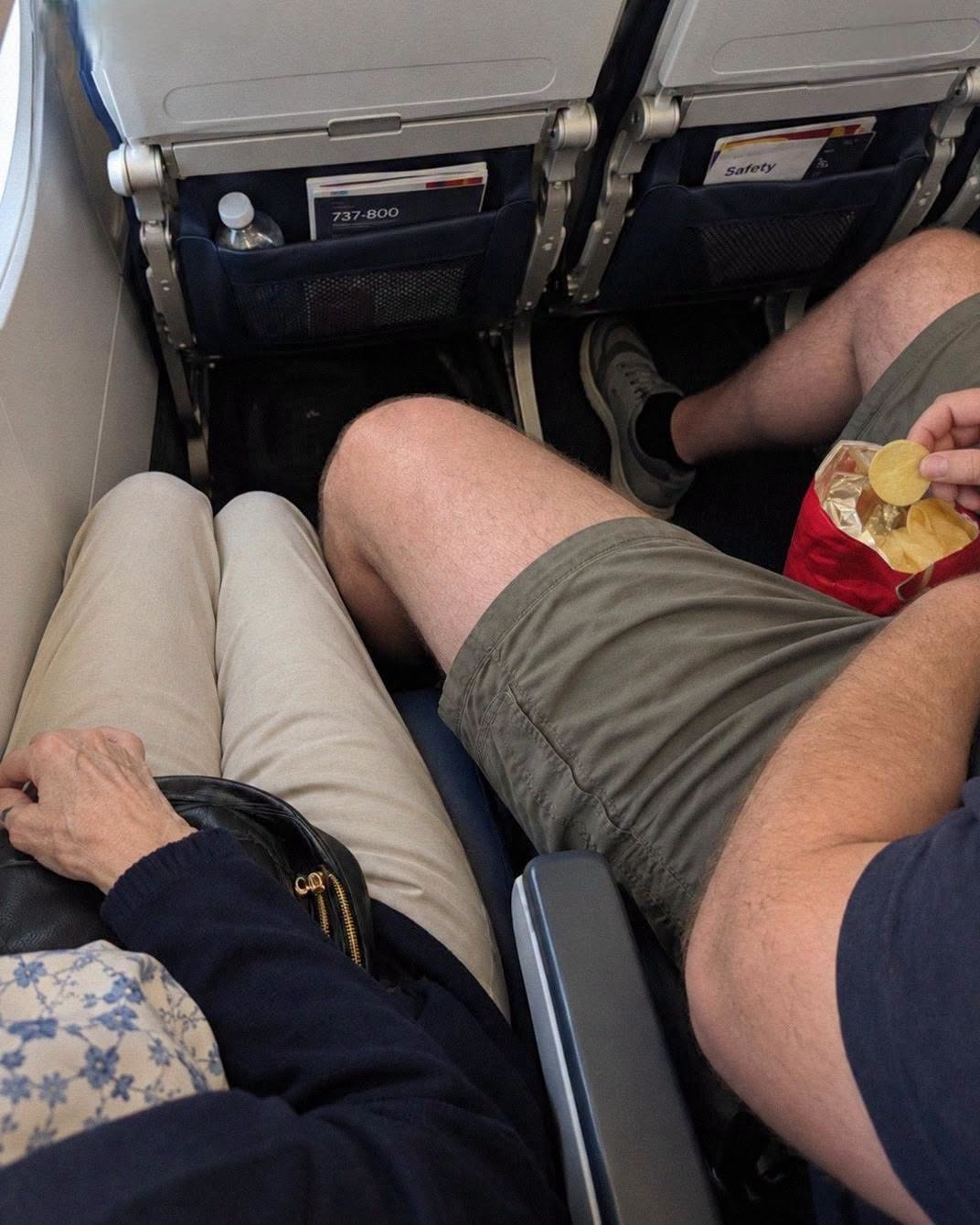
A Man Kept Manspreading Into a Woman’s Plane Seat for Hours—When He Returned From the Restroom, He Shouted, “What the Hell Did You Do?”
He Had Spent Hours Treating Her Seat Like His Own. But When He Got Up to Use the Restroom, She Decided She Had Had Enough—and His Reaction Left the Passengers Staring.
When Emily boarded the plane, she expected a long but uneventful flight. She had booked her seat weeks in advance, chosen a window position, and hoped to spend the journey reading a book and getting some much-needed rest.
She had no idea that the next several hours would turn into an uncomfortable battle over something as basic as personal space.
The man seated beside her, a broad-shouldered passenger in his forties, seemed determined to occupy more than his share of the row.
At first, Emily tried to ignore it.
His legs stretched into her space. His knees pressed against hers. Every time she adjusted herself toward the window, he gradually spread out again, as though the invisible boundary between their seats did not exist.
She glanced at him once, hoping he would notice.
He didn’t.
She shifted her bag beneath the seat in front of her and tried to settle into a comfortable position. Within minutes, his knee was back against hers.
Finally, she turned toward him.
“Excuse me, could you please keep your legs on your side? You’re taking up quite a bit of my space.”
He barely looked at her.
“I’m not doing anything,” he replied before returning his attention to his phone.
Emily stared at him in disbelief.
She had paid for her ticket just as he had. She wasn’t asking for extra room or special treatment. She simply wanted to sit in the seat she had purchased without having another passenger’s legs pressed against her.
But the man apparently saw no reason to accommodate her.
Three Hours of Growing Frustration
As the flight continued, Emily tried several times to make herself comfortable.
Whenever the man moved his legs, she hoped the problem was finally over. But each time he relaxed again, his knees and feet drifted back into her space.
She considered asking a flight attendant for help, but the cabin was busy, and she didn’t want to turn the situation into a public confrontation if a simple request might solve it.
Unfortunately, her earlier request had accomplished very little.
The man occasionally sighed when she shifted her legs, as though she were the one inconveniencing him.
At one point, he stretched so far across the shared space that Emily had to turn her body toward the window to avoid further contact.
That was when she decided she would not spend the entire flight silently enduring the situation.
She wasn’t interested in embarrassing him. She simply wanted the same consideration he expected for himself.
Then, several hours into the journey, the man unbuckled his seat belt and headed toward the restroom.
Emily watched him disappear down the aisle.
For the first time since boarding, she had enough room to stretch her legs.
She took a deep breath, adjusted her position, and looked at the space he had repeatedly occupied.
An idea occurred to her.
It wasn’t a dangerous idea, and she had no intention of touching his belongings or damaging anything. But she wanted him to understand what it felt like when someone ignored another person’s boundaries.
She decided that when he returned, she would no longer automatically move aside to accommodate him.
Instead, she would sit comfortably in her own seat and let him figure out how to manage his own space.
The Moment He Came Back
A few minutes later, the man returned.
He approached the row while looking at his phone, apparently expecting everything to be exactly as he had left it.
But when he reached his seat, he stopped abruptly.
Emily was sitting comfortably, with her legs positioned within her own seat area. Her bag was tucked neatly beneath the seat in front of her, and her armrest was in use.
There was nothing unusual about her position.
The problem was that she was no longer making herself smaller to accommodate him.
He tried to slide into his seat, but his usual sprawling position was no longer available without encroaching on her space.
He shifted once.
Then again.
Finally, he looked at her with an expression of disbelief.
“What the hell did you do?” he demanded.
Several nearby passengers turned their heads.
Emily looked at him calmly.
“What do you mean?”
He gestured toward the seats.
“I can’t sit properly!”
Emily raised her eyebrows.
“You’re sitting in your seat. I’m sitting in mine. What’s the problem?”
The man stared at her as though he couldn’t believe she had answered him that way.
For a moment, he seemed ready to argue. Then he glanced around and noticed that other passengers were watching.
“You were fine before I left,” he muttered.
Emily took a breath.
“No, I wasn’t. You spent hours pushing your legs into my space. I asked you politely to stop, and you ignored me. Now I’m simply sitting in the seat I paid for.”
Her voice remained steady.
She didn’t shout, insult him, or make a scene. She simply explained what had happened.
And suddenly, the situation looked very different from the way he had imagined it.
The Passenger Across the Aisle Speaks Up
A woman sitting across the aisle had witnessed much of the earlier interaction.
When the man began complaining again, she finally spoke.
“She’s right,” the woman said. “You’ve been spreading your legs into her seat for most of the flight.”
The man turned toward her.
“I wasn’t doing that!”
Another passenger nearby shook his head.
“Actually, you were.”
The cabin became quiet for a moment.
The man looked from one passenger to another, apparently realizing that his behavior had been more noticeable than he thought.
Emily didn’t smile or celebrate. She simply turned back toward the window.
She had not set out to win an argument. She wanted to finish the flight in peace.
After a few uncomfortable seconds, the man sat down and adjusted his legs to fit within his own space.
For the first time that day, he stopped pushing into hers.
A Flight Attendant Checks In
A flight attendant approached after noticing the tension.
“Is everything all right here?” she asked.
Emily briefly explained that the passenger beside her had repeatedly encroached on her seat space and had become upset when she stopped moving aside.
The flight attendant listened and reminded both passengers that they needed to remain within their assigned seating areas as much as reasonably possible.
She also made it clear that if the situation continued, the crew could help manage the seating dispute.
The man said little.
With the flight attendant nearby, the remainder of the journey passed more peacefully.
Emily finally opened her book and began reading.
It was a small victory, but after hours of discomfort, it felt enormous.
Why This Was Never Just About Legroom
When Emily later told a friend what had happened, the friend laughed at the man’s dramatic reaction.
But Emily remembered something else about the experience.
For hours, she had felt pressure to be accommodating simply because asking for basic consideration might make someone uncomfortable.
She had worried about appearing rude. She had tried to avoid a confrontation. She had repeatedly adjusted herself to make room for someone who seemed unwilling to do the same.
The moment she stopped automatically accommodating him, he acted as though she had taken something away from him.
That was what bothered her most.
Personal space on an airplane is limited, and passengers sometimes have to make reasonable compromises. But sharing a confined space does not mean one person is entitled to take more room at another passenger’s expense.
Courtesy works both ways.
Emily hadn’t needed to humiliate the man or retaliate against him. She had simply needed to stop treating his comfort as more important than her own.
The Lesson That Stayed With Her
By the time the plane landed, Emily felt relieved.
She had learned that setting a boundary did not automatically make her unreasonable, selfish, or difficult.
Sometimes, people become accustomed to others giving way. When that stops, they may react with surprise or anger—not because they have been treated unfairly, but because the arrangement no longer favors them.
The best response is not always a dramatic comeback. Often, it is a calm explanation, a firm boundary, and a willingness to ask for help when necessary.
Because buying a plane ticket doesn’t give anyone the right to occupy someone else’s seat. And basic respect should never depend on how loudly a person demands it.