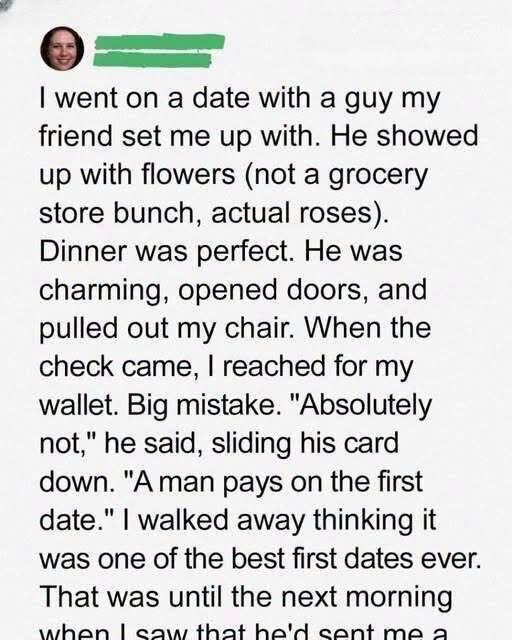
The email hit my inbox like a slap. One night filled with flowers, wine, and easy laughter had suddenly turned into something I never expected. What I thought had been a pleasant romantic evening was now being treated like a business transaction. Instead of a message asking when we could meet again, I received something that looked more like a corporate invoice, complete with a list of supposed debts I apparently owed him.
There it was, written out as though affection could be measured and charged by the hour. A hug for the bouquet. A coffee date for the little keychain he had given me. Every small gesture from that evening had been transformed into an item on his imaginary bill.
At first, I honestly struggled to believe what I was reading. Had he really spent the entire evening keeping track of every little thing he had offered? Had the flowers, the wine, and the laughter all come with conditions I had never agreed to?
Then the email became even more disturbing. He suggested that if I did not cooperate, he might involve a mutual friend. What had started as an uncomfortable demand was now accompanied by a veiled threat designed to make me feel pressured and embarrassed.
In a matter of hours, the image of the charming man I thought I had met began to disappear.
**When Kindness Comes With a Price**
The evening itself had seemed ordinary in the best possible way. There were flowers, thoughtful little gestures, and conversations that flowed naturally. He appeared attentive, confident, and interested in getting to know me. Nothing about the experience suggested that I would later receive an itemized list of everything he believed I owed him.
I had accepted the flowers because they were offered as a gift. I had enjoyed the coffee because it was part of spending time together. I had accepted the keychain as a small token of attention. None of those things had been presented as loans, contracts, or obligations.
That is what made the email so unsettling.
A gift is supposed to be freely given. A kind gesture should not secretly become a debt that someone can collect later. When a person offers something and then demands affection, attention, physical contact, or repayment in return, the gesture stops feeling generous.
It becomes a way of applying pressure.
What bothered me most was not the value of the items he listed. The bouquet, coffee, and keychain were not the issue. It was the assumption that he could decide what my response should be simply because he had spent money or made an effort.
A person can appreciate someone’s generosity without owing them romance. Accepting a gift does not create an obligation to return affection, continue dating, or provide anything physical.
That should not be a difficult concept, but his email made it clear that we understood the evening very differently.
**The Decision Not to Respond**
I read the message more than once, trying to understand whether he genuinely believed what he had written or whether he was deliberately attempting to intimidate me.
For a brief moment, I considered replying. I could have explained that I had never requested an invoice, that I had not agreed to any arrangement, and that his expectations were completely inappropriate.
But then I realized something important: I did not need to negotiate my right to say no.
I did not owe him a detailed explanation. I did not have to defend my decision to end contact. And I certainly did not have to accept responsibility for expectations he had created without my knowledge or consent.
So I chose not to answer.
Instead of getting pulled into an argument, I stepped back and paid attention to what happened next. I wanted to see whether he would recognize how inappropriate his behavior had been or whether he would continue trying to pressure me.
His message had already told me a great deal about how he viewed relationships. I did not need to keep participating in the conversation to prove that I understood it.
**The Mutual Friend and the Unexpected Support**
The reference to our mutual friend was particularly uncomfortable. It suggested that he was willing to bring another person into a private disagreement to create pressure or make me feel isolated.
That was something I took seriously.
I decided to be honest with the people I trusted. I explained what had happened, showed them the email, and let them see the words for themselves. I did not need to exaggerate anything or turn the situation into a dramatic story. The message spoke clearly enough on its own.
Their response surprised me in the best possible way.
My friends believed me. They listened, supported me, and made it clear that they did not approve of his behavior. Rather than allowing him to use our shared connections as leverage, they chose to distance themselves from him.
That support meant more than I could easily explain.
When someone tries to make you question your own judgment, having trusted people remind you that your boundaries are reasonable can make an enormous difference. I had worried that the situation might become awkward or that mutual friendships would complicate everything. Instead, the people closest to me showed that respect and honesty mattered more than maintaining a superficial connection with someone who had behaved badly.
The man who had presented himself as such a wonderful person suddenly had to face the consequences of his own words.
**The Real Reveal Was Not Just About Him**
Looking back, the most revealing part of the experience was not the strange invoice itself. It was the contrast between the image he had presented and the behavior he eventually displayed.
During the evening, he had seemed generous and thoughtful. But when he did not receive the response he apparently expected, his generosity became a list of demands.
That difference taught me something important about getting to know people.
Anyone can make a good first impression. Someone can buy flowers, pay for dinner, open a door, and say all the right things. Those gestures can be lovely, and there is nothing wrong with appreciating them.
But character becomes clearer when things do not go according to someone’s expectations.
How does a person react when you disagree? What happens when you decline another date? Can they accept that you are not interested without becoming angry or trying to make you feel guilty? Do they respect your boundaries even when those boundaries are not what they wanted?
Those moments reveal much more than a polished first impression ever could.
And the experience also revealed something about my friends. Their support reminded me that genuine relationships are built on trust, respect, and the willingness to stand beside someone when things become uncomfortable.
**What Healthy Dating Should Actually Feel Like**
I have not stopped appreciating romance because of one unpleasant experience. I still enjoy flowers, thoughtful surprises, a door being held open, and an unhurried conversation about favorite films.
There is nothing wrong with traditional gestures or someone wanting to make another person feel special. The difference is whether those gestures are offered freely or used as a way to create an obligation.
Healthy dating should feel comfortable. It should leave room for curiosity, laughter, and the freedom to decide whether two people genuinely want to see each other again.
Nobody should feel that they have to repay a dinner with affection or accept another date because someone purchased a gift. A person is allowed to change their mind, establish boundaries, and walk away from a situation that no longer feels right.
Respect is not something that should be offered only when someone gets what they want. It should remain present even when the answer is no.
That is why I now pay closer attention to what happens after the first impression. I notice whether someone’s kindness remains consistent, whether they listen when I speak, and whether they can accept a boundary without turning it into a personal insult.
I am no longer impressed by appearances alone. I want to see how someone treats me when there is nothing to gain from being charming.
**My Time Is Not a Line Item**
That strange email could have made me feel guilty, embarrassed, or hesitant about dating again. Instead, it reminded me of something I should never have to question: my time, attention, and affection belong to me.
I do not owe someone a relationship because they bought me flowers. I do not owe them physical affection because they paid for coffee. And I do not owe them continued access to my life because they once appeared thoughtful.
A gift is not a contract. A date is not a purchase. And kindness should never come with an invoice delivered after the fact.
I still believe in romance. I still believe in generosity and in the beauty of small gestures. But I now understand that the most meaningful sign of someone’s character is not what they offer when everything is going their way. It is whether they continue to respect you when they do not get the answer they hoped for.
So when I date, I welcome the flowers, the laughter, and the conversations. I simply pay attention to what comes afterward.
If someone offers kindness with hidden conditions, I am comfortable walking away. Not dramatically, not vindictively, and without feeling the need to explain myself repeatedly.
My time is not a line item. My boundaries are not negotiable. And anyone genuinely worth getting to know will understand that before the first drink even arrives.